EV Charging Billing Software: Why the Payment Layer Decides CPO Margin

Most charge point operators (CPOs) buy hardware and a network app, switch the site on, and only then discover that the hard part was never the charger. It was the money. Every session has to be metered accurately, priced against the right tariff, taxed in the right jurisdiction, settled with roaming partners, and reconciled against the bank before a single euro or dollar of margin is real. That chain is what EV charging billing software has to manage, and it is where margin quietly leaks. A capable EV charging station billing system sits at the center of operations, because it decides whether a profitable-looking site actually clears a profit. For European operators, the Alternative Fuels Infrastructure Regulation (AFIR) has made parts of that layer a legal requirement rather than a roadmap item, and US operators are meeting parallel pressure from state-level metering and pricing rules. The operators who hold their margin treat billing as core architecture, and the e-mobility software around it as something to be designed, not assembled by accident.
Key Takeaways
- Billing and payment is core architecture, not a reporting feature of the network app: it decides whether a profitable-looking site clears a profit.
- Pricing (rating) and payment acceptance are two different engineering problems; designing them as separate, evolvable layers keeps each from breaking the other.
- Margin leaks in the integration pipeline from meter to bank: unbilled sessions, mis-rated energy, failed cross-network settlement, and tax errors that surface at audit.
- In Europe, AFIR has made ad-hoc payment and per-kWh pricing transparency a legal requirement; US operators face parallel pressure from state metering-accuracy and pricing rules.
CPOs Buy a Network and Inherit a Billing Problem
A network app shows sessions, uptime, and revenue in a dashboard. That view is reassuring and incomplete. The moment an operator runs more than a handful of sites, the billing logic underneath that dashboard becomes the constraint: it has to rate every session correctly, split revenue across site hosts and partners, apply the right tax, handle refunds and disputes, and produce records an auditor will accept. Codibly’s foundational guidance on handling billing and payments for EV stations framed this years ago, and the problem has only deepened as networks scale across borders and pricing models multiply.
The reason this surprises so many operators is that billing sits at the intersection of three systems that rarely speak the same language: the charger, which reports energy and events; the financial stack, which expects clean, taxed, reconciled transactions; and the customer relationship, which expects a clear receipt. An off-the-shelf module typically does the easy 80 percent, showing a price and taking a card, and leaves the operator to solve the 20 percent that determines profitability: multi-party settlement, jurisdictional tax, dispute handling, and reconciliation at scale. That last 20 percent is the difference between a billing readout and a true ev charging station billing system.
Pricing and Payment Are Two Different Engineering Problems
Operators routinely collapse “pricing” and “payment” into one line item, then wonder why their ev charging payment solutions feel brittle. They are two distinct engineering problems with different failure modes. Pricing is a rating problem: applying time-of-use (TOU) rates, demand charges, idle fees, membership tiers, and ad-hoc rates to metered energy, correctly, every time. Payment is an acceptance and security problem: taking money through terminals, contactless cards, app wallets, or roaming tokens, and doing it under card-industry security obligations such as the PCI DSS standard. A strong ev charging payment system can still produce wrong invoices if the rating engine behind it is weak, and a precise rating engine is worthless if payment acceptance fails at the terminal. The hardware-led framing of an ev charger payment system, a terminal on a post, hides this, because the terminal is the visible part and the rating logic is not.
The practical consequence is that these two layers should be designed to evolve independently. Tariff structures change with energy markets and competitive pressure; payment methods change with regulation and consumer behavior. Coupling them tightly means every pricing experiment risks the payment path, and every new payment method risks the books.
| Dimension | Pricing / rating engine | Payment acceptance |
|---|---|---|
| Core job: | Apply the correct tariff to metered energy | Take money securely from the driver |
| Typical inputs: | Metered kWh, time of use, demand charges, membership tier, jurisdiction | Contactless card, app wallet, roaming token, terminal data |
| Must handle: | TOU and dynamic rates, idle fees, ad-hoc vs member pricing, tax rules | Authorization, refunds, chargebacks, PCI DSS security obligations |
| Failure mode: | Wrong invoice on a working payment path (silent margin loss) | Failed or insecure transaction on a correctly priced session |
| Changes driven by: | Energy markets and competitive strategy | Regulation (e.g., AFIR) and consumer payment behavior |
| Pricing and payment are distinct engineering problems with different failure modes; designing them as separate, evolvable layers lets each change without breaking the other. | ||
Billing Integration Is Where Margin Leaks: Meter Data In, Settled Revenue Out
The phrase operators search for, billing integration for ev chargers, describes the single most underestimated part of the stack. The integration is not one connection; it is a pipeline that has to preserve accuracy and accountability from the meter to the bank. When that pipeline has gaps, margin leaks through them: unbilled sessions, mis-rated energy, failed settlements with roaming partners, and tax errors that surface during audit.
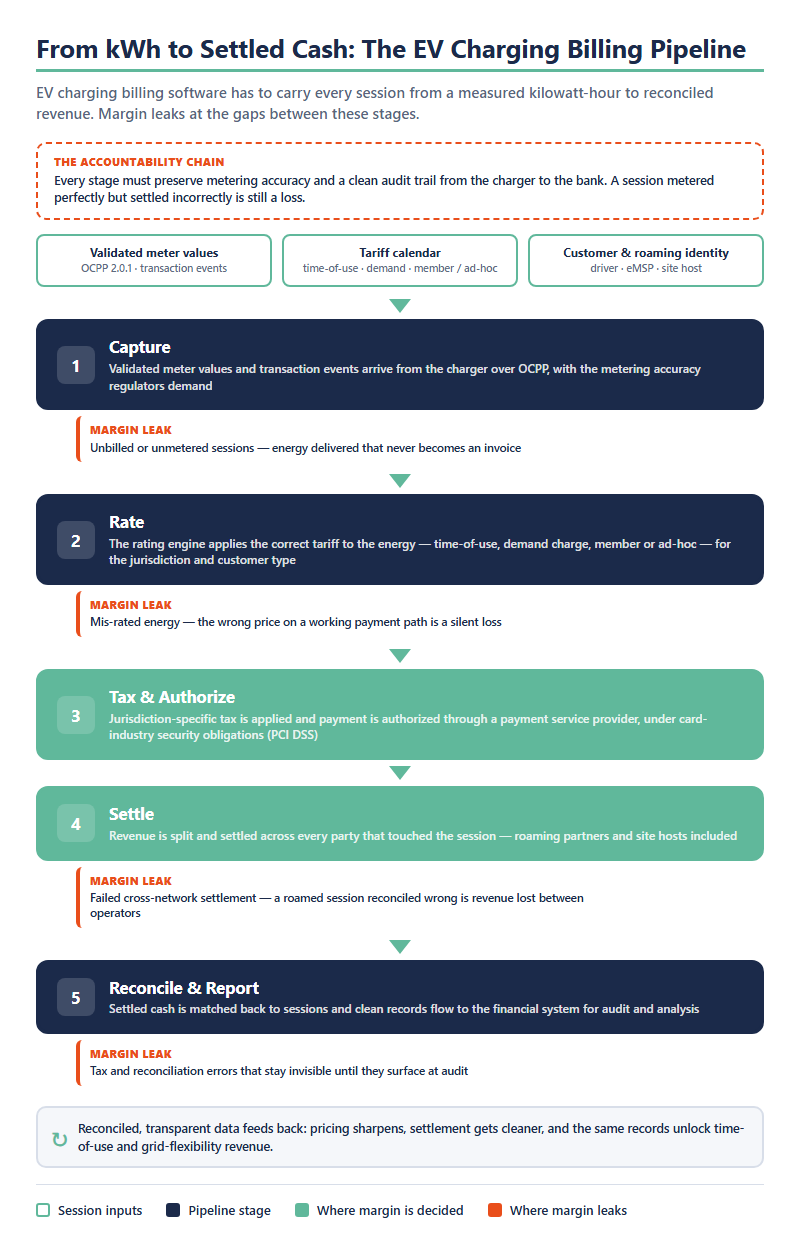
A robust electric vehicle charge point billing solution treats that pipeline as a sequence of explicit, observable steps:
- Capture. The charger reports validated meter values and transaction events, typically over OCPP 2.0.1, with the metering accuracy regulators increasingly demand.
- Rate. The rating engine applies the correct tariff (TOU, demand charge, member or ad-hoc) to that energy, accounting for the jurisdiction and the customer type.
- Tax and authorize. Jurisdiction-specific tax is applied, and payment is authorized through a payment service provider (PSP).
- Settle. Revenue is split and settled across the parties that touched the session, including roaming partners and site hosts.
- Reconcile and report. Settled cash is matched back to sessions, and clean records flow to the financial system for audit and analysis.
Steps four and five are where cross-network complexity concentrates. When a driver from one network charges on another operator’s site, the energy, the price, and the settlement obligation move through a roaming relationship that has to be reconciled precisely. Codibly’s work on cross-network roaming and settlement and on settlement across operator and driver platforms shows why this cannot be an afterthought: a session that is metered perfectly but settled incorrectly is still a loss.
The Build-vs-Integrate Map for a Charging Billing and Payment Stack
Once an operator accepts that billing is core architecture, the real decision is build versus integrate, and increasingly the answer is composed rather than bought whole. Modern stacks expose an EV charging API layer that lets operators connect a best-in-class PSP, a dedicated tax engine, and a roaming hub, while owning the one component that encodes their commercial strategy: the rating engine. Closed billing modules win on speed to launch and are a reasonable starting point. They lose when an operator needs to run an unusual tariff, settle across several markets, or use its own transaction data as a competitive asset.
| Consideration | Closed billing module | API-composed billing stack |
|---|---|---|
| Time to launch: | Fast — billing ships with the network app | Higher up front — integrate PSP, tax engine, roaming hub |
| Tariff flexibility: | Constrained to the vendor’s pricing model | Full control via an owned rating engine |
| Multi-market settlement: | Limited; cross-border tax and roaming often manual | Designed in; settlement and tax handled per jurisdiction |
| Data ownership: | Session data lives in the vendor’s platform | Operator owns transaction data as a strategic asset |
| Best fit: | Single-market operator with standard pricing | Multi-market operator running dynamic tariffs at scale |
| Build vs integrate is decided component by component: own the rating engine that encodes commercial strategy, and integrate the commodity pieces (PSP, tax, roaming) around it through APIs. | ||
The economics favor ownership at the points where billing becomes a differentiator rather than a utility. A single-market operator with standard pricing is well served by an integrated module. A multi-market operator running dynamic tariffs, capturing time-of-use revenue and grid flexibility, and treating its session data as strategic should own the rating engine and integrate the commodity pieces around it through APIs. The build-versus-integrate map is therefore a decision made component by component, and the operators who get it right keep the parts that compound and rent the parts that do not.
AFIR Turned Ad-Hoc Payment From a Feature Into a Legal Requirement
In Europe, this stopped being a purely commercial choice. AFIR made ad-hoc payment, the ability for any driver to pay at a public charger without a subscription using a contactless card or equivalent, a legal obligation for operators of new and many existing high-power public chargers. That single requirement reaches deep into the billing stack: it mandates payment acceptance, transparent per-kWh pricing, and the data transparency that makes roaming and settlement auditable. Codibly has documented how AFIR payment terminals can create data silos when they are added as isolated devices rather than integrated into the billing pipeline, and how ad-hoc payment under AFIR has to be orchestrated across terminals, apps, and roaming relationships to actually work.
The strategic reading matters more than the compliance checklist. Operators who treat AFIR as a terminal-procurement exercise end up with compliant hardware and fragmented data. Operators who treat it as a billing-architecture requirement can turn the AFIR mandate into a revenue asset, because the same transparent, well-integrated data that satisfies the regulator also enables better pricing, cleaner settlement, and grid-flexibility revenue. The United States has no equivalent federal ad-hoc-payment mandate, but US operators face a parallel pressure from state-level metering-accuracy and per-kWh pricing rules, which push toward the same destination: accurate metering and transparent, auditable billing as a baseline rather than a feature. On both sides of the Atlantic, the regulatory direction rewards operators who build billing to be transparent by design.
The CPO That Keeps Its Margin Owns the Path From kWh to Settled Cash
The chargers are the visible investment, but the margin lives in the invisible path from a measured kilowatt-hour to settled, reconciled cash. Operators who treat billing and payment as a feature of the network app will keep finding their profit eroded by the gaps in that path: unbilled energy, mis-rated sessions, failed settlements, and audit risk. Operators who treat it as core architecture, design pricing and payment as separate and evolvable layers, and own the rating engine that encodes their strategy, are the ones who scale without watching their margin thin. As Europe’s regulatory baseline rises and US metering rules tighten, that architectural choice is becoming the difference between an operator that grows profitably and one that simply grows. Codibly works with CPOs and e-mobility providers to design exactly that path: accurate, compliant, and built to scale. To explore how a billing and payment architecture would fit your network, talk to Codibly’s e-mobility team.
Frequently Asked Questions
An EV charging billing system is the software that turns a charging session into settled revenue. It meters the energy delivered, applies the correct tariff, calculates tax, processes payment, settles revenue with any roaming partners or site hosts, and reconciles the result against financial records. It is distinct from the operational dashboard that simply displays sessions and uptime.
Billing integration connects the charger, the financial systems, and the customer-facing receipt into one accountable pipeline. The charger reports validated meter values and events (typically over OCPP); a rating engine prices the energy; a payment service provider authorizes the transaction; revenue is settled across the relevant parties; and clean records flow to the financial system for reconciliation and audit. Gaps anywhere in that pipeline translate directly into lost margin.
Public charging stations commonly support contactless bank cards and digital wallets at the terminal, in-app payment through the operator or e-mobility provider application, and roaming tokens that let a driver from one network pay on another. In Europe, AFIR requires ad-hoc contactless payment at new and many existing high-power public chargers, so card or contactless acceptance is increasingly a baseline rather than an option.
AFIR requires that drivers be able to pay at public charging points on an ad-hoc basis, without a subscription or prior contract, using widely available means such as contactless payment cards. It also requires transparent, per-kWh pricing and the data transparency that supports interoperability and roaming. In practice this means operators must integrate payment acceptance, pricing transparency, and settlement data into their billing architecture rather than treating the payment terminal as a standalone device.
When a driver uses a charger outside their home network, the session is authorized and recorded through a roaming relationship between the charge point operator and the e-mobility service provider. The energy delivered, the agreed price, and the resulting charge are exchanged and reconciled so that revenue is settled correctly between the parties. Handling this accurately depends on clean session data and well-defined interfaces between the billing system of the operator and its roaming partners.