OCPP Implementation Services
Leverage Codibly’s proven expertise to implement and optimize the Open Charge Point Protocol (OCPP) for your EV charging network. Our services cover technical consulting, microservice deployments, custom integrations, and ongoing support – giving you a robust, scalable, and fully OCPP-compliant infrastructure that you control.
What Is OCPP and How Does It Work?
OCPP (Open Charge Point Protocol) is the global open standard for communication between EV charging stations and central management systems (CSMS). Managed by the Open Charge Alliance (OCA), OCPP enables any compliant charger to work with any compliant backend — regardless of manufacturer.
OCPP works as a client-server protocol where the charging station (client) connects to the CSMS (server) via WebSocket. The charger sends messages like BootNotification, Heartbeat, and transaction events. The CSMS responds with configuration, authorization decisions, and charging profiles. All communication happens over TLS-encrypted connections.
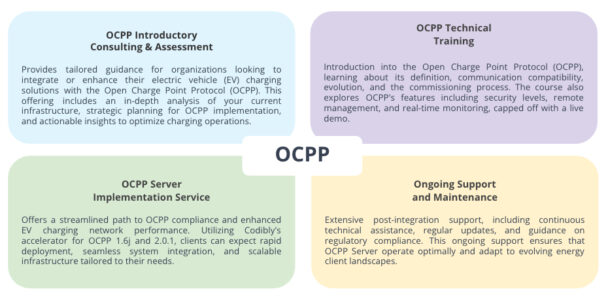
Codibly provides full-stack OCPP implementation services:
- Technical Consulting: Evaluate your current EV charging setup, define OCPP scope, and align features with your business goals.
- Microservice Deployments: Containerize the OCPP server and auxiliary modules in Docker or Kubernetes for easy scaling and failover.
- Custom APIs & Event Flows: Adapt OCPP flows for smart charging, local tariffs, or external queue systems.
- Security Hardening: Configure TLS certificates, password rotation, and advanced security profiles (Profiles 2 and 3) to protect the data pipeline.
Powered by Codibly’s OCPP Accelerator
What Are the Differences Between OCPP 1.6, 2.0.1, and 2.1?
OCPP 1.6 uses SOAP or JSON over WebSocket and supports basic charging operations, smart charging profiles, and firmware management. OCPP 2.0.1 adds the Device Model (component/variable structure), improved security with TLS certificates and mutual authentication, ISO 15118 support for Plug & Charge, and a modular architecture. OCPP 2.1 (released 2025) further adds V2X (vehicle-to-grid) support, tariff management, and ISO 15118-20 integration.
Codibly’s proprietary OCPP Accelerator (view details) supports OCPP 1.6J and 2.0.1, with future readiness for 2.1. It auto-detects protocol versions, unifies command/event structures, and reduces implementation time significantly.
Auto Version Detection
Seamlessly handles OCPP 1.6J or 2.0.1 messages, ensuring mixed fleets run without extra overhead. Supports dual-stack architecture for simultaneous legacy and modern charger communication.
Flexible Integration
REST APIs, MQTT, RabbitMQ, or custom queue systems — designed to adapt to your enterprise architecture. Works with GitLab CI, Jenkins, or any preferred CI/CD toolchain.
Enhanced Security Profiles
Implements OCPP Security Profiles 2 and 3 with WSS (WebSockets Secure), TLS 1.2/1.3, and mutual TLS for client-side certificate authentication.
Auto Scaling & Logging
Message brokers like Apache Kafka or RabbitMQ buffer incoming OCPP messages, enabling horizontal scaling to tens of thousands of simultaneous connections.
How Long Does OCPP Implementation Take?
A minimal viable OCPP integration using Codibly’s Accelerator is measured in weeks, not months. A full OCPP implementation with custom features typically takes 4–8 weeks depending on scope and complexity.
- Repository Setup & Code Migration (Week 1): Import accelerator code into your repositories, configure Docker builds and CI pipelines.
- Infrastructure Configuration (Week 2): Set up Kubernetes clusters, AWS ECS, or Azure container instances for horizontal scaling. Link databases and message queues (e.g., RabbitMQ).
- Feature Customization (Weeks 3–6): Develop specialized endpoints for smart charging, tariff management, or local authentication. Adapt base OCPP flows to match your operational policies.
- Testing & Launch (Weeks 6–8): Automated integration tests and load simulations validate system stability. The OCPP server begins receiving real-world charging sessions.
What Licensing and Support Options Are Available?
Codibly offers a straightforward licensing model designed to avoid vendor lock-in while ensuring your OCPP environment stays current and high-performing:
Perpetual License
Pay a one-time fee to use and modify the OCPP accelerator code within your organization’s environment, retaining control without forced vendor lock-in.
Annual Updates
Receive new features, security patches, and OCPP expansions (e.g., 2.1) throughout the subscription year. Ensure your setup keeps pace with industry changes.
Dedicated Monthly Support
Reserve monthly hours for priority debugging, custom feature requests, or advanced performance tuning. Our experts address issues quickly, minimizing downtime.
Ownership & Restrictions
Domain-specific customizations belong to you. However, resale or third-party distribution of the base accelerator is restricted unless separately negotiated.
Take the Next Step
Speak with Codibly’s eMobility specialists and learn how our OCPP Implementation Services fit into your larger EV charging strategy. Contact us today to discuss your exact requirements, deployment timelines, and the potential of our OCPP accelerator to boost your charging operations.
What our clients say
“Codibly was more than just a software development company; they were a capable partner who understands the EV industry and helped us push our vision forward.”

“Working closely with Codibly has been instrumental in the successful development of the test tool for OpenADR 3.0. Their expertise and commitment to quality have ensured reliability and effectiveness for the energy industry, and we look forward to continuing our collaborative efforts to advance OpenADR technology.”

“Codibly worked with us each step along the way to help us quickly implement IEEE 2030.5 CSIP across both the US and Australian markets where we have business. They were an invaluable partner in helping us verify readiness for a key program with SCE and in getting us certified with the SunSpec Alliance. We are excited to continue working with them in the future.”

“Codibly has brought not only technical leadership but also strong market knowledge to help us shape and deliver our MVP. Their collaborative approach and eMobility expertise made a real difference in ensuring we could move fast without compromising quality. We look forward to expanding our platform together.”

CASE STUDIES
See the success stories of our clients



Meet our Expert
As the eMobility Practice Lead at Codibly, I am responsible for driving the strategic development and growth of our electromobility division. With over 15 years of experience in the IT sector, I specialize in building strong client relationships and aligning technology solutions with business objectives. Having spent the last decade focused on the automotive and electromobility industries, I bring a wealth of expertise in delivering tailored solutions for both the public and private sectors. Prior to Codibly, I led the IT teams at Volkswagen Group Poland, where I successfully managed a range of large-scale projects and IT portfolios. Throughout my career, I have consistently focused on delivering both off-the-shelf and custom solutions that address complex business challenges.

Frequently Asked Questions
OCPP stands for Open Charge Point Protocol. It is an open-source communication standard managed by the Open Charge Alliance (OCA) that defines how EV charging stations communicate with central management systems (CSMS). OCPP ensures interoperability between chargers from different manufacturers and is the most widely adopted EV charging protocol globally.
OCPP 1.6 uses SOAP or JSON over WebSocket and supports basic charging operations, smart charging profiles, and firmware management. OCPP 2.0.1 adds device management, improved security with TLS certificates, ISO 15118 support for Plug & Charge, and a modular architecture. OCPP 2.1 further adds V2X (vehicle-to-grid) support and tariff management.
OCPP works as a client-server protocol where the charging station (client) connects to a central system (server/CSMS) via WebSocket. The charger sends messages like BootNotification, Heartbeat, and transaction events. The CSMS responds with configuration, authorization decisions, and charging profiles. All communication happens over TLS-encrypted connections.
We support a dual-stack architecture that allows CSMS (Charging Station Management Systems) to communicate with both legacy OCPP 1.6J chargers and modern OCPP 2.0.1 hardware simultaneously. Our migration strategy involves implementing the new Device Model (component/variable structure) and advanced transaction handling required by 2.0.1, enabling features like ISO 15118 (Plug & Charge) while maintaining backward compatibility.
We implement OCPP Security Profiles 2 and 3 as standard. This ensures all communication happens over WSS (WebSockets Secure) using TLS 1.2 or 1.3 encryption. For Profile 3, we implement client-side certificates (Mutual TLS) to authenticate not just the server, but the charging station itself, preventing “Man-in-the-Middle” attacks and unauthorized charger cloning.
To prevent bottlenecks, we decouple the WebSocket Gateway from the business logic. We utilize high-throughput message brokers like Apache Kafka or RabbitMQ to buffer incoming OCPP messages (Heartbeats, MeterValues). This allows the system to horizontally scale the gateway layer to handle tens of thousands of simultaneous connections without locking the database or increasing latency.
Yes. While we strictly adhere to Open Charge Alliance (OCA) standards for interoperability, we utilize the DataTransfer message type to support proprietary hardware features (e.g., parking sensor data, ad-screen management, or credit card terminal status). We document these extensions in a custom schema to ensure the CSMS can parse and utilize the non-standard data effectively.
We utilize the official OCTT (OCPP Compliance Testing Tool) from the Open Charge Alliance to validate all implementations. Additionally, we have developed proprietary OCPP Simulators that can mimic the behavior of thousands of chargers to load-test the CSMS before deployment, ensuring the system remains stable during “thundering herd” scenarios (e.g., grid recovery after a blackout).
CONTACT US
Let’s Connect and Optimize Your OCPP Implementation
Find out how Codibly’s consultancy and development services can accelerate your EV business. Book a call and let’s shape the future of eMobility together.

Recommended Articles