Securing Your Product’s Future from California to Texas
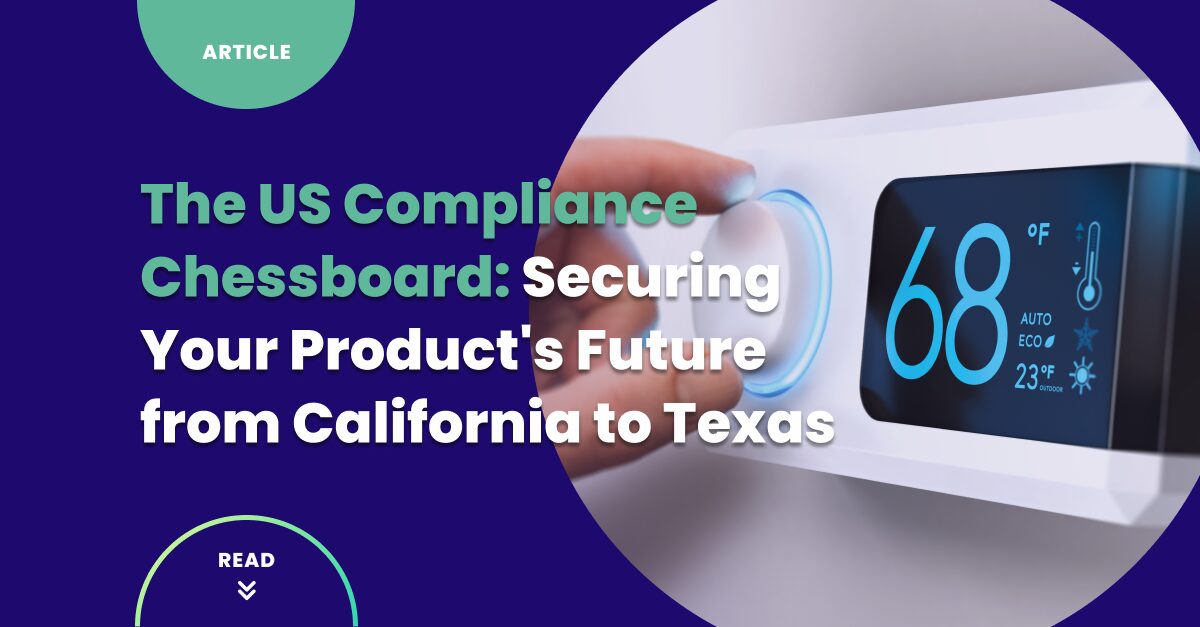
The US market for Distributed Energy Resources (DERs) is no longer a “wild west” of unrestricted innovation. It has evolved into a high-stakes compliance chessboard, where every strategic move—from product roadmap to market entry—is constrained by a tightening web of interoperability standards.
For hardware manufacturers of smart inverters, batteries, and connected appliances, the era of “ship it and patch it later” is over. Today, technical compliance with standards like California Rule 21, SB 49, and IEEE 1547-2018 is the non-negotiable gatekeeper to the world’s most lucrative energy markets. The question is no longer if you must comply, but how fast you can execute before your competitors capture the board.
The California “Gatekeeper”: SB 49 & Rule 21
California remains the definitive market-maker. If your hardware cannot speak the state’s mandated digital languages, you are effectively locked out of the fifth-largest economy in the world.
The Immediate Threat: Senate Bill 49 (SB 49). While much industry attention focuses on inverters, a massive regulatory shift is currently hitting mass-market appliances. Senate Bill 49 has moved from theory to enforcement.
- The Deadline: As of September 29, 2025, the mandate is fully effective for pool pump controllers. These devices must now be “connected” and capable of responding to grid signals.
- The Requirement: To legally sell in California, these controllers must support at least one of three standard protocols: OpenADR 2.0b, IEEE 2030.5, or the physical CTA-2045 port.
- The Implication: This is the tip of the spear. Similar mandates will roll out for smart thermostats, water heaters, and HVAC units in 2026 and 2027. Manufacturers who treat this as a “future problem” risk sales bans and inventory write-downs.
The Technical Beast: Rule 21 & SunSpec CSIP For inverter and battery OEMs, the challenge is deeper. California Rule 21 mandates that smart inverters communicate via IEEE 2030.5 using the Common Smart Inverter Profile (CSIP).
- Why It’s Hard: CSIP is not a simple API integration. It requires implementing nearly 20 of the 30+ functional sets defined in the standard.
- The Security Hurdle: It mandates a military-grade security architecture, including Public Key Infrastructure (PKI) and mutual Transport Layer Security (TLS) to encrypt every data packet. A single flaw in your proprietary security stack can lead to certification failure or, worse, a vulnerability that compromises the grid.
Beyond the Coast: The “Nationwide” Reality
It is a dangerous misconception to view these standards as “California problems.” The IEEE 1547-2018 national standard has effectively harmonized technical requirements across the US, exporting California’s rules to every major grid operator.
- Texas (ERCOT): Even in the deregulated Texas market, utilities like Austin Energy enforce strict interoperability. Participation in their commercial Fast Demand Response program (which offers lucrative incentives) explicitly requires OpenADR 2.0b or higher capabilities.
- Wholesale Market Access (FERC Order 2222): The Federal Energy Regulatory Commission’s Order 2222 is forcing Regional Transmission Organizations (RTOs) like PJM and ISO-NE to open their markets to DER aggregations. To participate and capture these revenue streams, your hardware must be capable of standardized, secure telemetry—likely via IEEE 2030.5 or OpenADR.
In this context, compliance is not just a regulatory hoop; it is a revenue enabler. A device that is “smart-grid-ready” is an asset; one that isn’t is a liability.
The “Build vs. Buy” Strategic Pivot
For a CTO or Product Manager, the chessboard presents a critical choice: Build the compliance stack in-house or partner for the components.
The data suggests the “Build” route is risky:
- Time-to-Revenue: A full, from-scratch implementation of IEEE 2030.5/CSIP can take a dedicated engineering team four to six months. In a market moving at the speed of software, losing half a year is a strategic failure.
- Security Risks: Recent legislative scrutiny has highlighted the risks of “rogue” communication devices and insecure inverters. Building your own security layer increases the risk of vulnerabilities (like weak encryption keys) that could lead to a reputational catastrophe.
- Opportunity Cost: Every hour your best engineers spend reading XML schemas for a certification test is an hour they aren’t spending on differentiating your core product.
The Winning Move: The most successful OEMs are treating compliance as infrastructure, not innovation. By integrating pre-certified, proven software accelerators (for OpenADR or IEEE 2030.5), manufacturers can:
- Slash Development Time: Cut months off the roadmap and enter the certification lab with confidence.
- De-Risk Security: Rely on a security stack that is already validated against the most demanding utility standards.
- Focus on Value: Reallocate engineering talent to features that actually sell the product.
The US compliance chessboard is complex, but it is navigable. The winners will be those who stop fighting the standards and start using them as a strategic moat to secure their future.