Why Utility Demand Response Programs Struggle with Residential Participation — And What Unlocks It
Utilities have invested heavily in demand response infrastructure. Smart meters are deployed. Protocols like OpenADR and CTA-2045 are standardized. Regulatory frameworks from FERC 2222 to state-level mandates have opened markets. Yet according to the FERC 2024 Assessment of Demand Response and Advanced Metering, only 38% of residential customers participate in demand response programs.
That figure represents a massive untapped resource. Commercial and industrial customers reliably deliver load flexibility, but residential participation — the segment with the largest aggregate potential — remains frustratingly stagnant. The technology exists. The market incentives exist. Something else is broken.
The answer is not more hardware or stricter mandates. The residential participation gap is fundamentally a design problem — a failure to translate infrastructure investments into customer value propositions that make sense at the household level.
The Residential Participation Gap
The gap between C&I and residential demand response participation tells a clear story. Commercial and industrial facilities have dedicated energy managers, established procurement processes, and load profiles large enough to justify sophisticated monitoring. A single factory can deliver megawatts of flexibility with one decision-maker signing off.
Residential demand response requires enrolling thousands of individual households to achieve the same aggregate impact. Each enrollment requires overcoming customer skepticism, explaining unfamiliar concepts, and demonstrating value that competes with dozens of other subscription and utility offerings. The economics work at scale, but the customer acquisition friction is an order of magnitude higher.
This is where utility demand response programs have systematically underperformed. The infrastructure is ready. The customer engagement models are not. The same enrollment economics govern the broader class of virtual power plant programs now spreading across U.S. utilities.
| Factor | Commercial & Industrial (C&I) | Residential |
|---|---|---|
| Decision-Maker | Single: Dedicated energy manager or facilities director signs off. | Individual: Each household decides independently. Thousands needed for equivalent impact. |
| Load per Enrollment | Megawatts: A single factory or campus can deliver MW-scale flexibility. | Kilowatts: Individual homes contribute kW-scale loads (4.5 kW water heater, 3–5 kW HVAC). |
| Acquisition Cost | Low per MW: One sales cycle per facility. Established procurement processes. | High per MW: Requires mass marketing, individual enrollment, ongoing engagement per household. |
| Monitoring | Sophisticated: BMS, sub-metering, dedicated energy monitoring already in place. | Basic: Smart meters deployed but data rarely surfaces to customer-facing applications. |
| Participation Rate | High: Clear ROI, dedicated staff, established relationships with utilities. | 38%: Skepticism, unfamiliar concepts, competing priorities at household level. |
Barrier #1: Revenue Uncertainty
The primary barrier is straightforward: residential customers do not understand what they will earn from participation, and utilities have not made it easy to find out.
Most residential DR programs offer incentive structures that are difficult to predict. Bill credits arrive months after events. Performance calculations depend on baselines that customers cannot verify. The value proposition sounds appealing in marketing materials but becomes opaque in practice. When customers cannot model their returns, they default to inaction.
Contrast this with commercial programs where aggregators provide detailed forecasts, monthly performance reports, and transparent settlement calculations. The same rigor rarely extends to residential offerings. Until utilities can communicate residential benefits of demand response in terms customers understand — “You will save approximately $X per year based on your usage” — enrollment rates will remain constrained.
Barrier #2: Price Signal Gaps
Effective demand response requires customers to respond to price signals. But most residential customers are still on flat-rate tariffs that obscure the actual cost of electricity by time of day.
Time-of-use (TOU) rate adoption remains limited despite decades of utility rollout efforts. Smart meter deployments have accelerated — over 100 million are installed across the United States — but the data they collect often feeds utility back-office systems rather than customer-facing applications that would enable behavioral response.
Dynamic pricing, which would create the strongest incentive for load shifting, faces regulatory and consumer protection concerns in many jurisdictions. The result is a structural mismatch: demand response programs ask customers to shift consumption away from peak periods, while their bill structure provides no visible reward for doing so.
This gap will close as wholesale market exposure increases and as utilities implement more sophisticated rate designs. But the transition is slow, and residential demand response participation will track price signal clarity.
Barrier #3: Device Integration
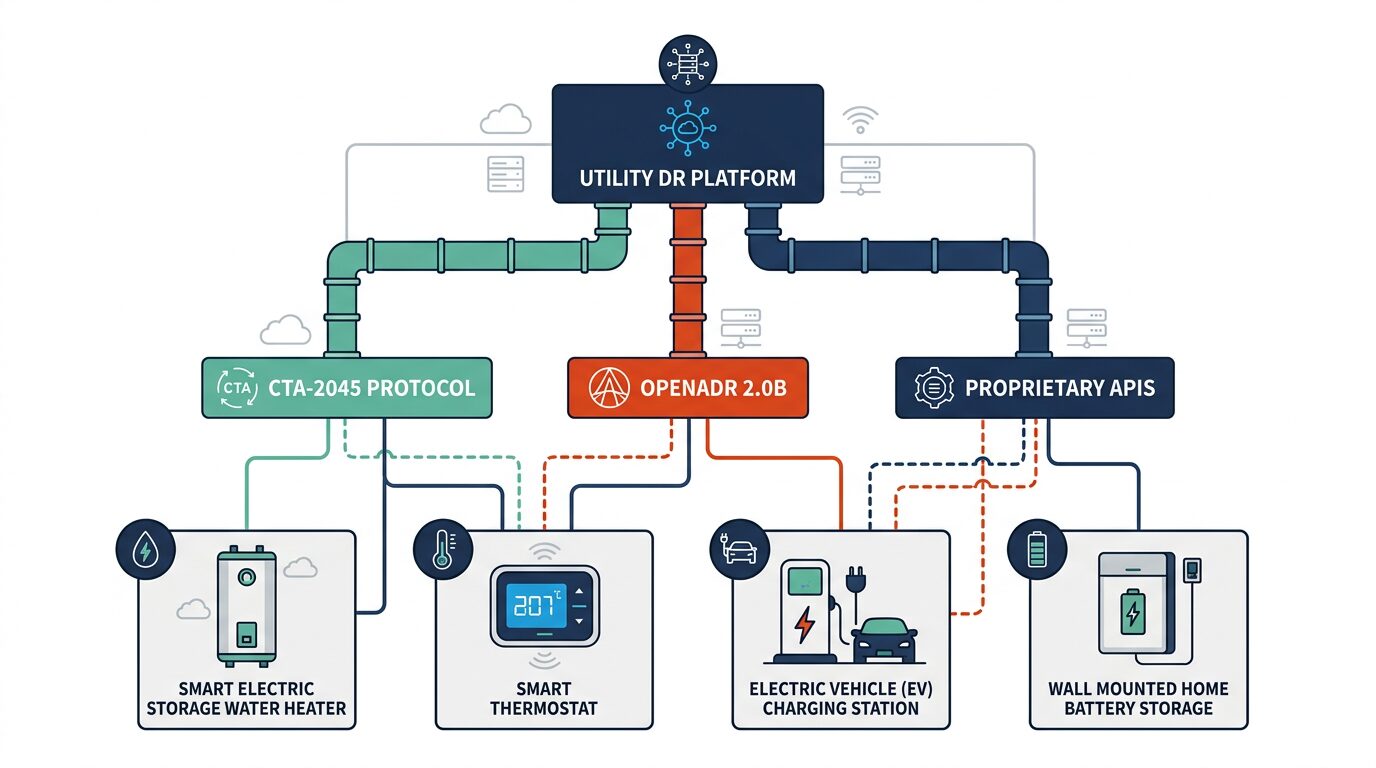
The third barrier is the most technical and the most tractable. Residential demand response depends on controllable devices — water heaters, smart thermostats, pool pumps, EV chargers, and home battery systems. But the device landscape remains fragmented.
Demand response water heaters represent the largest single controllable load in most homes, drawing 4,500 watts during heating cycles. States like Washington (HB 1444) and Oregon (HB 2062) now mandate CTA-2045 ports on new water heaters, enabling grid-interactive control. Yet the installed base of non-connected water heaters is enormous, and retrofit solutions remain expensive.
Smart thermostats have achieved better penetration, but integration with utility DR platforms requires manufacturer partnerships and API access that varies by brand. The same fragmentation applies to EV chargers and home batteries — each device type has different control protocols, different data formats, and different levels of utility integration maturity.
CTA-2045 and OpenADR provide standardized communication paths, but device manufacturers have been slow to implement them beyond regulatory mandates. Until the device ecosystem achieves genuine interoperability, residential DR programs will continue to rely on a patchwork of proprietary integrations.
| Barrier | Root Cause | What Unlocks It |
|---|---|---|
| Revenue Uncertainty | Opaque incentives: Bill credits arrive months late. Baseline calculations are unverifiable. Customers cannot model their returns. | Clear value communication: “You will save ~$X/year based on your usage.” Transparent, predictable, verifiable. |
| Price Signal Gaps | Flat-rate tariffs: 100M+ smart meters deployed, but most customers still see no time-of-use price variation on their bills. | Dynamic pricing & TOU adoption: Wholesale market exposure and customer-facing rate designs that reward load shifting. |
| Device Integration | Fragmented ecosystem: Each device type (water heaters, thermostats, EVs, batteries) uses different protocols, APIs, and data formats. | Standardized protocols: CTA-2045 mandates (WA, OR), OpenADR for utility signaling, multi-protocol platform support. |
What’s Working: Program Design Lessons
The utilities achieving higher residential participation share common characteristics in their program design.
Texas SB 1699 sets an ambitious target: 25% residential load reduction by 2030. The legislation recognizes that voluntary programs alone will not achieve this scale and mandates utility action. More importantly, it signals to manufacturers and technology providers that the Texas market will demand grid-interactive capabilities, accelerating device availability.
Behavioral demand response programs — where customers receive notifications rather than automated control — have shown surprisingly strong results when paired with gamification, community comparisons, and clear performance feedback. OhmConnect in California demonstrated that engaged customers will manually reduce load if the value proposition is visible and immediate.
White-label customer platforms allow utilities to maintain brand consistency while deploying sophisticated engagement tools. A UK-based aggregator serving 4,000+ residential customers demonstrated that a well-designed white-label solution — with live consumption data, DR availability calendars, and clear billing reports — can drive participation rates well above industry averages.
The lesson is consistent: residential DR enrollment scales when the value proposition is clear, the engagement is continuous, and the technology is invisible.
The Technology Stack for Residential Scale
Achieving residential demand response at scale requires a technology stack purpose-built for high-volume, low-touch operations.
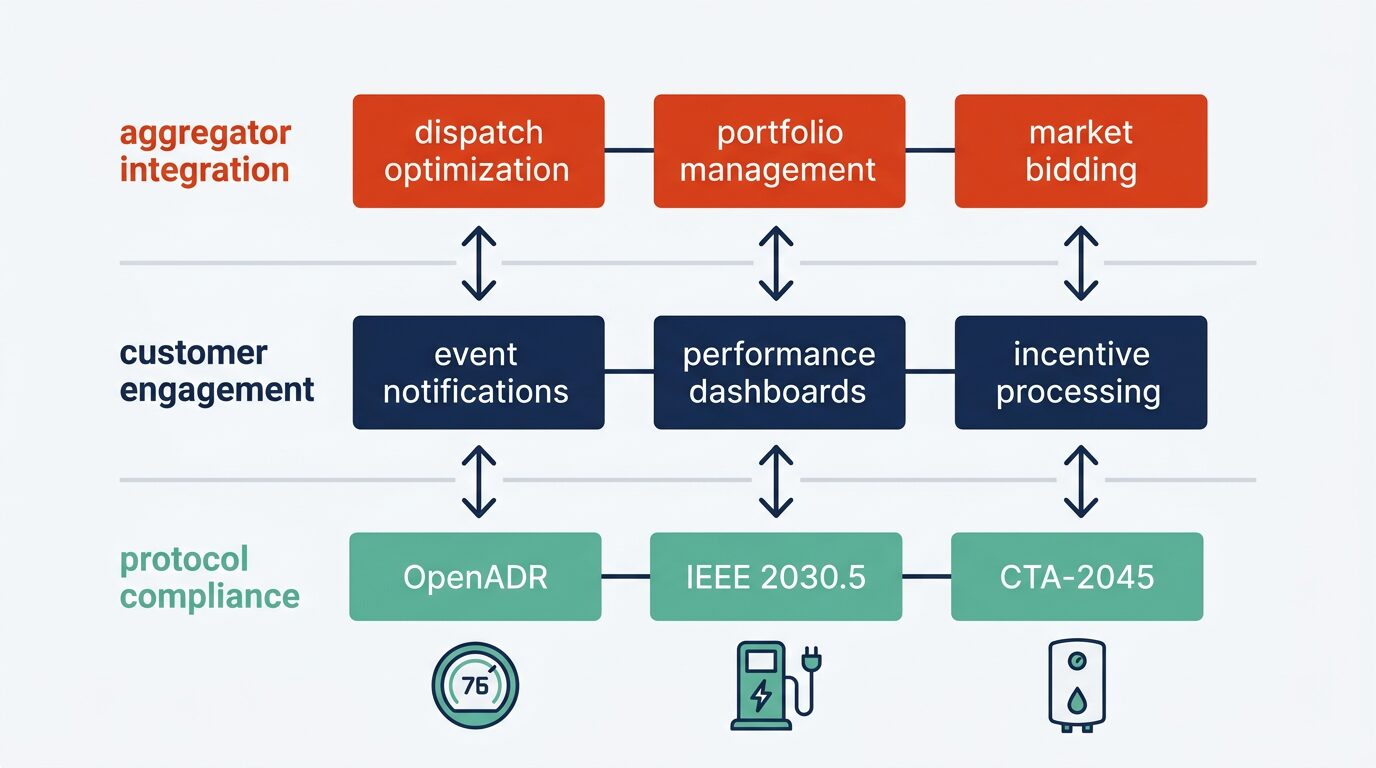
Protocol compliance is foundational. Utilities need platforms that can send OpenADR signals to aggregators and device manufacturers, receive IEEE 2030.5 telemetry from DERs, and support CTA-2045 for appliance-level control. Multi-protocol capability is essential because the installed device base will never converge on a single standard.
Customer engagement layers must translate grid events into customer-facing notifications, present performance data in accessible formats, and process incentive payments without manual intervention. When one engagement platform served over 4,000 non-technician residential customers, the key was simplifying every touchpoint — enrollment, event notification, performance reporting, and payment — to the point where participation required no technical sophistication.
Aggregator integration closes the loop. Whether utilities operate their own demand response programs or partner with third-party aggregators, the technology stack must support bi-directional data exchange with aggregation platforms that optimize dispatch across heterogeneous resource portfolios.
For utilities evaluating residential program expansion, the build-versus-buy decision is critical. Internal development of protocol-compliant platforms with customer engagement tools can take 18-24 months. Accelerator approaches — pre-built components for OpenADR, IEEE 2030.5, and customer-facing applications — can compress timelines to weeks. The residential BESS integration model demonstrates how pre-certified protocol components can accelerate deployment while preserving long-term operational control.
From Grid Infrastructure to Household Value
The 38% residential participation figure is not a technology problem. It is a design problem — a failure to translate grid-level infrastructure into household-level value propositions.
Utilities that close this gap will do so by addressing all three barriers simultaneously: communicating clear, predictable benefits; deploying price signals that reward load flexibility; and integrating the device ecosystem through standardized protocols. The regulatory momentum from Texas SB 1699 to state-level CTA-2045 mandates is accelerating device availability. The technology platforms exist to scale engagement. What remains is the program design discipline to put customers at the center of residential demand response.
The organizations that solve this will not just meet participation targets — they will unlock the largest untapped flexibility resource on the grid. The infrastructure investment has been made. The question now is execution.
Frequently Asked Questions
A demand response water heater is a water heater equipped with communication capabilities that allow utilities or aggregators to remotely adjust its operation during grid stress events. Because water heaters store thermal energy in the tank, they can be temporarily powered down without affecting hot water availability — making them ideal for demand response. Modern DR-ready water heaters include CTA-2045 communication ports that enable standardized grid-interactive control. States like Washington and Oregon now require CTA-2045 ports on new water heaters sold in those markets.
Washington (HB 1444) and Oregon (HB 2062) have enacted legislation requiring CTA-2045 communication ports on certain water heaters, effectively mandating demand response capability. California’s SB 49 requires demand response readiness for pool equipment and is driving similar requirements across appliance categories. Additional states are evaluating CTA-2045 mandates as part of building code updates and appliance efficiency standards. The trend is toward broader adoption as utilities seek controllable loads to manage grid stability.
Homeowners who participate in demand response programs can receive bill credits, direct incentive payments, or reduced electricity rates in exchange for allowing utilities to adjust the operation of enrolled devices during peak periods. Typical annual savings range from $50 to $200 depending on the program structure, enrolled devices, and frequency of events. Beyond financial benefits, participants contribute to grid stability and reduced need for peaking power plants — supporting broader decarbonization goals. Many programs also provide smart devices (thermostats, water heater controllers) at no cost as part of enrollment incentives.