Vendor Lock-In in EV Charging: The Cost of Leaving

Ask a charge point operator (CPO) what its management platform costs, and the answer arrives with decimal places: a fee per charge point per month, an annual escalator, a line on the invoice that finance can forecast three years out. Ask what it would cost to leave that platform, and the room goes quiet. Vendor lock-in is the price of that silence: the money, downtime, and forfeited revenue an operator absorbs to move a live charging network from one platform onto another. It is the second number in every platform contract, and it is almost never on the table when the first one is agreed.
Portugal is about to make that second number concrete for an entire market. Decree-Law 93/2025 restructures a charging market organized for years around a single national platform, with a transition period running to December 2026, and Codibly’s analysis of what the Portuguese transition asks of operators traces how much of the work lands on the software layer. Operators there have a public deadline to re-paper how their platforms connect, bill, and exchange data. The ones who negotiated an exit into their original contracts will run a project. The ones who did not will discover their exit price with a regulatory date already fixed and no alternative standing ready.
Vendor Lock-In Is Priced at the Exit
Procurement teams are good at entry. They benchmark the per-charger fee, extract implementation credits, tighten the service-level agreement, and win a discount on the three-year commitment. Then the redlines run out of energy somewhere around the termination section, which is treated as boilerplate because nobody in the room intends to terminate anything.
That section is where the real commercial position gets set. Whether session data comes back in a usable form, whether the notice period is survivable, whether anyone at the vendor is obliged to help on the way out, whether charger credentials belong to the operator or to the platform: those four decisions determine what a network is worth to a future buyer, a future partner, and a future negotiation with the incumbent. A companion piece models the cost of *staying* on a rented platform across five years of renting, building, or owning. This one models the cost of going, which is the number that decides how much freedom the first number ever buys.
The pattern holds across operator types. When a utility takes on charge point operations, as the utility-as-CPO case sets out, the exit terms inherited from a pilot procurement tend to outlive the pilot by a decade.
The Four Exits You Will Need, and What Each One Costs
Leaving a charging platform is four separate migrations wearing one name. Each has a different owner inside the business, a different failure mode, and a different way of turning into someone else’s negotiating advantage.
The first is session and charge detail record (CDR) history. Every transaction the network has ever produced sits in the incumbent’s database: meter values, tariffs applied, settlement lines, dispute evidence. Operators assume this data is theirs because they generated it. Ownership in principle and retrieval in practice are different things, and the gap between them is a format question. A rolling twelve months of flattened CSV exports will not reconstruct a roaming settlement dispute from year two.
The second is charger configuration and firmware control. Connection profiles, security credentials, load-management settings, and firmware update rights all live in the platform. Re-pointing a fleet at a new backend is straightforward when the operator holds those credentials and can push a configuration change remotely. It becomes a field program when it does not.
The third is roaming and eMSP contracts. Where a platform provides roaming through its own hub agreement, the Open Charge Point Interface (OCPI) links that bring partner drivers to your sites may be the vendor’s commercial relationships rather than yours. Those connections do not travel. Session volume from partner networks stops at cutover and comes back only as fast as new agreements are signed with each e-Mobility Service Provider (eMSP).
Hardest of all is the driver base. Accounts, RFID and app tokens, subscription plans, and stored payment mandates resist moving, because a direct-debit mandate is tied to the merchant of record and a re-enrollment email is an invitation to churn.
| The exit | What has to move | Where the friction sits | What it costs when the contract is silent |
|---|---|---|---|
| Session and CDR history: the operating record of the network | Every transaction, meter value, tariff applied, and settlement line the network has produced | Export scope, schema, and timing are set by the incumbent; derived tables and field documentation are rarely included | Tax positions and roaming disputes you cannot substantiate, plus a reporting discontinuity on the day the new platform goes live |
| Charger configuration and firmware: control of the assets themselves | Connection profiles, security credentials, tariff and load-management settings, firmware update rights | Configuration lives inside the platform; some fleets need a vendor-held credential or a technician visit to re-point | Truck rolls across the estate and charge points offline during the switch |
| Roaming and eMSP contracts: the demand you did not originate | Live OCPI links to the eMSPs and roaming hubs that bring partner drivers to your sites | Where roaming runs under the platform provider’s own hub agreement, the connection is the vendor’s relationship rather than yours | Session volume from partner networks stops at cutover and returns only as fast as new agreements are papered |
| The driver base: the accounts that make the network a business | User accounts, RFID and app tokens, subscription plans, stored payment mandates | Direct-debit mandates are tied to the merchant of record; tokens must be re-issued or re-mapped | Re-enrollment churn, concentrated among the customers who took the least effort to keep |
Only one of those four is primarily an engineering problem. The other three are decided by contract language written years earlier, which is why vendor lock-in risk is so rarely visible during a platform evaluation. Nothing about it shows up in a demo.
The Physical-Asset Multiplier: Why Charging Lock-In Bites Harder Than Cloud Lock-In
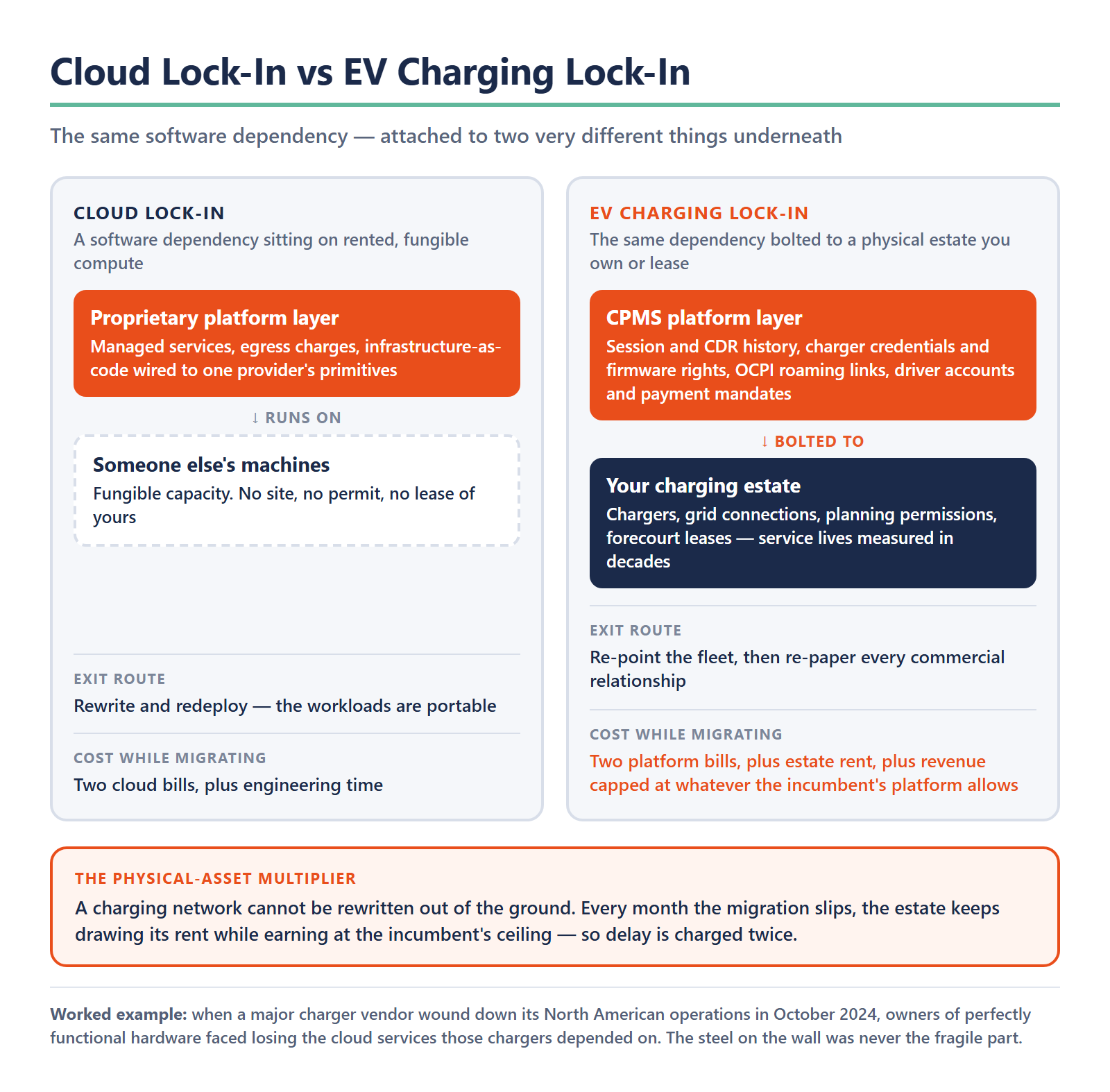
Enterprise buyers already understand vendor lock-in in cloud form: egress charges, proprietary managed services, infrastructure-as-code that has hard-wired one provider’s primitives. It is expensive and it is slow. Ultimately, though, it remains a software exercise. The workloads are portable, the machines belong to someone else, and a determined platform team can rewrite its way out.
A charging network cannot be rewritten out of the ground. The software is bolted to physical assets with long service lives, planning permissions, grid connections, and lease terms on other people’s forecourts. Every month a migration slips, the estate keeps drawing its rent while earning at whatever level the incumbent’s platform allows. That asymmetry is the multiplier, and the hardware side of the market has already shown where it leads. Charging networks have watched vendors get acquired, restructured, and withdrawn from whole regions, leaving operators with perfectly functional steel on the wall and no cloud service behind it. The hardware was never the fragile part.
What Moving Off a Charging Platform Actually Takes
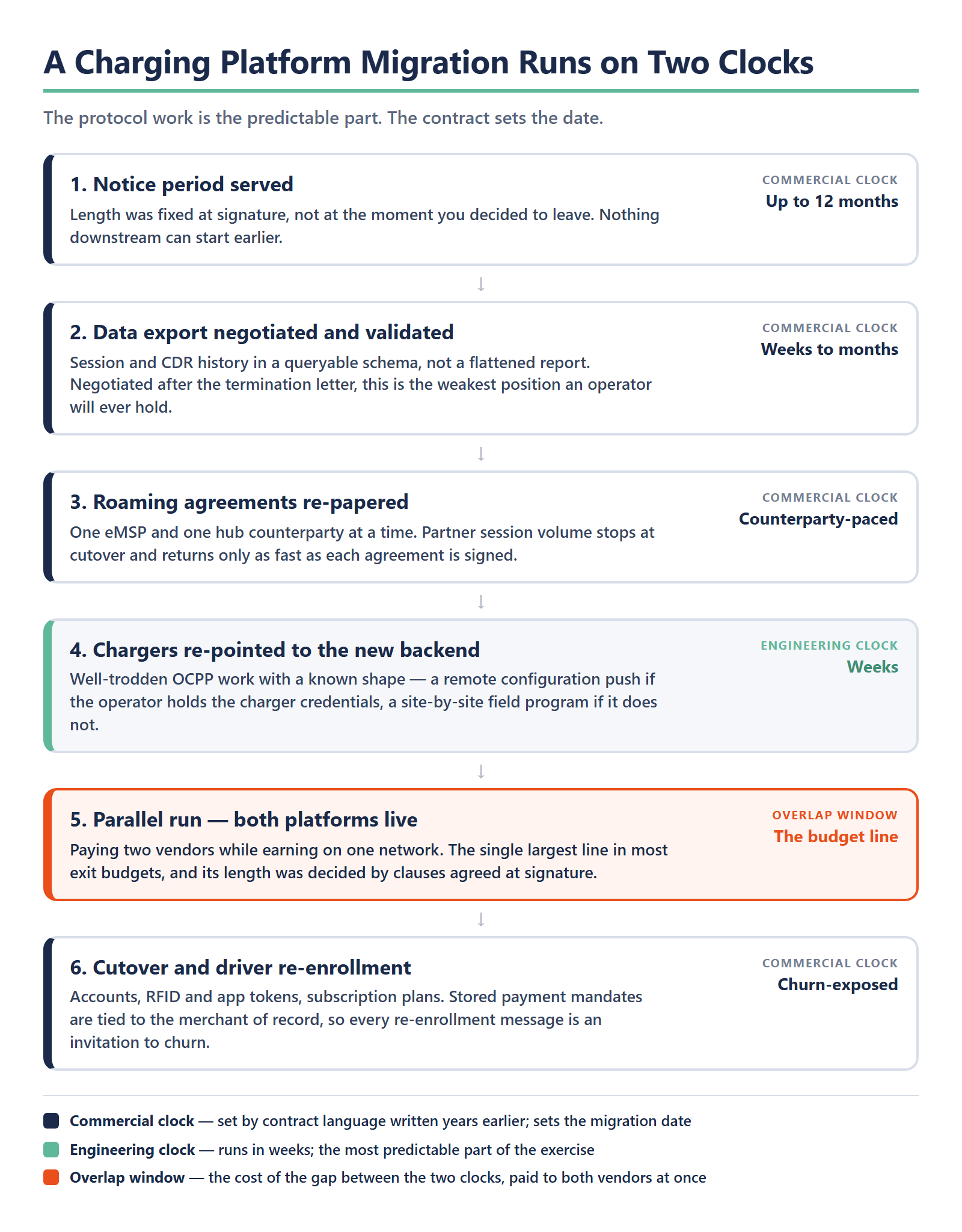
An EV charging platform migration is usually described as a technical exercise, and the technical part is the part that behaves. Re-pointing chargers at a new backend over the Open Charge Point Protocol (OCPP) is well-trodden work with a known shape, closer in character to the version upgrade covered in Codibly’s OCPP 1.6 to 2.0.1 migration guide than to anything exotic. Codibly integrated OCPP 1.6 into the cloud platform of an EV-charging hardware manufacturer in a month. The scalable OCPP 1.6J server Codibly built for IMP PAN has run charging and vehicle-to-grid sites across Poland, Denmark, and the Netherlands since the Horizon 2020 program funded it.
Protocol work runs on an engineering calendar measured in weeks. The commercial exit runs on a different calendar entirely, and it is the one that sets the date. A twelve-month notice period is twelve months. A data export negotiated after the termination letter has been sent is negotiated from the weakest position an operator will ever hold. Roaming agreements have to be re-signed one counterparty at a time. Drivers have to be told something, and told it in a way that does not read as an apology.
Then there is the overlap. Serious migrations run both platforms in parallel for a period, which means paying two vendors while earning on one network. That parallel window is the single largest line in most exit budgets, and its length is determined almost entirely by clauses agreed at signature.
The Clause That Decides Your Exit Price
Exit terms are usually presented as legal hygiene. They are pricing, and they deserve the attention of whoever negotiates price.
Four positions carry nearly all the value. Data portability written as “data will be made available in a standard format on request” concedes format, scope, and timing to the counterparty; the version worth holding names the entities, names the formats, sets a delivery window, and includes one full test export executed during the term, while the relationship is still cordial. Notice and renewal should be sized against a real migration plan rather than the vendor’s revenue-recognition preference.
Transition assistance left as best-efforts cooperation is worth roughly what it costs; a scoped, priced exit service with named roles and response times is worth a great deal, and it is far cheaper to buy at signature than at separation. Configuration and credential control determines whether re-pointing the fleet is a remote operation or a truck roll.
| Clause | The wording usually offered | The position worth holding |
|---|---|---|
| Data portability: what comes back, and in what shape | “Data will be made available in a standard format on request” | Named entities (sessions, CDRs, tariffs, assets, users), named formats, a defined delivery window, and one full test export executed during the term |
| Notice and renewal: the calendar the migration has to fit | Long notice against automatic renewal, sized to the vendor’s revenue recognition | Notice sized against a real migration plan, with renewal that never falls due before the export you are entitled to |
| Transition assistance: who does the work on the way out | Best-efforts cooperation, priced at the time | A scoped, priced exit service with named roles and response times, agreed at signature rather than at separation |
| Configuration and credential control: who can move the chargers | Vendor holds charger credentials and firmware update rights | Operator holds or co-holds credentials and the documented right to re-point charge points without a vendor-controlled step |
None of this requires an adversarial procurement posture. A vendor confident in its product has little reason to resist a clean exit, and the request itself is diagnostic: how a platform provider responds to an exit clause is the most reliable signal available about how the relationship will behave under strain. For operators specifying a new charge point management system (CPMS) or charging station management system (CSMS) from scratch, CSMS and CPMS development is where those obligations get translated into architecture instead of sitting in a contract nobody reopens.
Regulation is starting to push in the same direction. The EU’s Alternative Fuels Infrastructure Regulation (AFIR) already obliges operators to make static and dynamic data about their charge points available through national access points, so data an operator cannot extract from its own platform is a compliance exposure as well as a commercial one.
Everything You Can Change, You Change Before You Sign
Lock-in rarely originates as a defect in any particular platform. It is the natural resting state of a commercial arrangement where one party holds the data, the configuration, the roaming relationships, and the driver accounts, while the other party holds the invoice. Operators who have moved a live network tend to say the same thing about the experience: the decisions that made it survivable were taken years earlier, in a document nobody wanted to spend an afternoon on.
There is an honest limit to how far contract language can carry an operator. A well-drafted exit clause lowers the price of leaving; it does not change who owns the platform. That is the reason a third position exists between renting and building. Codibly’s CPMS Engine is a productized charging platform core, licensed once and owned outright with the source code, carrying no per-charger rent and no exit to negotiate, because the asset already sits on the operator’s side of the table. Ownership brings obligations of its own, and for a small network without an engineering function, renting remains the sensible choice. For an operator scaling past the point where per-charger fees grow faster than the value the platform adds, the useful question at the next renewal is a simple one: what would it cost to leave, and who decided that number?
Frequently Asked Questions
Vendor lock-in is the condition of being unable to move to an alternative supplier without incurring costs high enough to make staying the rational choice. In EV charging, it arises when a management platform holds the operator’s session data, charger configuration, roaming connections, and driver accounts in forms that are difficult, slow, or contractually restricted to extract. The lock-in is rarely created by a single clause. It accumulates from format decisions, credential arrangements, and notice periods that each look reasonable in isolation.
In practice it means the incumbent platform sets the terms of every subsequent negotiation. A price increase at renewal is easier to accept than a migration whose cost nobody has ever modeled. It also means specific operational limits: session history that cannot be reconstructed for a roaming dispute, chargers that need a technician visit to re-point at a different backend, roaming links that belong to the vendor’s hub agreement rather than the operator’s, and payment mandates that cannot follow drivers to a new merchant of record. Each of those is a real cost with a date attached, and none of them appears in a platform demonstration.
The commercial risk is pricing power: fees escalate faster than the value delivered, and the operator has no credible alternative to cite. The operational risk is dependency, which turns a supplier’s business decision into the operator’s outage. When a platform provider is acquired, changes strategy, or exits a market, physical charging assets can be left without the software that makes them earn. The strategic risk is the quietest one: an operator that cannot move cannot adopt a better tariff engine, a different roaming strategy, or a new grid-services revenue stream without the incumbent’s cooperation, so the roadmap becomes the vendor’s roadmap.
Start with the exit clause and the notice period, because they set the calendar that everything else fits inside. Extract and validate a complete data export early, including session and CDR history in a schema you can query rather than a flattened report. Confirm who holds the charger credentials and whether configuration can be changed remotely, since that answer determines whether the field work is a software push or a site-by-site program. Re-paper roaming agreements with each eMSP and hub counterparty in parallel with the technical work, not after it. Plan for a period of running both platforms simultaneously, and budget for it. The protocol layer, typically OCPP for the chargers and OCPI for roaming, is the most predictable part of the exercise; the commercial and contractual layers set the timeline.