Virtual Power Plant Software: The Technology Stack European Flexibility Aggregators Need to Scale
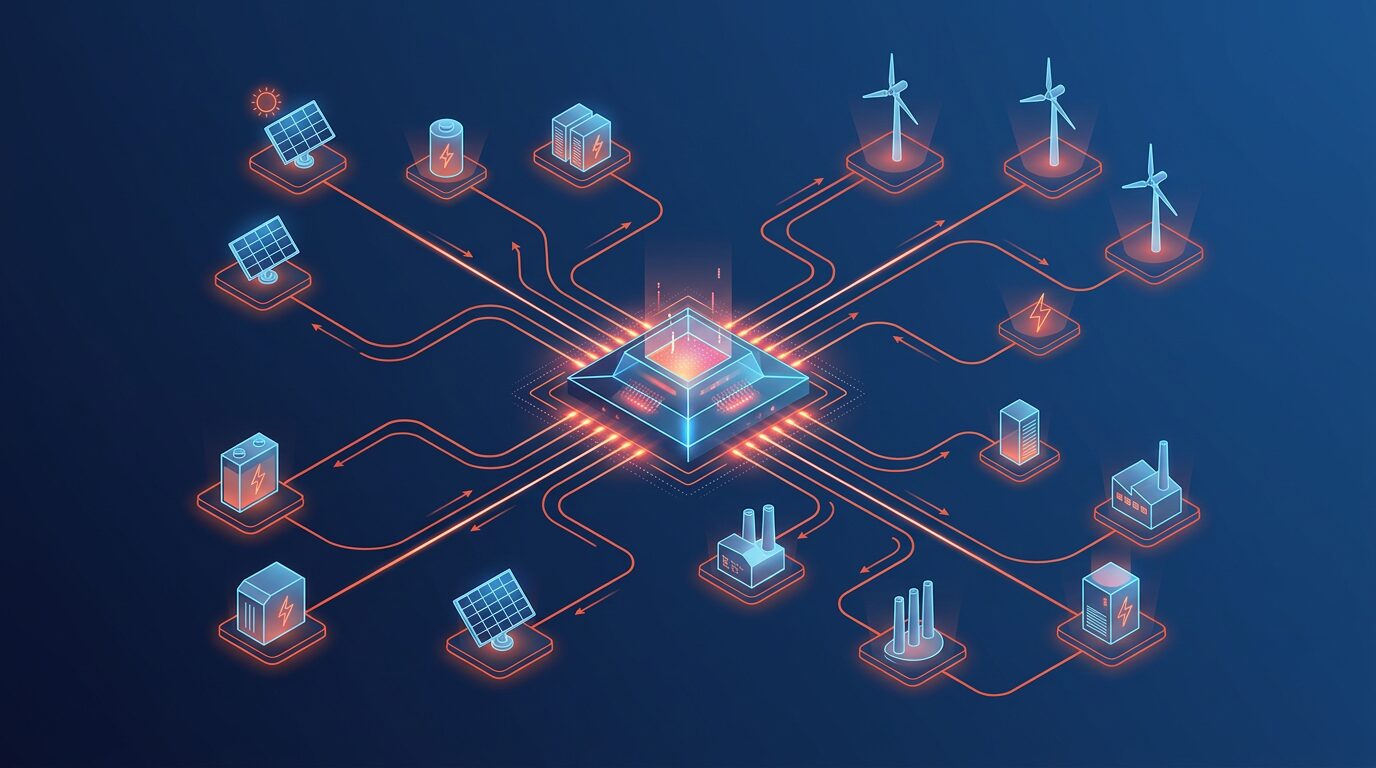
Europe’s flexibility market is entering its most consequential phase. As renewable penetration deepens, TSOs across Poland, Romania, Hungary, and Germany are shifting their balancing mechanisms toward real-time demand response and distributed storage — creating a window that agile aggregators are uniquely positioned to capture. But there’s a catch: the companies winning this market aren’t just the ones with the sharpest trading strategies. They’re the ones whose virtual power plant software can move faster than the grid itself.
For senior energy professionals who’ve built their careers in commodity trading and flexibility origination, the technology question is often the last thing they want to deal with — and the first thing that limits their scale.
From Trading Floor to Control Room: Why VPP Software Has Become a Competitive Moat
The thesis is now mainstream: flexible, algorithmically-driven energy traders will consistently outperform legacy utility structures. Poland’s PV capacity has grown from under 2 GW in 2019 to over 23 GW today. BESS deployment is accelerating across CEE. The coming phase-out of Russian gas imports by 2027 will force a step-change in demand-side flexibility at a scale that manual trading strategies simply can’t service.
What separates aggregators who capture this opportunity from those who watch it pass is the quality of their software stack. Specifically: how quickly they can connect a new asset type, integrate a new market, and operationalize a new flexibility product — without needing to rebuild their core platform each time.
The Four Technology Layers Every Scalable VPP Platform Needs
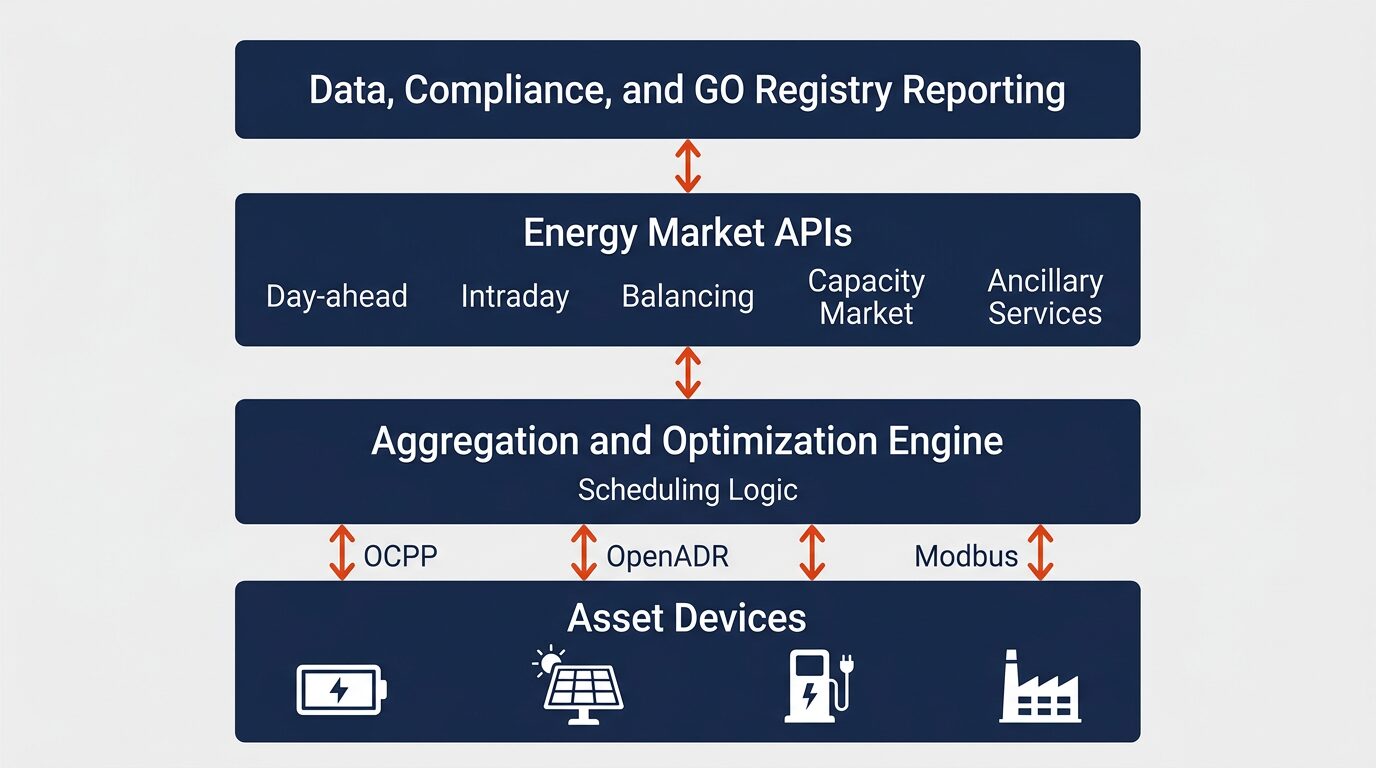
A production-ready flexibility aggregation platform is not a single application. It’s a stack of four distinct technology layers, each with its own protocol demands and integration complexity.
1. Asset Connectivity Layer
Every asset in your portfolio — BESS units, PV inverters, industrial demand consumers, heat pumps, EV chargers — communicates through a different protocol. OCPP for EV charging infrastructure, OpenADR for demand response signalling, EEBUS for smart home devices, Modbus and IEC 61850 for industrial assets. Your connectivity layer must handle all of these, in real time, at millisecond latency.
2. Aggregation and Optimization Engine
Above the connectivity layer sits the logic that makes a VPP valuable: portfolio scheduling, dispatch optimization, state-of-charge management for BESS, and constraint-aware activation across heterogeneous asset types. This is where AI-driven and algorithmic approaches create the most immediate advantage — optimizing dispatch sequences across hundreds of assets simultaneously against real-time market price signals.
3. Energy Market Integration Layer
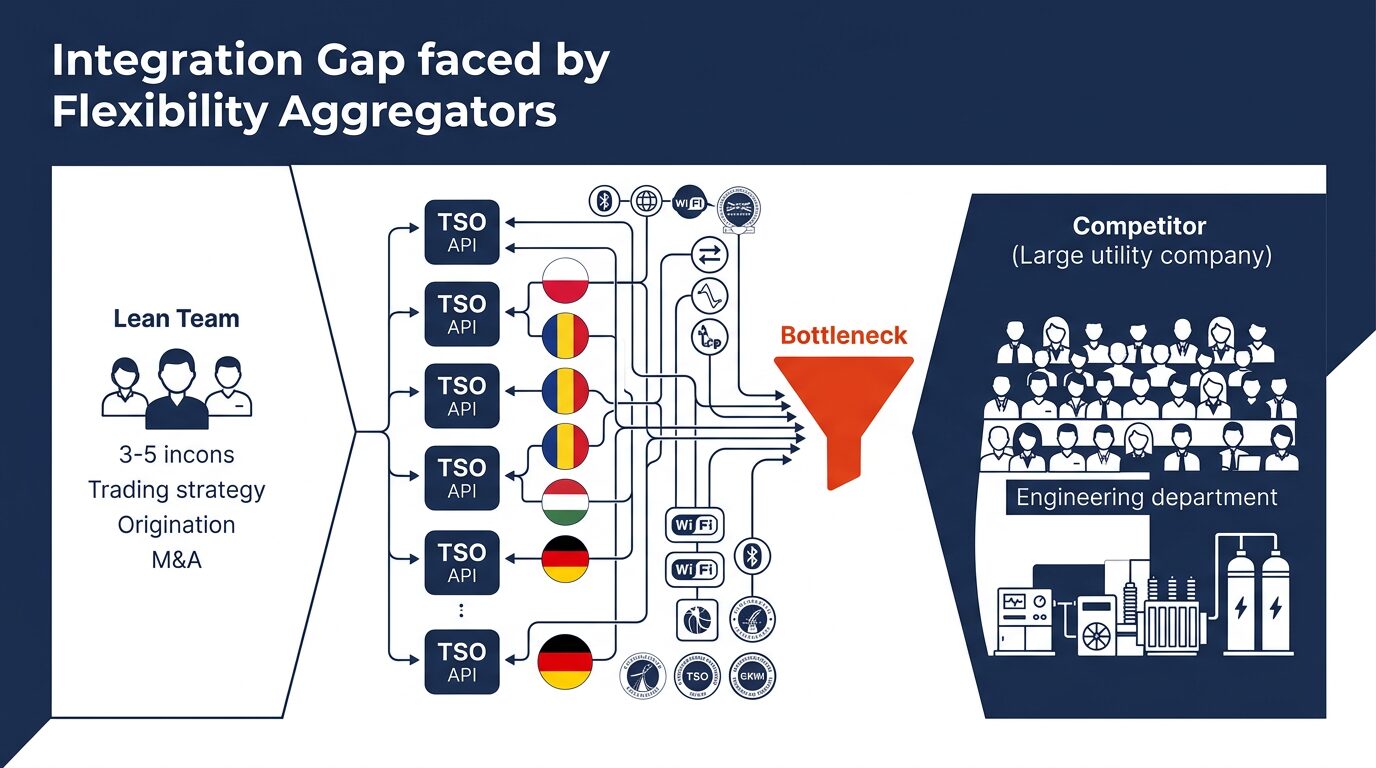
This is where most aggregators face their sharpest bottleneck. Each market — day-ahead, intraday continuous, balancing, capacity market, ancillary services — requires a dedicated API integration with its TSO or BSP. Across Poland (PSE), Romania (Transelectrica), Hungary (MAVIR), and Germany (all four TSOs), each has different data formats, authentication schemes, and submission windows. Building and maintaining these integrations is a significant, ongoing engineering investment.
4. Data, Compliance, and Reporting Layer
The top of the stack handles everything regulators and counterparties require: GO registry connectivity, meter data management, settlement reconciliation, and cross-border reporting. As European energy regulation evolves — with RED III, the Electricity Market Design Regulation, and national transpositions — this layer requires constant maintenance to remain compliant.
Where Lean Aggregators Lose Revenue: The Integration Gap
Most flexibility aggregators don’t lose margin in their trading strategies. They lose it at integration points.
Consider the actual cost of launching a new flexibility product in a new market: a single TSO API integration takes 4–12 weeks of senior engineering time. A new asset type requiring a new protocol adapter adds another 2–6 weeks. A regulatory compliance update — say, a change to Poland’s Capacity Market registration portal or a MAVIR ancillary service specification revision — can freeze operations for days if integrations are brittle.
For a lean team of 5–15 people focused on trading strategy, origination, and deal execution, this integration debt accumulates faster than it can be serviced in-house. Every week spent on API maintenance is a week not spent on the next commercial opportunity.
Large utilities absorb this cost with dedicated engineering departments. Independent aggregators competing against them need a different model.
Speed-to-Market Is the Real Competitive Advantage
In a balancing market, being three months late to connect means missing an entire seasonal price pattern. When a new ancillary service product launches — aFRR, mFRR, FCR, or a DSR tender — the aggregators with pre-built integration infrastructure capture the first-mover premium. Those still building API connectors arrive to a flattened spread.
The same logic applies to asset onboarding. A flexibility aggregator who can onboard a new industrial demand consumer in two weeks rather than two months will consistently win origination mandates against competitors still assembling their Modbus integration.
This is why the most sophisticated flexibility operators in CEE are treating their aggregator and optimizer software stack as a strategic investment — not an IT cost center. The ability to expand into a new country, asset class, or market product without rebuilding core infrastructure is the moat that compounds over time.
Build vs. Partner: The Real Economics for Flexibility Operators
Building a full VPP software stack in-house sounds appealing on paper. In practice, the hidden costs are substantial:
- Talent cost: Senior energy software engineers who understand both the protocol layer (OpenADR, OCPP, IEC standards) and energy market mechanics (balancing, ancillary services, capacity market) are among the scarcest technical profiles in Europe.
- Protocol maintenance: Energy communication standards evolve constantly. OpenADR 2.0b to 3.0, OCPP 1.6 to 2.0.1 to 2.1, IEC 61850 profile updates — each requires dedicated engineering cycles to maintain compatibility.
- Market API drift: TSO APIs change without warning. A PSE balancing market portal update, a MAVIR capacity market specification revision — these are operational blockers if not addressed immediately.
- Regulatory compliance overhead: Regulatory compliance across multiple CEE jurisdictions requires ongoing legal and technical monitoring that most trading-focused teams are not structured to provide.
Partnering with a specialist who has already built — and is actively maintaining — pre-certified protocol accelerators and energy market integrations converts a capital expense into a time-to-market advantage. For an aggregator operating across Poland, Romania, Hungary, and expanding into Germany or the Baltics, that translates directly into months gained on each new market entry.
What This Means for BESS-Heavy Portfolios
Battery storage is increasingly the anchor asset in European VPP portfolios — and the most demanding in terms of software requirements. A BESS asset participates simultaneously in day-ahead arbitrage, intraday balancing, FCR/aFRR ancillary services, and potentially capacity market contracts. Orchestrating these concurrent obligations without conflicting dispatch commands requires a dedicated BESS management software layer that understands both the asset’s technical constraints (SoC limits, ramp rates, cycle degradation) and the market context (price signals, activation windows, penalty structures).
The aggregators building durable BESS portfolios in CEE are the ones who’ve invested in this software layer early — before scale makes the technical debt insurmountable.
Frequently Asked Questions
What is virtual power plant software and why does it matter for flexibility aggregators?
Virtual power plant software is the technology layer that connects distributed energy assets — BESS, demand response consumers, PV installations, and EV chargers — and optimizes their combined output against energy market signals. For flexibility aggregators, it determines how quickly they can onboard new assets, enter new markets, and respond to real-time price opportunities. Without production-grade VPP software, even the sharpest trading strategy is constrained by operational bottlenecks.
How long does it take to build energy market API integrations from scratch?
A single TSO API integration typically requires 4–12 weeks of senior engineering time, depending on documentation quality and authentication complexity. Across a multi-country portfolio, this compounds quickly. Aggregators working with pre-built integration accelerators can reduce this to days rather than months for supported markets.
What communication protocols do BESS assets typically use in European VPPs?
BESS assets in European VPPs most commonly use Modbus TCP/RTU for direct control, IEC 61850 for substation-level automation, and increasingly OpenADR 2.0b/3.0 for demand response signalling from TSOs and aggregators. Some residential and commercial BESS systems also support EEBUS for smart home integration. A well-designed VPP platform handles all of these through a unified protocol abstraction layer.
Can flexibility aggregators participate in capacity markets with a VPP platform?
Yes — but it requires specific capacity market integrations tailored to each country’s BSP/TSO requirements. Poland’s Capacity Market (PSE), Romania’s (Transelectrica), and Germany’s capacity mechanisms each have specific registration, certification, and settlement processes. Aggregators operating multi-country portfolios need market-specific connectors for each jurisdiction.
Ready to Accelerate Your Flexibility Platform?
Codibly builds the technology infrastructure that lets flexibility aggregators and VPP operators focus on what they do best — trading, origination, and portfolio growth — while we handle the engineering complexity of asset protocols, market integrations, and regulatory compliance. Whether you’re launching a BESS-anchored VPP, expanding demand response aggregation across CEE markets, or need to connect an existing portfolio to new balancing and capacity market products, our team has the domain depth and pre-built accelerators to get you there faster.