CASE STUDY: IEEE 2030.5 Multi-DNSP Integration for the Australian Market
Client Overview
Client: SolarEdge — global leader in smart energy solutions for residential, commercial, and utility-scale applications
Market: Australia (NSW and additional DNSP territories)
Project: IEEE 2030.5 CSIP-Australia client alignment for multi-DNSP integration
Objective: Streamline utility integration across the Australian market to enable advanced Grid Services and Virtual Power Plant participation — without exposing proprietary architecture details.


EXECUTIVE SUMMARY
The Market Context
Australia requires rigorous standards for Distributed Energy Resources to maintain grid stability. Complying with local Distribution Network Service Provider requirements is a mandatory step for hardware manufacturers entering this market, making certification a critical go-to-market requirement.
To participate in advanced Grid Services, manufacturers must ensure their physical assets can reliably receive and respond to network signals. SolarEdge — already a global leader in smart energy solutions — set out to expand its Virtual Power Plant and Grid Services footprint across multiple Australian Distribution Network Service Providers (DNSPs) under a single, maintainable technical approach.
INTEGRATION CHALLENGE
What SolarEdge Needed to Solve
Multi-DNSP market access
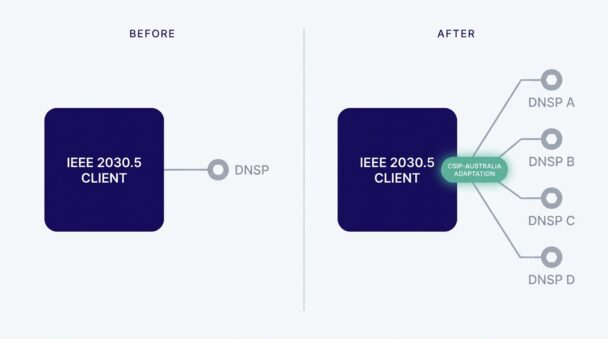
Align with IEEE 2030.5 CSIP-Australia — the critical standard for modern grid interoperability in the Australian market — across multiple regional utilities under one technical approach.
Regional protocol variability
Secure reliable communication between SolarEdge devices and several major Australian DNSPs, each with its own certification and operational nuances.
IP protection
Accelerate market access without exposing proprietary architecture details of SolarEdge’s already certified technology stack.
Time to Grid Services
Unlock advanced Grid Services revenue streams across multiple utility territories with minimal impact on existing deployment velocity.
TECHNOLOGY ENABLER
The Technical Partnership
Codibly implemented the necessary architectural modifications to the SolarEdge server IEEE 2030.5 client to enable these specific utility integrations. This engineering effort connected the already certified technology directly to regional networks, accelerating market access and ensuring seamless interoperability with several major Australian utility providers.
By acting as the technical integration partner, Codibly helped SolarEdge navigate the complex protocol landscape and establish a resilient foundation for their hardware to communicate securely with the grid — while SolarEdge retained full ownership of its certified technology stack.
BUSINESS IMPACT
What the Integration Delivered
Accelerated Utility Connection
Achieved seamless integration with strict Australian DNSP requirements to enable active grid participation.
Unlocked Market Value
Sped up time-to-market for advanced Grid Services across multiple utility territories, enabling new revenue streams.
Optimized Asset Management
Strengthened the scalability of Virtual Power Plants (VPP) to support the broader energy transition.
RELATED CASE STUDIES
More Work with Leading Energy Innovators


CONTACT US
Planning your own IEEE 2030.5 rollout?
Talk to Codibly’s Grid Services team about IEEE 2030.5, CSIP profiles, and multi-DNSP integration strategies for your hardware platform.
Frequently Asked Questions
IEEE 2030.5 is an international smart energy communication standard. CSIP-Australia is the Australian Common Smart Inverter Profile — a regional adaptation defining how Distributed Energy Resources (DERs) communicate with Distribution Network Service Providers under local grid rules. Hardware manufacturers must align with CSIP-Australia to participate in advanced Grid Services in the Australian market.
Each regional grid has its own operational rules, security expectations, and certification requirements. CSIP-Australia adapts the base IEEE 2030.5 standard to the specific needs of Australian Distribution Network Service Providers (DNSPs), ensuring reliable two-way communication between DER hardware and local utility networks.
A partner like Codibly works at the protocol adaptation layer — implementing architectural modifications to the existing certified client so it can communicate with new regional networks. The manufacturer’s core technology stack and proprietary architecture remain untouched, and market readiness is achieved much faster than rebuilding from scratch.
Yes. CSIP-Australia-aligned IEEE 2030.5 connectivity is a prerequisite for DER assets to participate in VPP programs and advanced Grid Services. The integration strengthens the scalability of VPP deployments across Australian utility territories.