BESS Energy Management System: The Layer That Decides Whether Your Battery Makes Money

A BESS energy management system (EMS) is the most consequential software decision on a battery energy storage system (BESS) project, and the least examined one. Cells get benchmarked to the decimal. Inverters get vetted across three vendors. The EMS, the layer that decides when the asset charges, discharges, and bids, often arrives as a checkbox on the integrator’s spec sheet. That ordering is backwards. The battery and the power electronics set the ceiling on what the project can physically do; the energy storage software above them determines how much of that ceiling converts into revenue. Two identical containers on the same interconnection can produce materially different returns based on nothing more than the intelligence of the dispatch layer running them.
Key Takeaways
- The EMS is the only major BESS component the owner actually chooses; the battery management system (BMS) and power conversion system (PCS) come with the hardware.
- Most products sold as a BESS EMS are monitoring dashboards. A revenue-grade EMS does five specific jobs, and the gap between the two shows up directly in project IRR.
- Single-site EMS logic breaks at portfolio scale. Multi-asset, multi-market operation is an architectural decision, and retrofitting it is expensive.
- Build versus buy is settled by integration depth, market mix, and whether your optimization logic is a differentiator or a commodity.
Your BESS Ships with a BMS. The EMS Is the Product You Actually Choose.
Three pieces of software touch every grid-scale battery, and conflating them is the most common mistake in storage procurement.
The BMS is firmware. It lives at the cell, pack, and string level, balancing voltage, estimating state of charge, managing temperature, and opening contactors before a thermal event. It ships embedded in the battery, written by the battery OEM and its semiconductor suppliers. You do not choose it; you inherit it.
The PCS is the power electronics layer, converting DC to AC and back, enforcing grid codes at the point of interconnection. It comes with the inverter. Again: inherited.
The EMS is different in kind. It is the orchestration layer above both, the software that ingests telemetry from the BMS and the meter, forecasts prices and load, decides what the asset should do in the next five minutes and the next day, and executes that decision against a market interface. The Sandia National Laboratories’ Energy Storage Handbook devotes a full chapter to energy storage management systems precisely because this layer, unlike the firmware below it, is an open design space: it can be a vendor product, an integrator’s add-on, or custom-built software the operator owns outright.
| Battery Management System (BMS) | Power Conversion System (PCS) | Energy Management System (EMS) | |
|---|---|---|---|
| What it is | Embedded firmware at cell, pack, and string level | Power electronics and controls at the DC-AC boundary | Supervisory dispatch and optimization software above the asset |
| Who supplies it | Battery OEM and its semiconductor stack | Inverter OEM | Open choice: vendor product, integrator add-on, or custom build |
| Core job | Cell balancing, state-of-charge estimation, thermal protection | DC-AC conversion, grid-code compliance at the interconnection | Forecasting, multi-market optimization, dispatch, settlement |
| Typical failure mode | Safety derating, premature capacity fade | Curtailment, grid-code non-compliance | Missed revenue: idle state of charge, single-stream dispatch, warranty-burning cycling |
| Buyer leverage | Hardware selection only | Hardware selection only | Full control: scope, architecture, market coverage, and ownership |
The practical consequence sits in the last row of that comparison. With the BMS and PCS, your leverage is limited to hardware selection. With the EMS, you hold every decision: scope, architecture, market coverage, and ownership of the optimization logic itself. That is why the EMS deserves the procurement scrutiny that usually goes to the cells.
The Five Jobs That Separate a Real BESS Energy Management System from a Monitoring Dashboard
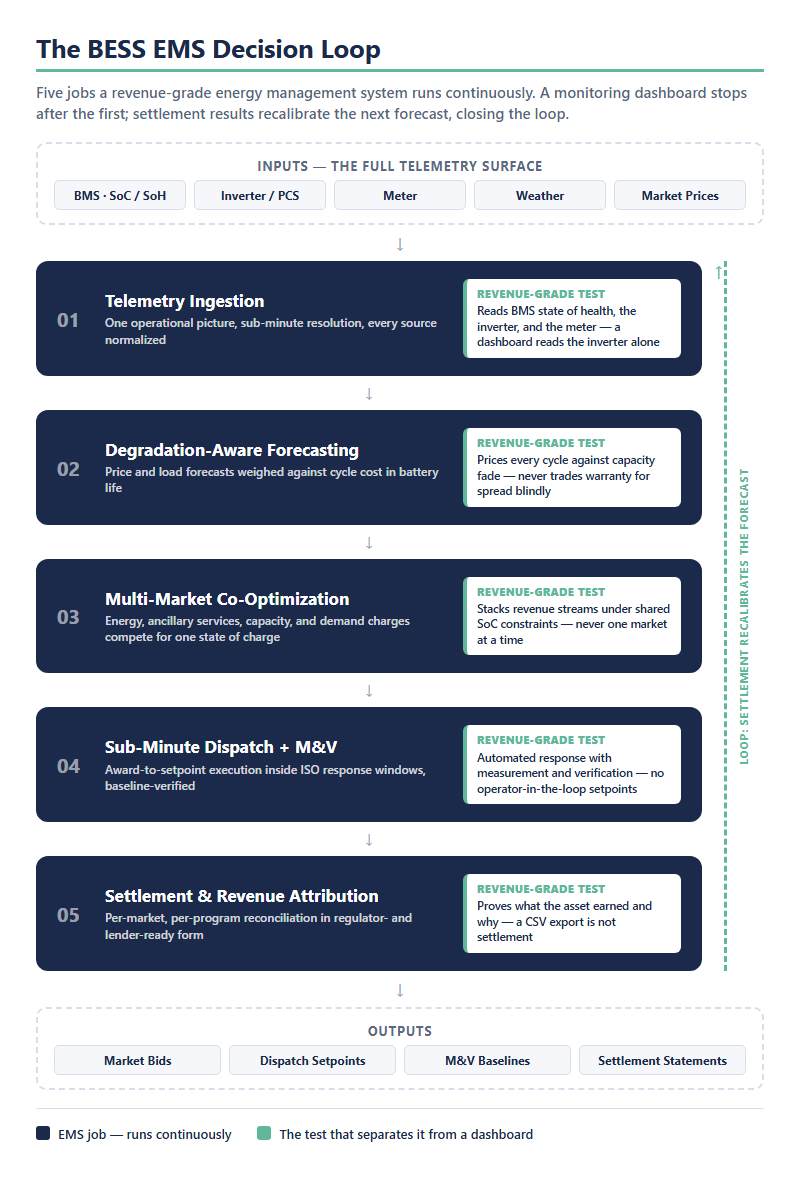
The storage software market has a labeling problem. SCADA front-ends, asset-performance dashboards, and genuine dispatch engines all market themselves as an EMS. The label tells you nothing; the job list does. A revenue-grade BESS EMS does five things, and each one is testable in a vendor conversation.
- Telemetry ingestion across the full stack. BMS state of charge and state of health, inverter status, meter data, weather, and market prices, normalized into one operational picture at sub-minute resolution. If the platform only reads the inverter, it is a dashboard.
- Degradation-aware forecasting. Price and load forecasts are table stakes. The harder question is whether the optimizer understands that every cycle has a cost in battery life, and weighs today’s arbitrage spread against tomorrow’s capacity fade. An EMS that ignores degradation will cheerfully cycle your warranty away.
- Multi-market co-optimization. Energy arbitrage, ancillary services, capacity payments, and behind-the-meter demand-charge management compete for the same state of charge. The economics of stacking these revenue streams are well documented in our analysis of merchant BESS economics in ERCOT: the spread between a single-stream and a co-optimized asset is frequently the difference between underperforming and clearing the hurdle rate.
- Sub-minute dispatch with measurement and verification (M&V). Deciding is half the job; executing within the response windows that ISO programs and demand response software signals require, then proving the response against a baseline, is the other half.
- Settlement and revenue attribution. When the month closes, the EMS must reconcile what the asset earned, per market and per program, in a form a regulator and a lender will accept.
FERC Order 841, which opened U.S. wholesale markets to storage participation, is the reason this job list keeps growing: every new market a battery can enter adds a forecasting problem, a dispatch interface, and a settlement format. The order created the revenue opportunity. The EMS determines how much of it any given asset captures.
| Job | Dashboard-grade answer | Revenue-grade answer |
|---|---|---|
| 1. Telemetry ingestion | Reads the inverter; refreshes every 15 minutes | BMS + PCS + meter + weather + market prices, normalized at sub-minute resolution |
| 2. Forecasting | Day-ahead price feed passed through | Degradation-aware optimization that prices every cycle against battery life |
| 3. Market coverage | One market, one revenue stream | Co-optimized stacking: energy, ancillary services, capacity, demand-charge management |
| 4. Dispatch & M&V | Operator-in-the-loop manual setpoints | Automated sub-minute response with baseline-verified measurement and verification |
| 5. Settlement | CSV export of raw telemetry | Per-market, per-program revenue attribution in regulator- and lender-ready form |
Energy Storage Management at Portfolio Scale: Where Single-Site EMS Logic Breaks
A subtler failure mode appears after the second or third project. An energy storage management system designed around one site, one market, and one battery chemistry tends to hard-code those assumptions. Then the portfolio grows: a second site in a different ISO, a co-located solar array, a tranche of customer-sited batteries that need aggregation. Each addition strains an architecture that was never designed to answer portfolio-level questions, such as which asset should serve a capacity call when three of them could, or how to allocate a shared interconnection limit across co-located resources. Once the portfolio is large enough to bid as a single resource, those questions stop belonging to the site controller and move up into virtual power plant software.
Portfolio-scale energy storage management has different requirements: fleet-level optimization with site-level constraints, market interfaces abstracted behind a common dispatch layer, and asset onboarding measured in configuration time rather than engineering time. This is the point where the EMS conversation starts to border on DERMS platform architecture, and the boundary matters. A distributed energy resource management system (DERMS) orchestrates many resource types for grid-level objectives; a storage EMS optimizes battery economics. Operators who need the second should be cautious about buying the first and assuming the storage depth comes along. In our integration work, the most common rescue project is exactly this: a generic orchestration platform that treats a battery as a dumb dispatchable load, with no degradation model and no state-of-charge strategy, retrofitted after the revenue shortfall becomes visible.
The pragmatic takeaway: scope the EMS for the portfolio you intend to have in three years, even if you only commission one site this year. The architectural cost of multi-asset readiness is modest at design time and punishing as a retrofit.
Build, Buy, or Integrate Your BESS EMS: The OEM and Operator Calculus
The procurement decision resolves into three honest paths, and the right one depends on who you are.
Buy a packaged EMS when your asset participates in one market, your hardware stack matches the vendor’s integration list, and your optimization needs are standard. The packaged product’s strength is speed; its limit is the roadmap. If your revenue strategy depends on a market the vendor has not built an interface for, you wait, and waiting has a megawatt-hour price.
Build or commission a custom dispatch stack when the optimization logic is your edge: proprietary forecasting, an unusual market position, OEM-embedded software that has to run from the firmware up, or ISO-specific interfaces a packaged vendor will not prioritize. This is where custom energy storage software development earns its keep, and it is the path most storage OEMs eventually take for the software they ship with their own hardware.
Integrate through an accelerator-led approach when the gap is connectivity rather than logic: the protocol layers (IEEE 2030.5, OpenADR, Modbus/SunSpec, ISO market APIs) that connect an existing platform to grids and markets. Pre-built, pre-certified protocol components compress the part of the build that is undifferentiated plumbing.
The pattern from the field is instructive. When Yotta Energy needed an EMS built for a panel-level storage OEM, the answer was a custom, cloud-native platform unifying solar generation, storage, and EV charging, because their hardware architecture made every off-the-shelf assumption wrong. A packaged product would have meant redesigning the product around the software. For an operator with standard containers in a single market, the same decision would have gone the other way. One caution that applies on every path: connecting an EMS to batteries over REST or Modbus is its own engineering discipline, covered in our work on EMS-BESS API integration, and underestimating it is the most common cause of commissioning slip.
An EMS Decision Is a Revenue Decision Made Once
Storage hardware is becoming a commodity on a visible cost curve; the National Renewable Energy Laboratory’s cost benchmarks show the trend year over year. Dispatch intelligence is moving the opposite direction, growing more valuable as markets fragment and revenue stacking gets more intricate. The EMS sits exactly at that intersection, and it is chosen once, at commissioning, by teams whose attention is mostly elsewhere.
Treat the choice with the weight it carries. Audit candidates against the five jobs. Scope for the portfolio, and decide deliberately whether your dispatch logic is something you rent or something you own. The asset will run for fifteen years on the consequences.
Frequently Asked Questions
A BESS energy management system is the supervisory software that decides how a battery energy storage system operates: when to charge and discharge, which markets or programs to serve, and how to balance revenue against battery degradation. It sits above the battery’s built-in BMS firmware and the inverter’s PCS, ingesting telemetry from both and executing dispatch decisions against market and utility interfaces.
The battery management system (BMS) is safety and health firmware embedded in the battery itself; it balances cells, estimates state of charge, and protects against thermal events. The energy management system (EMS) is the economic brain above it, deciding what the asset should do and when. A useful shorthand: the BMS keeps the battery alive, the EMS makes it earn. The power conversion system (PCS) sits between them, handling DC-AC conversion and grid-code compliance.
There is no single best product; there is a best fit for a given asset, market mix, and hardware stack. Evaluate candidates against five capabilities: full-stack telemetry ingestion, degradation-aware forecasting, multi-market co-optimization, sub-minute dispatch with measurement and verification, and settlement-grade reporting. A vendor strong in your specific ISO with proven integrations to your battery and inverter OEMs beats a nominally superior platform that treats your market as a roadmap item.
Energy storage management system (ESMS) is the broader industry term, used by Sandia National Laboratories among others, for the supervisory control and optimization layer of a storage plant. In practice it is synonymous with a BESS EMS for battery-based plants; ESMS is the more precise term when the fleet includes non-battery storage such as thermal or mechanical assets.
Buy when your needs are standard: single market, supported hardware, conventional revenue stack. Build, or commission a custom platform, when dispatch logic is a competitive differentiator, when you are an OEM shipping software with your hardware, or when your market mix requires interfaces packaged vendors will not prioritize. A third path, integrating pre-certified protocol components into an existing platform, fits teams whose gap is grid connectivity rather than optimization logic.