V2G Readiness: Why Bidirectional Charging Standards Are the DSOs’ and Fleet Operators’ New Mandate

Search “bidirectional charging” and the results are dominated by consumer questions: which cars support it, how much money can homeowners save, when will V2G chargers be affordable. Those are valid questions. They are also the wrong questions for anyone building the infrastructure that will actually make Vehicle-to-Grid (V2G) work at scale. The real question for fleet operators, Distribution System Operators (DSOs), and aggregators is more specific and more urgent: which EV charging standards does your platform need to participate in V2G flexibility markets? The answer is three protocols — IEEE 2030.5, OCPP 2.1, and ISO 15118-20 — and the compliance window is closing faster than most organizations realize.
The V2G Market Is Moving — The Standards Aren’t Optional
The regulatory architecture for V2G participation is no longer theoretical. In the US, FERC Order 2222 opens wholesale energy markets to distributed energy resource (DER) aggregations — and EVs with bidirectional charging capability qualify as DERs. California Rule 21 already mandates IEEE 2030.5 with the Common Smart Inverter Profile (CSIP) for any DER seeking grid interconnection approval, including V2G-capable chargers. Hawaii, Utah, and a growing list of states referencing IEEE 1547-2018 have parallel or adjacent requirements, and Australia’s CSIP-AUS mandates extend the same standard internationally. PJM, CAISO, and NYISO are each implementing their own FERC 2222 frameworks, creating a patchwork of participation rules — but all converge on the need for standardized grid-facing communication.
In Europe, the proposed EU Network Code on Demand Response — submitted by ACER to the European Commission in March 2025 — will formalize EV flexibility participation across member states, with national enforcement expected by 2027. The EU’s Alternative Fuels Infrastructure Regulation (AFIR) has required ISO 15118 at newly installed and renovated public charge points since 8 January 2026, and it requires ISO 15118-20 from 1 January 2027. What that means for where each grid function sits is covered in our white paper on ISO 15118 and grid functions in the charger.
The vehicles are arriving in parallel. Mercedes-Benz and BMW are each launching models with factory-enabled V2G capabilities in early to mid-2026. Renault already operates 500 bidirectional vehicles in a commercial car-sharing scheme in Utrecht. The hardware side of V2G is no longer the bottleneck — the software and standards side is.
The Bidirectional Charging Protocol Stack
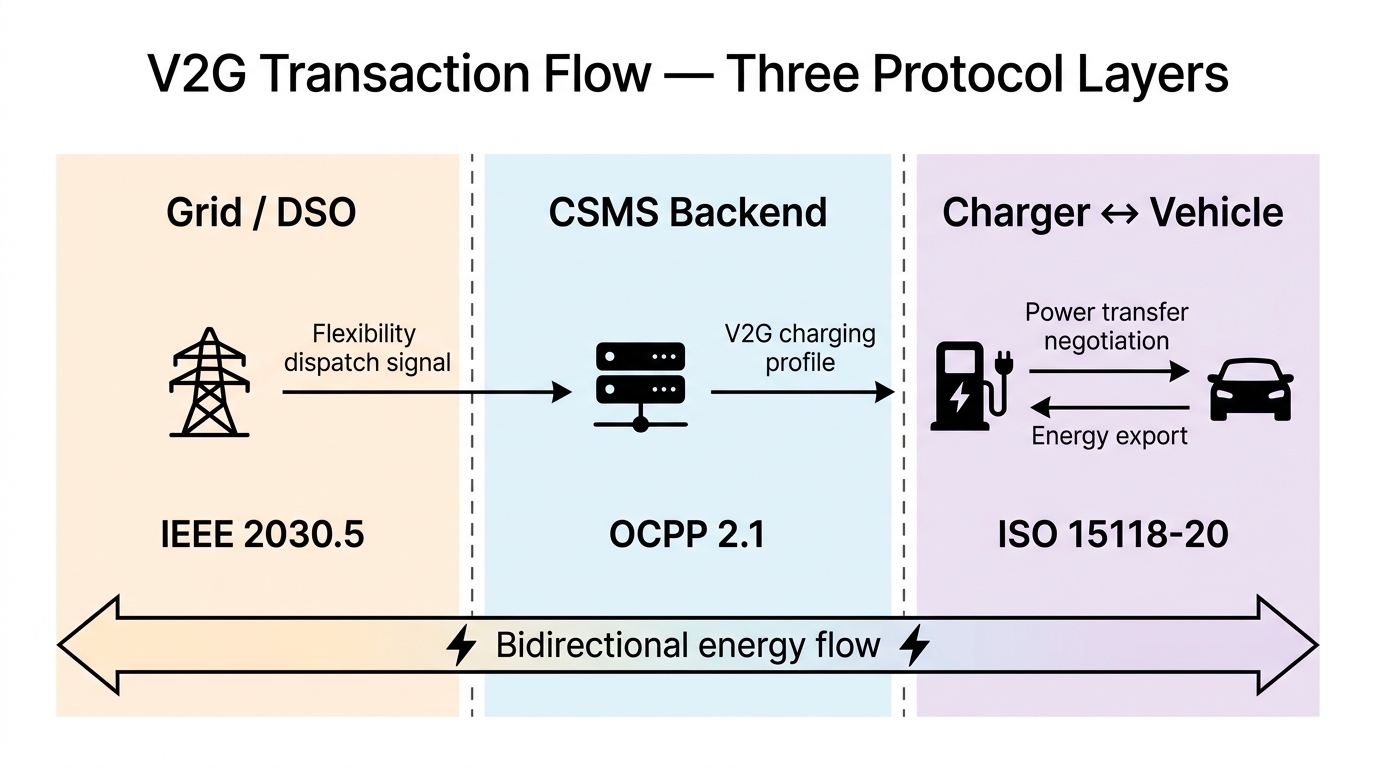
A single V2G transaction — where an EV exports energy back to the grid — passes through three distinct communication layers, each governed by a different protocol.
| Protocol Layer | Standard | Governing Body | Role in a V2G Transaction | Status (2026) |
|---|---|---|---|---|
| Grid-facing communication | IEEE 2030.5 (with CSIP) | IEEE / CSIP-AUS | Carries dispatch signals from DSO or aggregator to the charging platform; reports DER state (SOC, available capacity, dispatch acknowledgment) | Mandatory in California (Rule 21), Hawaii (Rule 14H); expanding via FERC 2222 state implementations |
| Charger-to-backend management | OCPP 2.1 (IEC 63584-210:2025) | OCA / IEC | Translates grid requests into charger commands via Device Model; manages V2G charging profiles, metering, and DER control functional block | Published as IEC standard; DER control block and bidirectional charging support are new in 2.1 |
| Vehicle-to-charger interface | ISO 15118-20 | ISO / IEC | Negotiates bidirectional power transfer between EV and EVSE; handles Plug & Charge authentication and discharge authorization | Required by AFIR at new and renovated public charge points from 1 January 2027; OEM adoption accelerating (Mercedes-Benz, BMW, Renault) |
| Electrical interconnection | IEEE 1547 | IEEE | Defines safety and electrical requirements for grid-connected DERs: anti-islanding, voltage ride-through, frequency response | Adopted in most US states; V2G chargers must comply as grid-connected DERs |
ISO 15118-20 handles the vehicle-to-charger interface. It manages the high-trust communication between the EV and the Electric Vehicle Supply Equipment (EVSE): authentication (Plug & Charge), energy negotiation, and the bidirectional power transfer commands that authorize the vehicle to discharge. Without ISO 15118-20, the charger cannot instruct the vehicle to export energy.
OCPP 2.1 governs the charger-to-backend layer. Its Device Model is what allows a Charging Station Management System (CSMS) to discover that a charger supports bidirectional operation, to send V2G-specific charging profiles, and to report granular metering data upstream. OCPP 2.1 also introduces a dedicated DER control functional block — purpose-built for smart charging scenarios where the grid needs to orchestrate charge and discharge across a fleet.
IEEE 2030.5 provides the grid-facing DER communication interface. When a DSO or aggregator needs to send a dispatch signal — requesting that a fleet of EVs discharge a specific amount of energy at a specific time — IEEE 2030.5 is the protocol that carries that signal. It is the same standard utilities use to communicate with solar inverters, battery systems, and other DERs. For V2G, it connects the EV ecosystem to the broader grid flexibility market.
These three protocols are not alternatives. They are layers. A V2G transaction starts with IEEE 2030.5 (grid dispatches a flexibility request), flows through OCPP 2.1 (CSMS translates the request into charger commands), and completes at ISO 15118-20 (charger and vehicle negotiate and execute the power transfer). Remove any layer and the transaction cannot complete.
Why Fleet Operators Cannot Ignore V2G Standards
Fleet operators managing depots of 50, 500, or 5,000 electric vehicles sit at the intersection of two trends: downward pressure on charging costs and upward opportunity in flexibility revenue. V2G unlocks the revenue side — but only if the fleet’s charging infrastructure meets the standards DSOs and aggregators require.
Grid connection contracts increasingly specify protocol compliance. A fleet depot seeking grid interconnection in California must demonstrate IEEE 2030.5/CSIP capability. Aggregators enrolling fleets in demand response programs require standardized communication — they cannot integrate proprietary APIs from every fleet operator individually.
Revenue stacking is the economic case. A V2G-capable fleet can earn from multiple streams simultaneously: capacity payments (committing to discharge during peak periods), energy arbitrage (buying cheap, selling high), and ancillary services (frequency regulation, voltage support). Each revenue stream has its own market participation requirements — and those requirements are defined in protocol terms.
Insurance and liability are the overlooked dimension. Grid-connected assets that export energy carry liability for grid stability impacts. Standards compliance (IEEE 1547 for interconnection, IEEE 2030.5 for communication) is the mechanism that limits that liability. Operating without it means operating without a clear liability framework.
The first movers in V2G flexibility markets are the fleet operators whose infrastructure was standards-ready before the market opened. Retrofitting compliance after the fact is slower, more expensive, and often requires hardware replacement.
DSO Requirements for V2G Interconnection
From the DSO perspective, a V2G-capable asset is a DER — subject to the same interconnection requirements as a rooftop solar installation or a behind-the-meter battery.
IEEE 1547 sets the baseline interconnection standard for DERs in the US. It defines the electrical and safety requirements: anti-islanding, voltage ride-through, frequency response. V2G chargers must comply with the same IEEE 1547 requirements as any other grid-connected DER. How a bidirectional charger proves this in product certification is covered in our guide to UL 9741 and UL 1741 SC.
IEEE 2030.5 provides the communication overlay. DSOs use it for real-time monitoring of connected DERs — state of charge, available capacity, dispatch acknowledgment — and for sending control signals. In California and Hawaii, IEEE 2030.5 with CSIP is the mandatory communication protocol for DER interconnection under Rule 21 and Rule 14H respectively.
Aggregator communication adds a third layer. Fleet operators typically participate in grid markets through aggregators rather than directly. The aggregator pools multiple DERs (including V2G fleets) and bids into wholesale or distribution-level flexibility markets. The communication between fleet CSMS and aggregator must be standardized — and increasingly, that means IEEE 2030.5 or OpenADR on the grid side, with OCPP 2.1 managing the assets behind the meter.
State-by-state implementation varies considerably. California leads with mandatory IEEE 2030.5/CSIP. Texas is advancing IEEE 1547-2018 adoption through ERCOT’s own framework. PJM and NYISO have published their own FERC 2222 participation models. For fleet operators with multi-state deployments, this fragmentation means the platform must support the broadest protocol set — not the minimum for any single jurisdiction.
Building the V2G-Ready Architecture Today
The practical path forward has three sequential priorities.
Start with OCPP 2.1 Device Model support. This is the foundation. If your CSMS cannot discover and control bidirectional charger capabilities through the Device Model, it cannot orchestrate V2G transactions regardless of what the charger hardware supports. For platforms still on OCPP 1.6, this means the migration to 2.0.1 or 2.1 is a prerequisite, not a parallel workstream.
Layer IEEE 2030.5 for grid-facing communication. This is what connects your fleet to the DSO and aggregator ecosystem. The IEEE 2030.5 accelerator approach — a pre-built, pre-certified server and client stack — compresses the certification timeline from months to weeks. A BESS provider used this approach to achieve IEEE 2030.5 CSIP certification in eight weeks, gaining California Rule 21 market access at a fraction of the development cost of building from scratch.
Plan for ISO 15118-20 as vehicles arrive. The vehicle side is the last piece to fall into place. ISO 15118-20 support is increasingly embedded in new charger hardware, but the backend must be ready to handle the bidirectional power transfer negotiation and metering that the standard requires.
This layered approach — OCPP 2.1 first, IEEE 2030.5 second, ISO 15118-20 readiness third — mirrors the order in which fleet operators will encounter real market demand. And it aligns with the multi-protocol architecture pattern that treats each protocol as a module on a shared foundation, rather than a separate project with its own data model and security infrastructure.
When Flux needed to validate V2X energy exchange with major automotive OEMs, the resulting platform demonstrated bidirectional energy flow, VPP integration, and real-time energy trading — built on exactly this kind of modular protocol architecture. The technology works. The question is whether your platform is architectured to use it.
Standards Readiness Is Market Readiness
V2G revenue does not start when the vehicles arrive. It starts when the platform is certified, the grid interconnection is approved, and the aggregator enrollment is complete. Each of those milestones is defined in standards compliance terms: IEEE 2030.5 for the grid interface, OCPP 2.1 for charger orchestration, ISO 15118-20 for the vehicle handshake.
Fleet operators and DSOs that treat standards readiness as a future workstream will find that the V2G market opened without them. The protocol stack exists. The vehicles are shipping. The only remaining variable is the software infrastructure that connects them.

Frequently Asked Questions
Bidirectional charging allows an electric vehicle to both receive energy from and export energy back to the grid, a building, or a home. The EV’s battery functions as a mobile energy storage asset. In a V2G transaction, a grid signal (typically via IEEE 2030.5) triggers a discharge request, the CSMS translates it into a charger command (via OCPP 2.1), and the charger negotiates the power transfer with the vehicle (via ISO 15118-20). The energy flows in reverse through the same physical connection used for charging.
Vehicle-to-Grid (V2G) is a subset of bidirectional charging specifically focused on grid services. V2G-capable vehicles can participate in demand response programs, frequency regulation, and energy arbitrage — earning revenue for the vehicle owner or fleet operator. V2G requires specific protocol compliance (IEEE 2030.5 for grid communication, OCPP 2.1 for charger management, ISO 15118-20 for vehicle-charger negotiation) and grid interconnection approval under standards like IEEE 1547.
Three protocol layers are required: IEEE 2030.5 (with CSIP in the US) for grid-facing DER communication and DSO interconnection approval, OCPP 2.1 for charger-to-backend management including the Device Model and DER control functional block, and ISO 15118-20 for the vehicle-to-charger bidirectional power transfer negotiation. Additionally, IEEE 1547 governs the electrical interconnection requirements for all DERs, including V2G chargers.