IEEE 2030.5 in 2026: From California Mandate to National Trajectory
For years, the IEEE 2030.5 standard lived in a single regulatory orbit: California Rule 21. If your inverter or battery didn’t need to interconnect in the Golden State, you could reasonably deprioritize it. That window has closed. With Australia mandating CSIP-AUS across four states, Utah’s Rocky Mountain Power requiring IEEE 2030.5 for its Wattsmart program, and three-quarters of US states now referencing IEEE 1547-2018 in their interconnection rules, the protocol that once seemed like a California peculiarity has become a baseline expectation for any DER manufacturer with multi-market ambitions.
The question facing product managers and engineering leads at DER hardware OEMs is no longer whether to implement IEEE 2030.5. It is whether their current implementation architecture will survive the next three years of expanding mandates, evolving profiles, and an entirely new version of the Common Smart Inverter Profile on the horizon.
California Rule 21 Set the Standard — Now It’s Spreading
What Rule 21 Actually Requires
California’s Rule 21 mandates that all grid-connected Distributed Energy Resources (DERs) support IEEE 2030.5/CSIP for wide-area communication with utilities. This isn’t advisory. Without CSIP certification, an inverter or battery system cannot legally interconnect in the state. For any OEM targeting the largest residential solar market in the US, this is a binary gate: certified or locked out.
The CPUC’s Smart Inverter Working Group continues to refine these requirements. In August 2025, the Commission opened Rulemaking R.25-08-004 to further tighten DER interconnection standards. The signal is clear: California is not loosening its grip on IEEE 2030.5 compliance.
From Pilot Programs to Portfolio-Level Deployments
The more significant development in 2026 is the shift from pilot-scale to portfolio-level IEEE 2030.5 deployments. According to SunSpec Alliance analysis, California utilities are moving beyond proof-of-concept CSIP implementations into active, production-grade management of distributed systems at scale. This transition from “testing a few devices” to “operating a fleet” exposes a class of implementation gaps that only surface under real-world load and complexity. That production-grade management is also where the deployment topology becomes visible: for how the protocol actually settles between utility servers, aggregator clients, and gateway-attested devices, see where IEEE 2030.5 actually lives in production.
Which States Are Next? The IEEE 1547 Conveyor Belt
Utah, Hawaii, and the Expanding Map
Beyond California, explicit IEEE 2030.5 mandates are already in effect in Hawaii (Rule 14H) and Utah (Rocky Mountain Power’s Wattsmart program). These aren’t pilots; they’re production requirements with the same market-access implications as Rule 21.
But the real expansion engine is IEEE 1547-2018, the national standard for DER interconnection. IEEE 1547-2018 requires every grid-connected DER to support at least one standardized communication protocol: IEEE 2030.5, DNP3, or SunSpec Modbus. Roughly 75% of US states have adopted, referenced, or incorporated IEEE 1547 into their public utility commission interconnection rules.
Why Every IEEE 1547 Adoption Opens the Door to IEEE 2030.5
Not every state that adopts IEEE 1547 will mandate IEEE 2030.5 specifically. But the standard’s inclusion as one of three designated protocols means that every new 1547 adoption expands the addressable market for IEEE 2030.5-compliant devices. When a utility in Massachusetts, Texas, or Colorado writes its next interconnection agreement, IEEE 2030.5 is on the menu.
| Jurisdiction | Mandate | Protocol Requirement | Status |
|---|---|---|---|
| California | Rule 21 | IEEE 2030.5/CSIP required for all grid-connected DERs | Active — portfolio-level deployments in 2026 |
| Hawaii | Rule 14H | IEEE 2030.5 required for DER interconnection | Active |
| Utah | Rocky Mountain Power Wattsmart | IEEE 2030.5 required for program participation | Active |
| ~75% of US states | IEEE 1547-2018 adoption | IEEE 2030.5 listed as one of three designated protocols (alongside DNP3 and SunSpec Modbus) | Adopted or referenced — specific protocol choice varies by utility |
| South Australia | CSIP-AUS mandate | CSIP-AUS (IEEE 2030.5 adaptation) for all new DER installations | Active since 2021 |
| Victoria (AU) | CSIP-AUS mandate | CSIP-AUS for DER interconnection | Active since 2024 |
| Western Australia | CSIP-AUS mandate | CSIP-AUS for DER interconnection | Active since 2025 |
| New South Wales (AU) | Emergency Backstop Mechanism | CSIP-AUS mandated from June 2026 | Mandated — effective June 2026 |
For OEMs building devices with multi-state or multi-market distribution, this trajectory matters. Building a protocol stack that only satisfies today’s mandates means rebuilding it when the next state formalizes its requirements. Building an architecture-grade IEEE 2030.5 implementation now means one codebase serves every jurisdiction that adopts the standard.
Australia’s CSIP-AUS Proves the Model Scales
Four States in Five Years
The most compelling evidence that IEEE 2030.5 has global staying power comes from Australia. CSIP-AUS, an adaptation of California’s CSIP tailored to the Australian grid, has been mandated across four states in five years:
- South Australia — mandated CSIP-AUS in 2021
- Victoria — mandated in 2024
- Western Australia — mandated in 2025
- New South Wales — mandating for Emergency Backstop Mechanism from June 2026
The Australian Renewable Energy Agency (ARENA) funds the national testing and certification service that develops CSIP-AUS test procedures. Version 1.2, expected to become the mandated version across multiple jurisdictions from mid-2026, reflects a maturation cycle that mirrors California’s own evolution.
What Dynamic Operating Envelopes Mean for OEMs
Australia didn’t just copy CSIP; it extended it. CSIP-AUS includes explicit support for Dynamic Operating Envelopes (DOEs), which enable utilities and DERs to exchange real-time export and import limits based on live grid conditions. For OEMs, this means the Australian market demands a richer IEEE 2030.5 implementation than California’s minimum CSIP profile. Any manufacturer targeting both the US and Australian markets needs an architecture that can accommodate both profiles without parallel codebases.
We saw this firsthand when a DER hardware manufacturer needed to certify for both US and Australian markets simultaneously. Using a pre-built CSIP stack, they achieved certification-ready status in eight weeks with a single codebase that supported both CSIP and CSIP-AUS requirements. The dual-market approach isn’t just efficient; it’s the only approach that scales.
V2G and the Expanding Scope of IEEE 2030.5
IEEE 2030.5 is no longer confined to solar inverters and battery systems. The SunSpec Alliance’s V2G-AC Profile, which defines IEEE 2030.5-based communication for vehicle-to-grid systems under SAE J3072, reached TEST status in 2022. Version 2.0 is now in active development. UL 1741 SC already includes mandatory IEEE 2030.5 protocol validation for V2G AC chargers.
According to the DOE’s 2025 Vehicle-Grid Integration Assessment, the industry is transitioning from V2G pilots to production-scale deployments. For manufacturers building bidirectional chargers or EV-integrated energy systems, IEEE 2030.5 is becoming the communication bridge between the mobility and grid domains.
This convergence reinforces a simple architectural argument: any DER device that communicates with the grid will increasingly need IEEE 2030.5 capability, whether it’s a rooftop inverter, a home battery, or an EV charger. Building protocol-specific silos for each device category creates maintenance burden that a unified IEEE 2030.5 architecture avoids.
The Architecture Question: Why Minimum Compliance Creates Maximum Debt
Twenty Function Sets, Not One
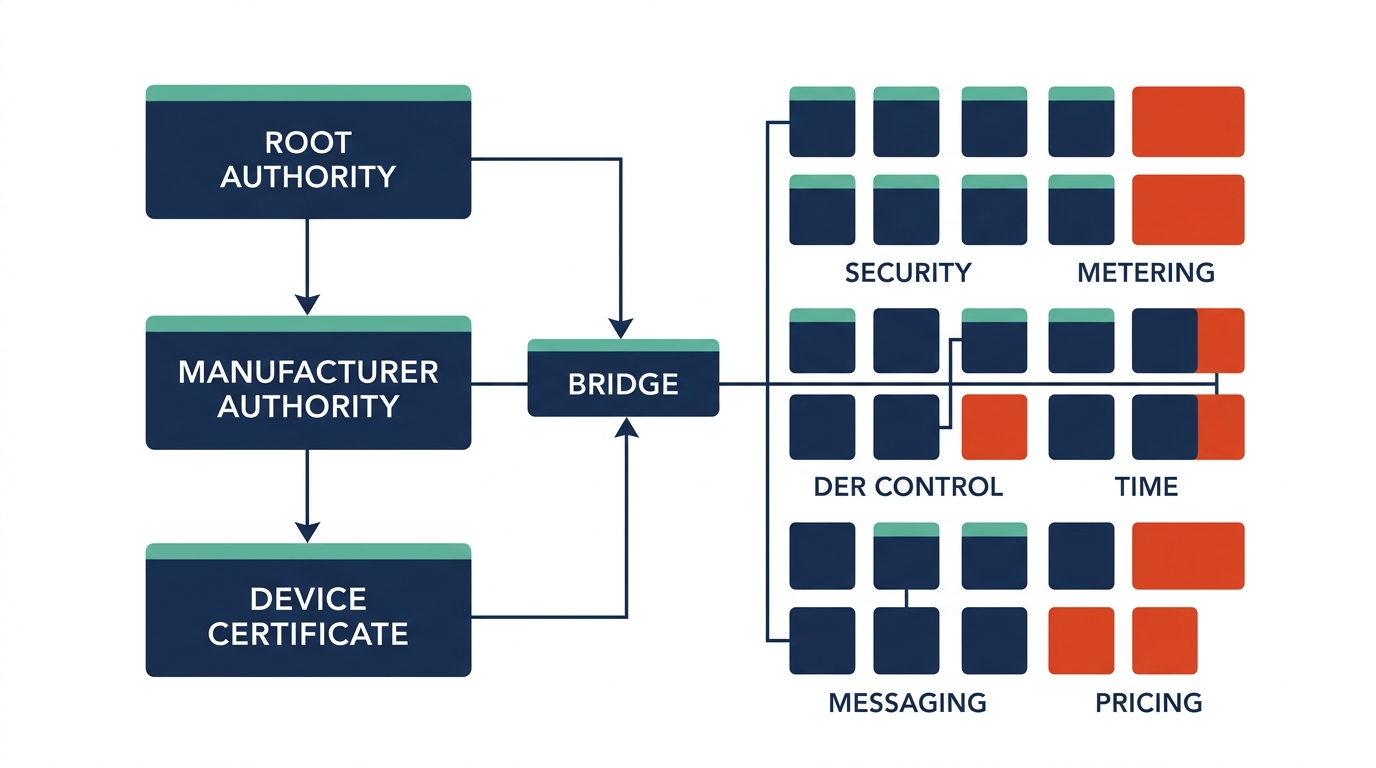
The most common mistake DER manufacturers make when approaching IEEE 2030.5 is underestimating its scope. CSIP compliance requires implementing roughly 20 of the standard’s 30+ function sets. This isn’t just the DER control function set. It includes time synchronization, device registration, metering, pricing, messaging, and the full security stack. Teams that approach IEEE 2030.5 as a thin protocol adapter built on top of existing firmware discover, usually mid-project, that the standard demands a significantly deeper architectural integration.
PKI, Edge Cases, and the Compliance-Readiness Gap
The IEEE 2030.5 security model mandates a three-tier Public Key Infrastructure (PKI) hierarchy: SERCA (Smart Energy Root CA) at the top, Manufacturer CA in the middle, and Manufacturer-Installed CA at the device level. Getting this certificate chain right, including provisioning, validation, and handling indefinite-validity certificates, consistently consumes more engineering time than the protocol logic itself.
Then there are the edge cases. Overlapping DERControl events, DefaultDERControl updates arriving mid-event, clock synchronization failures under poor network conditions: these scenarios are well-specified in the CSIP Implementation Guide but frequently missed during initial development. A device can pass IEEE 1547.1 interoperability testing and still fail in production, because IEEE 1547.1 does not include security testing. Passing certification and being production-ready are different milestones.
In a recent IEEE 2030.5 certification engagement, a battery storage manufacturer achieved full CSIP certification in eight weeks using an accelerator approach. The compressed timeline wasn’t about cutting corners; it was about starting with an architecture that already accounted for the function sets, PKI hierarchy, and edge cases that trip up from-scratch implementations.
CSIP 3.0 Is Coming — Is Your Implementation Ready?
The IEEE 2030.5-2023 standard, published in December 2024, introduced refinements to security and interoperability. The IEEE 2030.5 Ecosystem Steering Committee is actively shaping the next phase. CSIP 3.0, expected to enter development with global stakeholder participation, will align with the 2023 revision and incorporate lessons from field deployments across multiple jurisdictions.
For manufacturers who built a minimal CSIP layer just to pass certification, CSIP 3.0 represents a potential rebuild. For those who invested in a full-stack architecture, it represents an upgrade. The difference between a six-month re-architecture project and a configuration update depends entirely on how deeply the initial implementation embraced the standard’s resource model.
One Protocol, Expanding Geography, Compounding Complexity
The trajectory of IEEE 2030.5 over the next two to three years points in one direction: more jurisdictions, richer profiles, and deeper integration requirements. California is tightening. Australia is expanding. The V2G profile is maturing. CSIP 3.0 is on the horizon. And three-quarters of US states have adopted the interconnection standard that puts IEEE 2030.5 on every utility’s shortlist.
For DER manufacturers, the strategic calculus is straightforward. The cost of a proper IEEE 2030.5 architecture is fixed and front-loaded. The cost of minimum-viable compliance is recurring and compounding: with each new jurisdiction, each profile extension, and each standard revision, a thin protocol layer requires rework that a well-architected implementation absorbs.
The protocol certification landscape is only getting more complex. The OEMs that treat IEEE 2030.5 as an architecture decision rather than a compliance checkbox will be the ones that enter new markets in weeks, not quarters.
Frequently Asked Questions
Compliance means passing a certification test. Readiness means your implementation works reliably in production across varying grid conditions, utility configurations, and firmware environments. IEEE 1547.1 interoperability testing, for example, does not include security testing or validate certificate management. A device can be “compliant” and still fail when deployed at scale. True readiness requires a full-stack architecture that handles PKI certificate management, edge cases like overlapping control events, and graceful degradation under network failures.
Using an accelerator-based approach with pre-built protocol components, certification-ready status can be achieved in six to eight weeks. From-scratch implementations typically take six to twelve months or longer, depending on team expertise and the complexity of the device’s existing firmware. The timeline difference comes down to whether the engineering team is solving already-solved protocol problems or building on proven, pre-certified components.
CSIP 3.0 is the next major revision of the Common Smart Inverter Profile, the application-level specification that defines how DERs use the IEEE 2030.5 standard for grid communication. The CPUC directed that SunSpec Alliance would develop test procedures while IEEE would develop the CSIP 3.0 specification itself. Development is expected to begin with broad stakeholder participation. CSIP 3.0 will align with the IEEE 2030.5-2023 revision and incorporate field deployment lessons from US and international implementations.