The Complete Guide to CSIP: What It Is, How Certification Works, and Why It Matters Beyond California
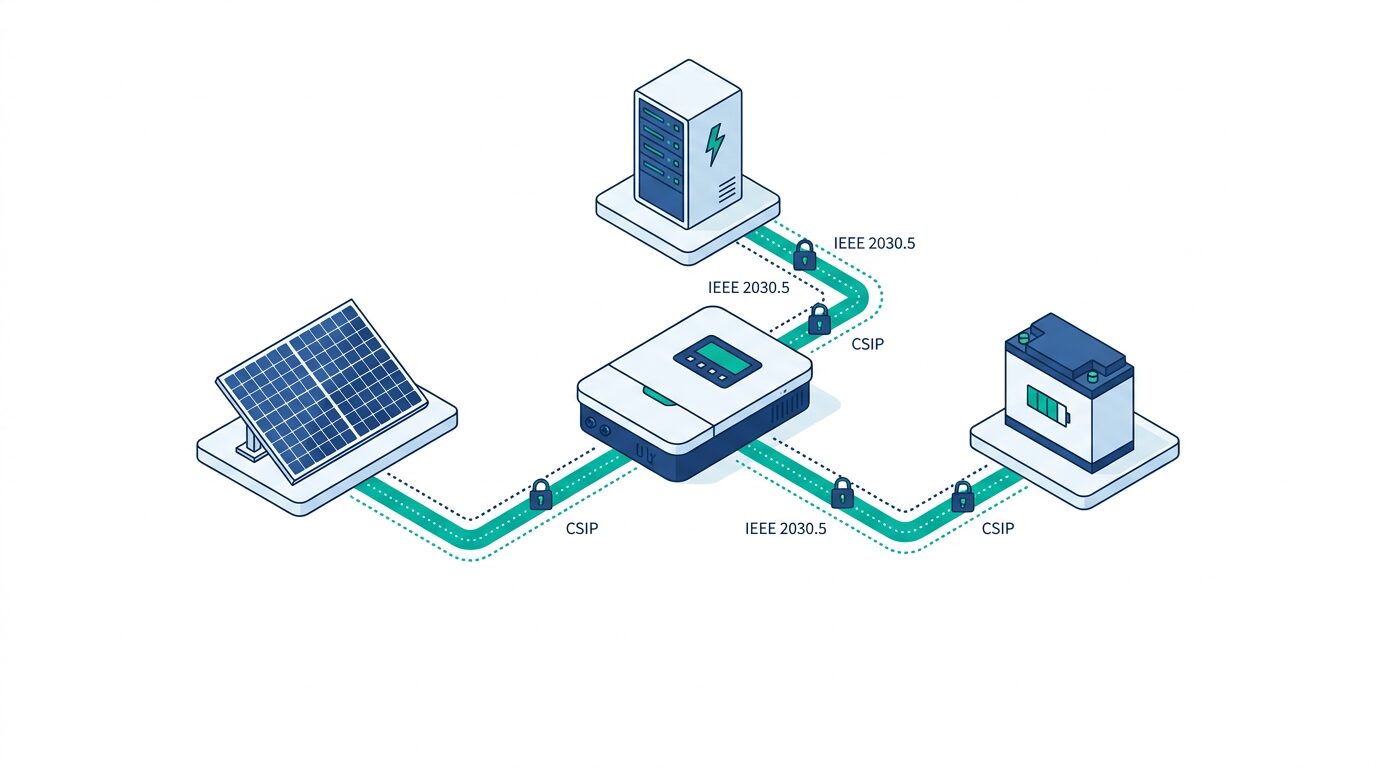
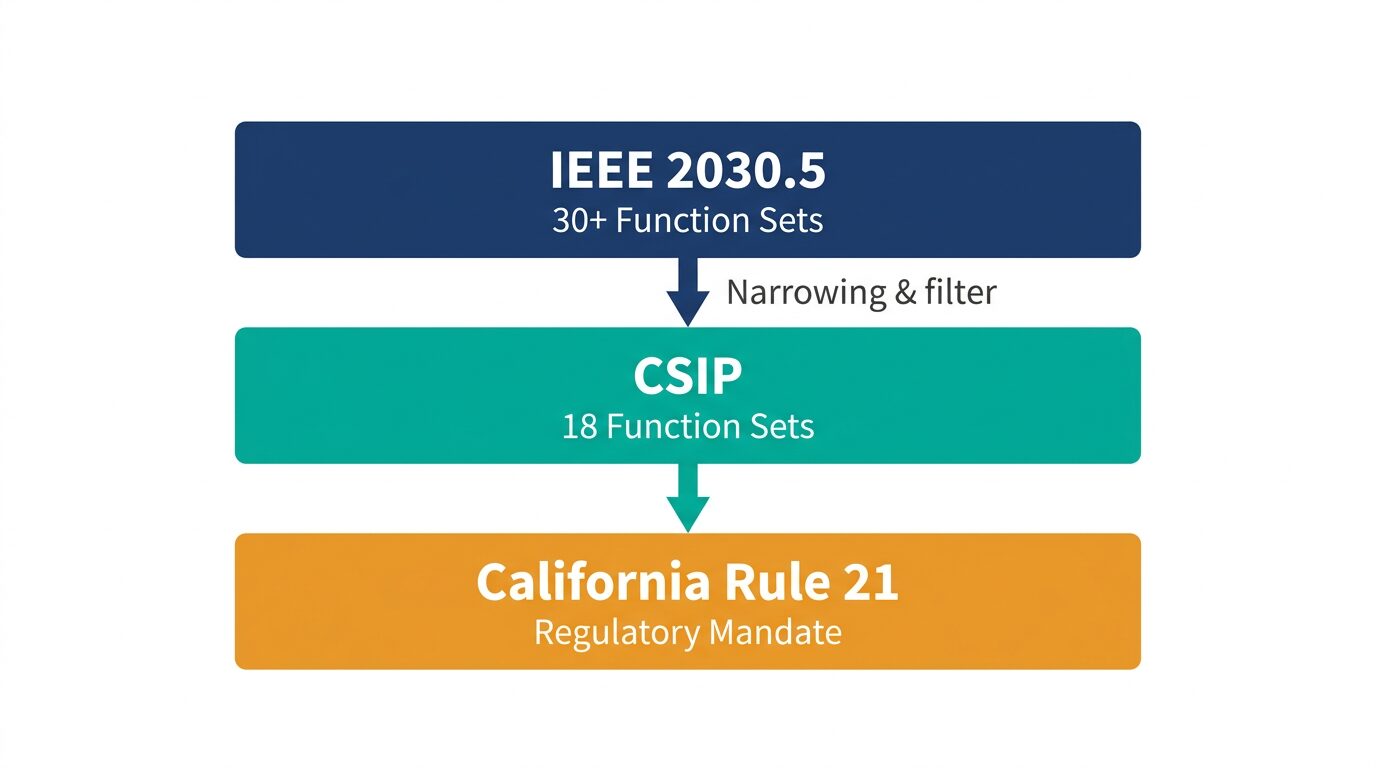
If you’ve been told your smart inverter needs IEEE 2030.5 compliance for the California market, you’ve probably encountered CSIP — the Common Smart Inverter Profile. What you may not have been told is that CSIP is not IEEE 2030.5. It is a strict subset: 18 of the protocol’s 30+ function sets, selected and profiled specifically for DER interconnection under California Rule 21. Understanding that distinction — and the architecture, certification process, and global expansion that follow from it — is the difference between a compliant product and a delayed market entry.
CSIP Is Not Just Another Acronym
The energy industry has a naming problem. IEEE 2030.5, SEP 2.0 (its legacy name), CSIP, CSIP-AUS, Rule 21, Rule 14H — these terms get used interchangeably in sales conversations and technical documentation, but they represent distinct layers of a standards hierarchy.
IEEE 2030.5 is the communication protocol. Published by the IEEE Standards Association, it defines over 30 function sets for smart energy devices — covering everything from metering and pricing to DER control and demand response. The protocol uses RESTful communication over HTTPS with TLS 1.2, XML-based data payloads, and a mandatory PKI (Public Key Infrastructure) model for device authentication. The most recent revision, IEEE 2030.5-2023, added function sets for electric vehicle charging and refined DER monitoring capabilities.
CSIP (Common Smart Inverter Profile) is an implementation guide. Developed by SunSpec Alliance in collaboration with the California Public Utilities Commission (CPUC), CSIP selects 18 of IEEE 2030.5’s function sets and specifies exactly how they must be implemented for smart inverter interconnection. CSIP does not add new capabilities — it constrains the protocol to a specific, testable subset.
California Rule 21 is the regulatory mandate. Since June 2020, all distributed energy resources (DERs) interconnecting with California’s three investor-owned utilities — PG&E, SCE, and SDG&E — must communicate via IEEE 2030.5 using the CSIP profile. No CSIP certification means no grid interconnection in the largest DER market in the United States.
The hierarchy continues expanding. Hawaii Rule 14H adopted similar IEEE 2030.5 requirements. Texas utilities including AEP Texas are running IEEE 2030.5 pilots under the ERCOT ADER program. Utah’s Rocky Mountain Power Wattsmart program requires the protocol. And Australia created its own adaptation — CSIP-AUS — which becomes mandatory across multiple states from July 2026. CSIP 3.0 is currently in development, targeting alignment with IEEE 2030.5-2023 and expanded support for battery storage and EV integration.
What started as a California-only requirement is becoming the global communication standard for grid-connected DERs. Teams that build for regulatory compliance today are positioning their products for every market adopting these standards tomorrow.
How the Architecture Actually Works
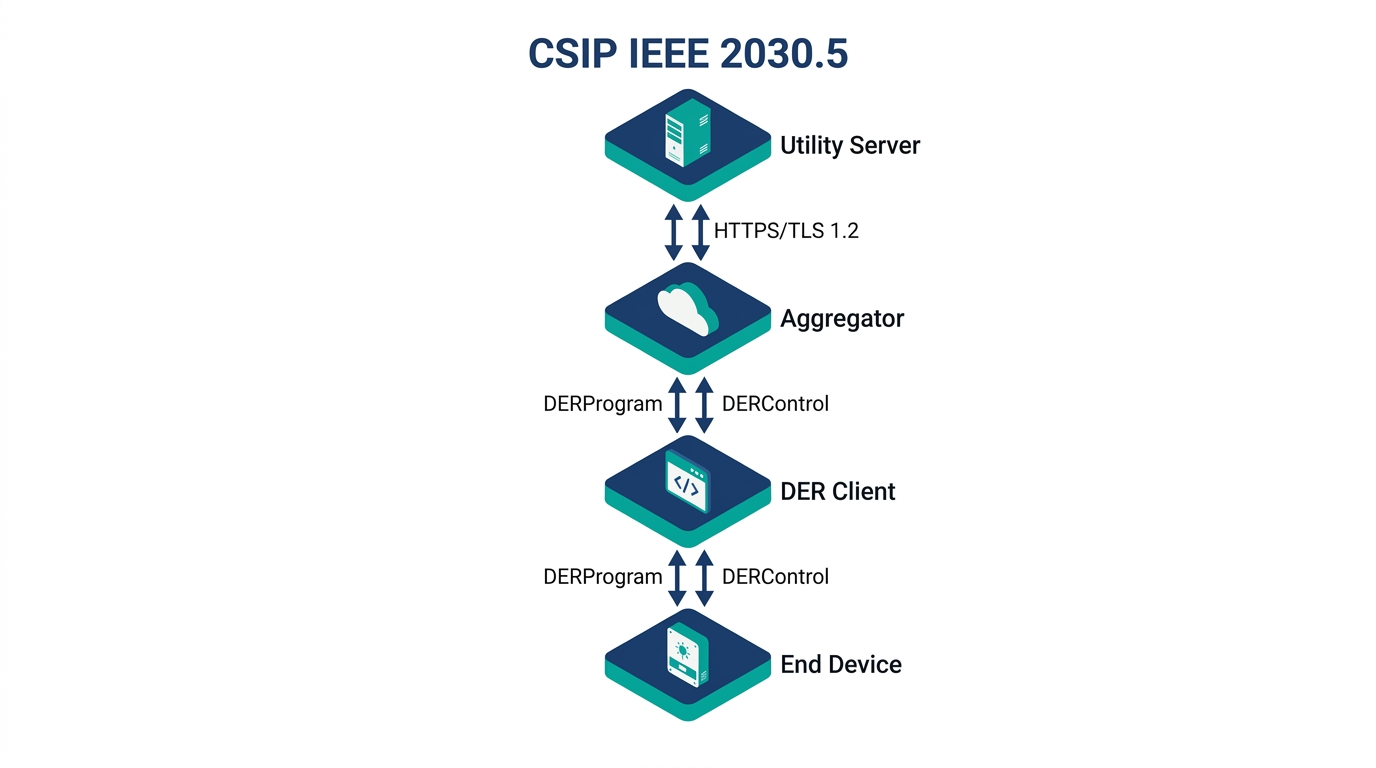
CSIP defines four primary roles in the communication architecture:
Utility Server — the top-level entity, typically operated by the investor-owned utility (PG&E, SCE, SDG&E). It hosts the DER program definitions, publishes DER control events, and maintains the device registry.
Aggregator — an intermediary that manages a fleet of DER devices on behalf of the utility. Aggregators receive commands from the utility server and relay them to individual devices. In California’s implementation, SunSpec-certified aggregation server operators handle this layer.
DER Client — the software component running on or near the DER device that communicates with the utility server or aggregator. The client implements the CSIP function sets, handles PKI authentication, and executes grid control commands.
End Device — the physical hardware: inverters, battery systems, EV chargers, or other DER equipment.
Communication follows a mandatory polling model. DER clients periodically poll the utility server or aggregator for new control events rather than receiving push notifications. This design trades latency for reliability — polling ensures that devices recover gracefully from connectivity interruptions without missing critical commands. For teams accustomed to WebSocket or event-driven architectures, the polling model feels unfamiliar, but it reflects the grid’s requirement for deterministic, fault-tolerant communication. For a deeper analysis of how IEEE 2030.5 integrates with fleet operations, see V2G readiness and the DSO mandate.
The data model follows a hierarchy: DERProgram → DERControl → DefaultDERControl. A DERProgram represents a utility’s operational program. DERControl events are time-bound commands within that program (e.g., “limit power export to 50% from 2:00 PM to 6:00 PM”). DefaultDERControl defines the fallback behavior when no active event is present — a critical safety mechanism that prevents uncontrolled operation if communication is lost.
DER devices integrate through three primary methods: a native CSIP client embedded in the inverter firmware, a gateway device that bridges CSIP to SunSpec Modbus for legacy inverters, or a SCADA relay for industrial-scale installations.
The 18 function sets profiled by CSIP cover the essential grid services:
| Category | Function Sets | Purpose |
|---|---|---|
| Power Limiting | Max Generation, Max Export/Import | Cap active power output or export during grid congestion events |
| Voltage Support | Volt-VAR, Volt-Watt | Adjust reactive and active power based on local voltage levels |
| Frequency Support | Freq-Watt, Freq-Droop | Modulate power output in response to grid frequency deviations |
| Autonomous Functions | Connect/Disconnect, Ramp Rate | Control DER connection state and power ramp behavior |
| Monitoring | DER Status, DER Availability, Metering | Report device state, capacity, and production data to the utility |
| Program Management | DERProgram, DERControl, DefaultDERControl | Define operational programs, time-bound events, and failsafe defaults |
The Certification Pathway Nobody Explains Clearly
SunSpec Alliance serves as the CPUC-designated certification body for CSIP compliance. SunSpec manages the CSIP Implementation Guide, maintains the conformance test procedures, and authorizes the test labs that conduct formal certification testing.
Authorized Test Labs include UL Solutions, Intertek, CSA Group, and QualityLogic. These labs conduct the conformance tests that validate a DER client’s CSIP implementation against the SunSpec test procedures. The choice of lab affects scheduling more than outcome — all follow the same test specifications.
What testing actually involves. Certification validates three layers: protocol conformance (does the client implement the 18 function sets correctly?), functional behavior (does the DER execute control commands as specified?), and security compliance (does the PKI implementation meet the certificate hierarchy requirements?). Test cases cover normal operation, edge cases (overlapping events, rapid event sequences), and failure modes (communication loss, certificate expiry).
Timeline expectations. A well-prepared team can achieve CSIP certification in 8-16 weeks from development start. The lower end of that range is realistic for teams using pre-built protocol libraries with established test coverage. The upper end reflects teams building from scratch, encountering PKI challenges, or iterating through test failures. Codibly achieved IEEE 2030.5 CSIP certification for California Rule 21 in eight weeks using accelerator components with pre-certified protocol modules.
Common failure points. The areas where teams lose the most time during certification:
PKI certificate hierarchy. CSIP mandates a three-tier PKI model: SERCA (Smart Energy Root CA) at the top, Manufacturer CA (MCA) in the middle, and Manufacturer-Installed CA (MICA) at the device level. Getting this hierarchy right — including certificate provisioning, chain validation, and handling of indefinite-validity certificates — consistently consumes more engineering time than the protocol implementation itself.
Polling edge cases. The mandatory polling model creates timing-sensitive scenarios that catch teams off guard. What happens when a poll returns multiple overlapping DERControl events? What happens when a DefaultDERControl update arrives mid-event? These edge cases are well-specified in the CSIP Implementation Guide but frequently missed during initial development.
DefaultDERControl failsafe behavior. If a DER client loses communication with its server, it must revert to the most recently received DefaultDERControl settings — not shut down, not continue the last active event, and not operate without constraints. Teams that implement this incorrectly face certification failure on safety-critical test cases.
CSIP-AUS: Why Australia Is Moving Faster Than Anyone Expected
Australia’s adaptation of CSIP — CSIP-AUS — addresses a problem that California is only beginning to face: what happens when rooftop solar penetration exceeds grid capacity during the middle of the day?
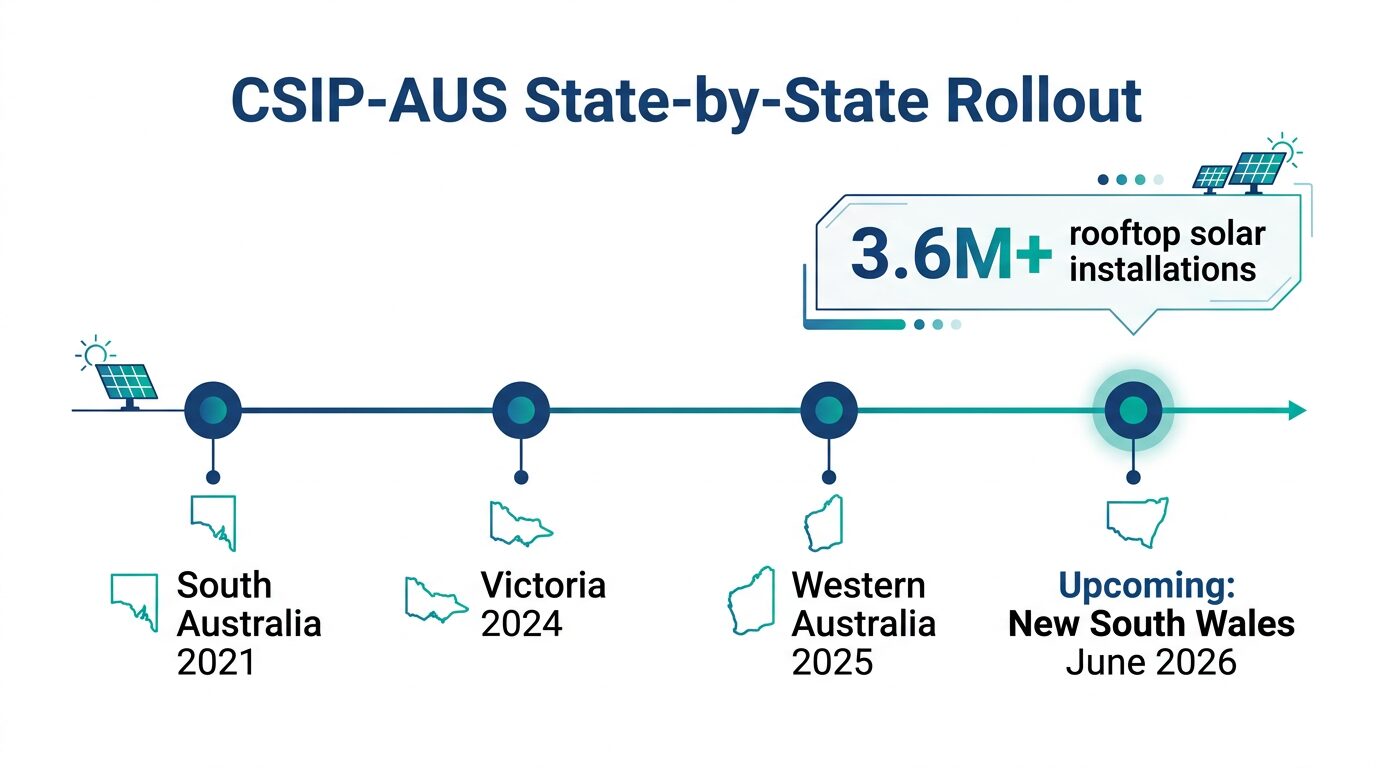
With over 3.6 million rooftop solar installations (the highest per-capita solar adoption in the world), Australia’s distribution networks regularly experience reverse power flows that exceed transformer and feeder capacity. The result: involuntary curtailment, voltage instability, and in extreme cases, grid emergency events that require mass inverter disconnection.
CSIP-AUS introduces two capabilities that go beyond the California CSIP profile:
Dynamic Operating Envelopes (DOE). Instead of static export limits, DOE allows distribution network service providers (DNSPs) to set real-time import and export limits per connection point. A household solar system might be allowed to export 5 kW at 10:00 AM when local demand is high, but only 1.5 kW at noon when every rooftop on the street is generating at peak. DOE turns the grid constraint from a fixed ceiling into a dynamically managed resource.
Emergency Backstop Mechanism. In grid emergency scenarios, CSIP-AUS enables DNSPs to issue commands that override all other DER control settings — including local owner preferences — to prevent system-wide cascading failures. This capability was added after the South Australia grid events of 2016 and subsequent near-miss incidents demonstrated the need for centralized emergency control over distributed generation.
The rollout is accelerating state by state. South Australia mandated CSIP-AUS for new solar installations starting in 2021. Victoria followed in 2024. Western Australia incorporated the standard in 2025. New South Wales requires compliance from June 2026. The Australian National University (ANU) launched a national testing service in October 2025 to support certification at scale.
CSIP-AUS v1.2 is the current mandatory version. Version 1.3 is in development with expanded battery communication capabilities and dynamic pricing integration — features that align with Australia’s push toward time-of-use tariffs and virtual power plant enrollment.
For DER manufacturers selling globally, CSIP-AUS compliance is no longer optional for the Australian market. And because it extends the same IEEE 2030.5 foundation as California’s CSIP, teams that have implemented one profile are well-positioned to support the other.
When to Use IEEE 2030.5 vs. OpenADR vs. SunSpec Modbus
The three protocols serve different layers of the energy stack, and confusing their roles is one of the most common mistakes in DER platform architecture.
IEEE 2030.5 / CSIP handles DER-to-utility communication for grid interconnection. It tells an inverter how to behave: what power to export, what voltage to maintain, when to disconnect. It is mandatory in California (Rule 21), Hawaii (Rule 14H), expanding across the US West, and adopted in Australia via CSIP-AUS.
OpenADR handles demand response signaling between utilities or aggregators and load-side resources. It tells a device when to curtail and by how much, within the context of a demand response program. It operates at a higher abstraction level than IEEE 2030.5 and targets different use cases. For a detailed comparison of OpenADR certification requirements, see DR protocol certification as market access.
SunSpec Modbus handles local device communication. It is the standard for on-site monitoring and control of inverters — reading production data, setting operational parameters, and integrating with SCADA systems. It operates over local networks (RS-485, TCP/IP) and does not communicate with external utility systems.
| Criterion | IEEE 2030.5 / CSIP | OpenADR 2.0b / 3.x | SunSpec Modbus |
|---|---|---|---|
| Primary Use | DER grid interconnection and control | Demand response signaling | Local device monitoring |
| Communication | HTTPS/TLS 1.2, mandatory polling | HTTP(S), push/pull events | RS-485 / TCP/IP (local) |
| Scope | Utility ↔ DER device | Utility/Aggregator ↔ Load resource | On-site / Local network only |
| Key Geography | CA, HI, TX, UT, AU | US-wide, expanding globally | Universal (local standard) |
| Regulatory Mandate | CA Rule 21, HI Rule 14H, CSIP-AUS | CA SB 49, utility program requirements | No regulatory mandate |
| Best For | Smart inverters, battery systems, DER fleets | DR programs, load flexibility, aggregation | Inverter monitoring, on-site SCADA |
You may need more than one. A battery storage system participating in a California utility’s demand response program might require IEEE 2030.5/CSIP for grid interconnection compliance, OpenADR for DR program enrollment, and SunSpec Modbus for local SCADA integration. These protocols are complementary, not competing. The architecture question is not “which one” but “which combination” — and how to manage the interaction between control signals from different sources.
What Most Teams Get Wrong
After supporting multiple IEEE 2030.5 certification programs, a pattern of recurring mistakes emerges. These are not edge cases — they are the default failure modes for teams approaching CSIP implementation for the first time.
Underestimating the learning curve. Even the “reduced” 18-function-set CSIP profile represents significant implementation complexity. Each function set has its own data models, validation rules, and interaction patterns. Teams that estimate CSIP as “just another REST API” typically revise their timelines by 2-3x after the first sprint.
PKI at scale. CSIP’s PKI model uses certificates with indefinite validity — they do not expire. This simplifies initial deployment but creates long-term challenges around certificate revocation, key compromise response, and fleet-wide credential rotation. Teams that defer PKI architecture decisions to “after the first deployment” invariably face operational pain when managing certificates across thousands of devices.
Confusing compliance with operational readiness. A SunSpec-certified DER client proves protocol conformance. It does not prove that your device will operate correctly when connected to a specific utility’s aggregation server. Each California IOU — PG&E, SCE, SDG&E — maintains its own interconnection handbook with utility-specific requirements, testing procedures, and onboarding workflows. Certification is the starting line, not the finish line. For a deployment-topology view of where the protocol actually runs once certification is done, see where IEEE 2030.5 lives in production.
Ignoring IOU differences. PG&E’s aggregation server behavior differs from SCE’s, which differs from SDG&E’s. Polling intervals, event priorities, DefaultDERControl handling, and certificate enrollment processes all vary. A DER client certified against the SunSpec test suite may still require utility-specific adaptations before it can interconnect with each IOU.
Polling overhead for large fleets. When managing hundreds or thousands of DER devices, the cumulative polling traffic between DER clients and the utility server becomes a scalability concern. Efficient polling strategies — adaptive intervals, conditional requests, batch status reporting — are essential for fleet-scale operations but rarely addressed during initial implementation.
These challenges are exactly why Codibly’s IEEE 2030.5 Accelerator exists: pre-certified protocol modules, PKI infrastructure templates, and utility-specific integration guides that compress the implementation timeline from months to weeks. For teams evaluating their broader protocol strategy, the energy standards implementation overview provides context on how IEEE 2030.5 fits alongside OpenADR, OCPP, and other energy protocols.
Frequently Asked Questions
IEEE 2030.5 is the full protocol standard with 30+ function sets covering DER communication. CSIP (Common Smart Inverter Profile) is an implementation guide that selects 18 of those function sets specifically for smart inverter interconnection under California Rule 21. Think of IEEE 2030.5 as the language and CSIP as the dialect required for California compliance.
Typical timeline is 8-16 weeks from development start to SunSpec certification, depending on your team’s familiarity with the protocol and the complexity of your DER architecture. Codibly has completed IEEE 2030.5 certification for California Rule 21 in 8 weeks using pre-built accelerator components. The main time sinks are PKI certificate setup, conformance test iteration, and aggregator integration testing.
No. While California Rule 21 was the first mandate, IEEE 2030.5 via CSIP is now required or adopted in Hawaii (Rule 14H), Texas (AEP Texas, ERCOT ADER Pilot), Utah (Wattsmart), and South Korea. Australia has its own adaptation (CSIP-AUS) becoming mandatory across multiple states from July 2026. The protocol is becoming the global default for DER-to-grid communication.
Pre-certified code is a codebase that has already passed formal testing inside other products, so it is built to pass again. Certification is something else. An accredited laboratory tests your product, and the certificate is issued for that product under your name. No supplier is certified on your behalf. Codibly is a SunSpec Alliance Authorized Test Laboratory, so the conformance testing and the implementation can sit with one partner, but the certificate still belongs to your product. In an RFP, ask which laboratory runs the tests, whose name goes on the certificate, how many times the supplier’s code has been through the process, and who pays if a test fails.
Treat it as a re-registration, not a certificate swap. You take certificates from the new authority, your aggregator identifier changes, the server address changes, and your devices have to find the utility server again and register. Ask the network for an overlap window in which old and new credentials both work, and migrate in batches. The risk is not the cryptography. It is losing sight of devices that never finish the re-registration.