Commercial and Industrial Energy Management Systems

For most of its history, commercial and industrial energy management software did one thing: meter the plant. Track where the kilowatt-hours go, benchmark against last year, flag the line that’s drifting, trim the bill. For a site whose only relationship with energy is consumption, that’s a reasonable tool and a reasonable purchase. But the commercial or industrial site stopped being a pure consumer. It now has rooftop or carport solar, a battery in the yard, EV chargers filling up at shift change, and loads it can shift or shed — plus demand charges that punish its peaks and demand-response programs that pay for its flexibility. The question is no longer just “what did we use?” It’s “what should we do with what we can flex?” That second question is an orchestration problem, and it’s not the one the metering platforms were built to answer.
Two Jobs C&I Energy Software Is Asked to Do
When a facilities or operations team shops for commercial energy management solutions, they’re usually trying to fill one of two very different roles without realizing they’re different. The first is monitoring: sub-metering, consumption analytics, ISO 50001 reporting, anomaly detection — the software that tells you the chiller plant is your biggest load and last month’s bill spiked because of it. The industrial-automation vendors do this well, and for a single site focused on efficiency, buying it is the right call. The second is orchestration: deciding, in real time, what the site’s flexible assets should do — charge the battery from midday solar, hold it for the 4 p.m. demand-charge peak, throttle EV charging, or bid the whole package into a demand-response event. Monitoring tells you what happened; orchestration changes what happens next. Most “C&I EMS” comparisons quietly assume the first job. Sites that have flexible assets are paying for the second.
| Monitoring (the plant) | Orchestration (the site) | |
|---|---|---|
| Core job | Track and report consumption | Decide what flexible assets do next |
| Data | Sub-meters, bills, equipment telemetry | Telemetry + tariffs + DR signals + forecasts |
| Decision | Flag waste, benchmark, report | Shift load, dispatch storage, manage peaks |
| Who sells it | Industrial-automation vendors | Control-layer / custom integration |
| Right when | Efficiency is the goal | The site has flexible assets + tariff exposure |
The C&I Site Stopped Being a Pure Consumer
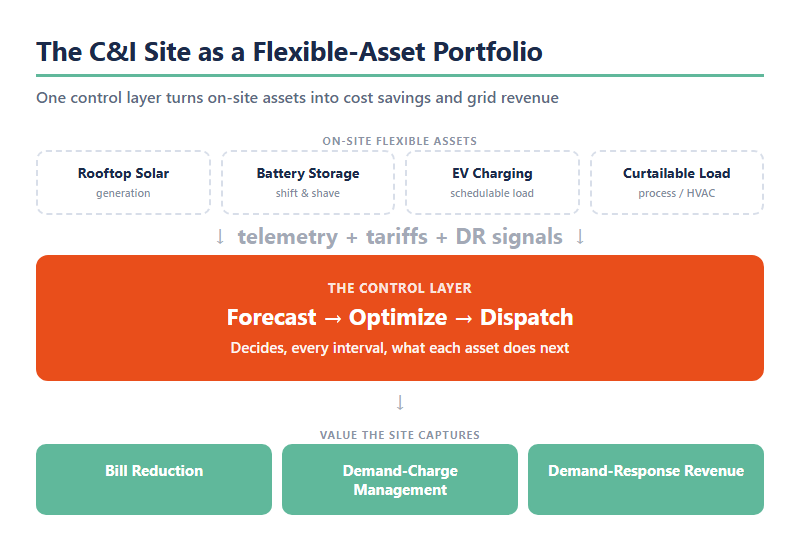
The reason orchestration matters now is that the commercial and industrial site has quietly turned into a small portfolio of energy assets. Behind-the-meter solar offsets daytime load and sometimes exports. A battery can arbitrage time-of-use rates and, more importantly for many C&I bills, shave the monthly demand charge that can account for a large share of what the site pays. EV charging — for a delivery depot, a corporate fleet, or employee parking — is a fast-growing, schedulable load that can either wreck a demand peak or absorb surplus solar, depending entirely on whether software is deciding when it runs. And curtailable process load plus all of the above can be packaged into demand-response participation that turns the site’s flexibility into a revenue line. None of that is visible to a platform built to chart consumption. Each asset is a decision, and the decisions interact — which is the definition of an orchestration problem, not a reporting one.
The Orchestration Layer for a Commercial or Industrial Site
The orchestration layer runs the familiar loop — ingest, forecast, decide, settle — scoped to a C&I site’s economics. It ingests telemetry from the solar inverter, the battery, the chargers, and the meter; it forecasts site load, solar output, and the tariff and DR signals coming at it; it decides, interval by interval, how the assets cooperate to minimize cost and capture revenue; and it settles the result against the utility bill and any program payments. The highest-value decision for most C&I sites is demand-charge management — using storage and load flexibility to flatten the peaks the utility prices most aggressively — closely followed by demand-response dispatch. The demand-response slice has its own software depth, which is why a serious C&I program leans on commercial and industrial demand response software for enrollment, dispatch, and settlement, while battery storage dispatch handles the asset that does most of the physical work. The orchestration layer is what ties those together into one decision for the site, and it’s the layer the monitoring platforms leave to you.
Build, Buy, or Integrate for C&I
The decision follows the same logic as the rest of the energy-management category, scaled to a site. If your goal is efficiency and reporting across one facility, buy an off-the-shelf industrial energy management software platform — the monitoring category is mature and rebuilding it is waste. If you operate a portfolio of sites with mixed flexible assets, standardized but not identical, the realistic path is integrate: keep the monitoring you have and add the orchestration layer that makes the demand-charge and DR decisions across them. And if flexibility is a material revenue line — multiple sites, storage at scale, DR participation, EV depots — the orchestration logic is your margin and belongs in software you control, which is where custom energy software development earns its place, sitting above the monitoring tools rather than replacing them.
| Site profile | Path | What you trade | When it pays back |
|---|---|---|---|
| Single facility, efficiency focus | Buy a factory/commercial EMS | Cross-asset orchestration | Immediately — monitoring is solved |
| Portfolio of sites, mixed assets | Integrate an orchestration layer | Single-vendor simplicity | When demand charges + DR span sites |
| Storage at scale + DR revenue | Build the orchestration layer | Time-to-deploy | When flexibility is a real revenue line |
The Question Moved From “What Did the Plant Use?” to “What Should the Site Flex?”
Commercial and industrial energy management software grew up answering the consumption question, and for a site that only consumes, that’s still the right tool. But the modern C&I site has assets it can move — solar, storage, charging, curtailable load — and demand charges and DR revenue that reward moving them well. Choosing software in 2026 means deciding how that orchestration happens: inside a monitoring platform that wasn’t built for it, inside an integration layer you add on top, or inside logic you own because the flexibility is worth real money to you. That’s the conversation Codibly’s custom energy software work starts from — not another consumption dashboard, but the layer that decides what your site does with what it can flex.
Frequently Asked Questions
It’s software that helps commercial and industrial sites manage energy — historically by metering and reporting consumption, and increasingly by orchestrating on-site flexible assets like solar, storage, EV charging, and curtailable load to cut costs and earn grid revenue. The monitoring role and the orchestration role are different jobs often sold under the same name.
The software overlaps, but the load profiles and drivers differ: industrial sites have large, often continuous process loads where efficiency and power quality dominate, while commercial sites (offices, retail, logistics) are shaped more by HVAC, lighting, occupancy, and increasingly EV charging. Both are converging on the same need — orchestrating flexible assets against demand charges and demand-response revenue.
Demand charges bill a site for its highest power draw in a period, not just total energy — and for many C&I sites they’re a large share of the bill. Demand-charge management uses storage and flexible load to flatten those peaks, and it’s one of the highest-value decisions a C&I orchestration layer makes.
Buy an off-the-shelf platform when efficiency and reporting for a single facility is the goal. Integrate an orchestration layer when you run a portfolio of sites with mixed flexible assets. Build when storage at scale and demand-response revenue make flexibility a material margin line that should live in software you control.
C&I energy management is the site-level orchestration layer; demand-response software handles program enrollment, dispatch, and settlement; battery storage software runs the dispatch of the asset that does most of the physical flexing. On a flexible C&I site they work together — the energy management layer decides, and the DR and storage layers execute.
contact us
Need expert guidance on your next energy project?
Reach out to us and discover how Codibly can offer tailored solutions to drive your business.