Commercial & Industrial Demand Response Software: C&I Integration with Solar, Storage & EV Charging

“Commercial demand response” returns search results that overwhelmingly answer one question — how do I enroll in my utility’s program? — and almost none describe what software a C&I facility actually needs to participate intelligently in 2026. The integration problem is the part that’s missing. A modern commercial or industrial site is no longer a single curtailable load: it’s an on-site solar array under a power-purchase agreement, a behind-the-meter battery, an EV charging fleet, and process loads that can’t all be treated the same way during a dispatch event. Standard utility-side DRMS doesn’t know your solar PPA carve-out, who has discharge authority over your storage, or how to interrupt EV charging mid-session without breaking the driver experience. This guide describes the commercial demand response software & platform architecture C&I facility energy managers, microgrid operators, and curtailment service providers are actually procuring or building — the software layer between the ISO/utility signal and the heterogeneous DERs already deployed inside the fence.
Commercial vs Industrial Demand Response: Why The Software Stack Diverges
The “C&I” shorthand papers over two operating realities that demand different software stacks. Commercial demand response typically means retail buildings, offices, multi-tenant campuses, and light commercial — small per-site MW, large fleet, fast control, and program participation through capacity bidding (PJM Capacity Performance), day-ahead notification (CAISO ELRP), or behavioral response. Industrial demand response means manufacturing, cold storage, cement, water/wastewater, and process-coupled loads — large per-site MW, slow control, and program participation through ancillary services, frequency response, or economic curtailment.
PJM’s 2026/2027 Base Residual Auction cleared at a record $120,147/MW-year, with about 5% of the cleared resource mix coming from demand response. ERCOT continues to procure four ERS service types (WS/Non-WS at 10 and 30-minute response) for residential, commercial, and industrial participants. CAISO ELRP runs May–October events at $2/kWh through October 2027. The economics for C&I participation are the strongest they’ve been in a decade — and that pressure is what’s exposing the software gap.
The C&I Shorthand Exists For A Reason — And Where It Breaks Down
A 30 MW manufacturing plant and a 30-store retail chain can both bid 5 MW into a capacity market, but the software stack required to deliver that 5 MW reliably is fundamentally different. Manufacturing requires SCADA/PLC integration, process-aware curtailment logic, and baseline customization that handles shift schedules. Retail requires multi-tenant, multi-site fleet management and a control plane that can dispatch hundreds of small assets in seconds. Treating them as one buyer profile is how procurement teams end up with software that fits neither.
Program Tariff Structure Drives The Software Requirements
Capacity programs reward availability — your software needs to prove the asset *could have* curtailed. Energy programs reward actual reduction — your software needs sub-minute telemetry and clean baselines. Ancillary-service programs reward speed — your software needs sub-second control authority and protocol-certified hardware. The procurement question for commercial demand response software starts here, not at “which vendor is best.”
The First Integration Problem: Solar PPA Carve-Outs
On-site solar changes the math. The moment a C&I site has a behind-the-meter PV array — especially under a third-party power-purchase agreement — the DR software stops looking at a single curtailable meter and starts looking at two flows: facility consumption and solar generation. They cannot be treated the same way during a DR event.
Most PPAs include explicit carve-out language: the off-taker (the facility) is contractually obligated to consume the solar generation when produced, or compensate the developer for curtailed generation. A flat curtailment command that drops site demand below solar production creates “negative load” — site export — which depending on tariff and interconnection agreement can either unlock additional revenue or trigger PPA penalties. The software has to know the difference. This is exactly why the long-tail query demand response programs with industrial solar integration shows up in our search-console data — operators are looking for software that handles this, not generic DR enrollment.
Why Telemetry Must Read Inverter Output Separately From Net-Meter
Net metering tells you what crossed the utility meter. Inverter telemetry tells you what the array produced. During a DR event, the demand response management system has to disaggregate the two in real time so the curtailment is measured against the controllable load, not the net consumption. Most off-the-shelf C&I DRMS software treats the meter as the source of truth — which is fine until the array is producing 800 kW and the DR baseline calculation starts inflating performance.
PPA Carve-Out Clauses And What The Software Has To Enforce
Three contract patterns dominate: (1) full off-take with no curtailment rights, (2) curtailment with developer compensation, and (3) curtailment with shared upside on event-window arbitrage. The DR software has to encode which pattern applies, gate dispatch decisions accordingly, and surface the contractual constraint to the operator before they accept a curtailment commitment they cannot legally execute.
The Second Integration Problem: Behind-the-Meter Storage Discharge Authority
Battery storage changes the question from “how much can we curtail?” to “who decides when we discharge?” This is the part utility-side DRMS doesn’t answer — because for a utility-owned asset, the answer is obvious. For a customer-owned BESS participating in DR, it’s not.
Four authority models dominate in 2026. The right one depends on contract structure, OEM warranty terms, and whether the asset is participating in a single program or stacking revenue across capacity markets, energy arbitrage, and resilience.
| Authority model | Decision authority | Latency / control | Typical contract | Risk to facility |
|---|---|---|---|---|
| Facility-prioritized | Site operator retains final discharge authority; aggregator and ISO submit requests, facility approves or declines per event. | Highest latency (operator confirmation in the loop); manual override at any time. | Direct ISO/utility participation under a self-managed enrollment; no aggregator middleware. | Lowest dispatch reliability; missed events accumulate non-performance penalties. |
| Aggregator-prioritized | Curtailment service provider holds dispatch authority via a delegated control agreement; facility has manual override but defaults to aggregator decisions. | Sub-minute response; aggregator runs the dispatch optimizer. | Standard CSP contract (Voltus, CPower, Enel X NA, Enchanted Rock, Leap, Sunrun and adjacencies). | Facility loses fine-grained control over state-of-charge and OEM warranty cycle counts unless contract enforces them. |
| Market-prioritized | ISO/utility dispatch signal flows directly to the storage system via certified protocol (OpenADR 2.0b/3.0, IEEE 2030.5); facility and aggregator are non-blocking. | Sub-second response when required (frequency response, synchronized reserve); designed for ancillary-service participation. | Direct market participation with telemetry and control certified through the ISO. | Highest revenue ceiling; least operational flexibility outside event windows. |
| OEM-supervised | Battery OEM (Tesla, Fluence, Powin, Form Energy and adjacencies) gates discharge against warranty and safety constraints; ISO/aggregator/facility command flows through the OEM control plane. | Variable; depends on OEM API and warranty-cycle accounting. | OEM-bundled software-as-a-service or warranty-linked control agreement. | Predictable warranty preservation; reduced flexibility, less customizable dispatch logic. |
A device-agnostic IoT EMS for demand response programs handles all four authority models on the same control plane — translating the discharge command from whichever stakeholder holds priority into the OEM-specific API or Modbus/SunSpec endpoint required to actuate. Without that abstraction layer, a multi-OEM portfolio (Tesla + Fluence + Powin in the same site) becomes a bespoke integration project per asset.
Device-Agnostic IoT Abstraction Makes Multi-OEM Portfolios Manageable
OEM warranty terms are the constraint procurement teams forget about. Most BESS OEMs cap permitted cycles per year and depth-of-discharge per event; exceed them and the warranty voids. The DR software has to track cycle count, depth, and rest periods across the warranty window — not just the dispatch event. This is operational accounting, not control engineering, and it’s why purpose-built C&I DR software outperforms repurposed grid-scale DRMS for behind-the-meter portfolios.
The Third Integration Problem: EV Charging Mid-Session Interruption
EV charging is the newest C&I asset class to land in DR scope, and it has the worst UX failure mode. A flat curtailment command that pauses an active charging session at minute 45 of a planned 90-minute charge breaks driver expectations, triggers complaint volume, and — for fleet operators — can leave drivers stranded. The fix is software-side, not hardware-side.
OCPP 2.0.1’s SmartCharging profile is the protocol foundation: it lets the EV charging load management software drop a charger’s instantaneous rate without aborting the session. The DR software issues a “charge to no more than X kW” command, the charger throttles, the session continues, and the driver sees a slightly slower charge instead of a hard stop. This is the canonical pattern for demand response ev charging in commercial deployments — and it’s exactly what’s missing from utility-side DRMS that grew up assuming curtailable loads were HVAC and process equipment.
Soft Curtailment vs Hard Interrupt — And Why Drivers Churn
The query top-rated demand response software for industrial load shedding already surfaces in our search console — buyers are looking for this specifically. Soft curtailment respects the contract with the driver; hard interrupt does not. For workplace charging, where the driver returns hours later, soft curtailment is acceptable. For depot fleets, where the next shift depends on a full charge by 5:00 AM, even soft curtailment has to be reasoned against the duty cycle.
Workplace, Depot, and Public-Destination Charging Each Demand A Different DR Profile
Workplace and overnight depot charging tolerate aggressive flexibility. Public destination charging at retail or hospitality sites tolerates almost none — the customer paid to charge, and the merchant paid the CSMS/CPMS platform for that customer transaction. The DR software has to know which charger belongs to which use case and apply different curtailment policies accordingly.
The Coordination Layer: Multi-Asset Dispatch Across Solar + Storage + EV + Process Loads
The integration software’s hardest job is sequencing. When a 4 MW industrial campus with rooftop solar, BTM storage, and EV charging gets a 2-hour ELRP dispatch signal, what curtails first? The wrong answer destroys economics or trips a process; the right answer extracts the program payment without breaking anything else.
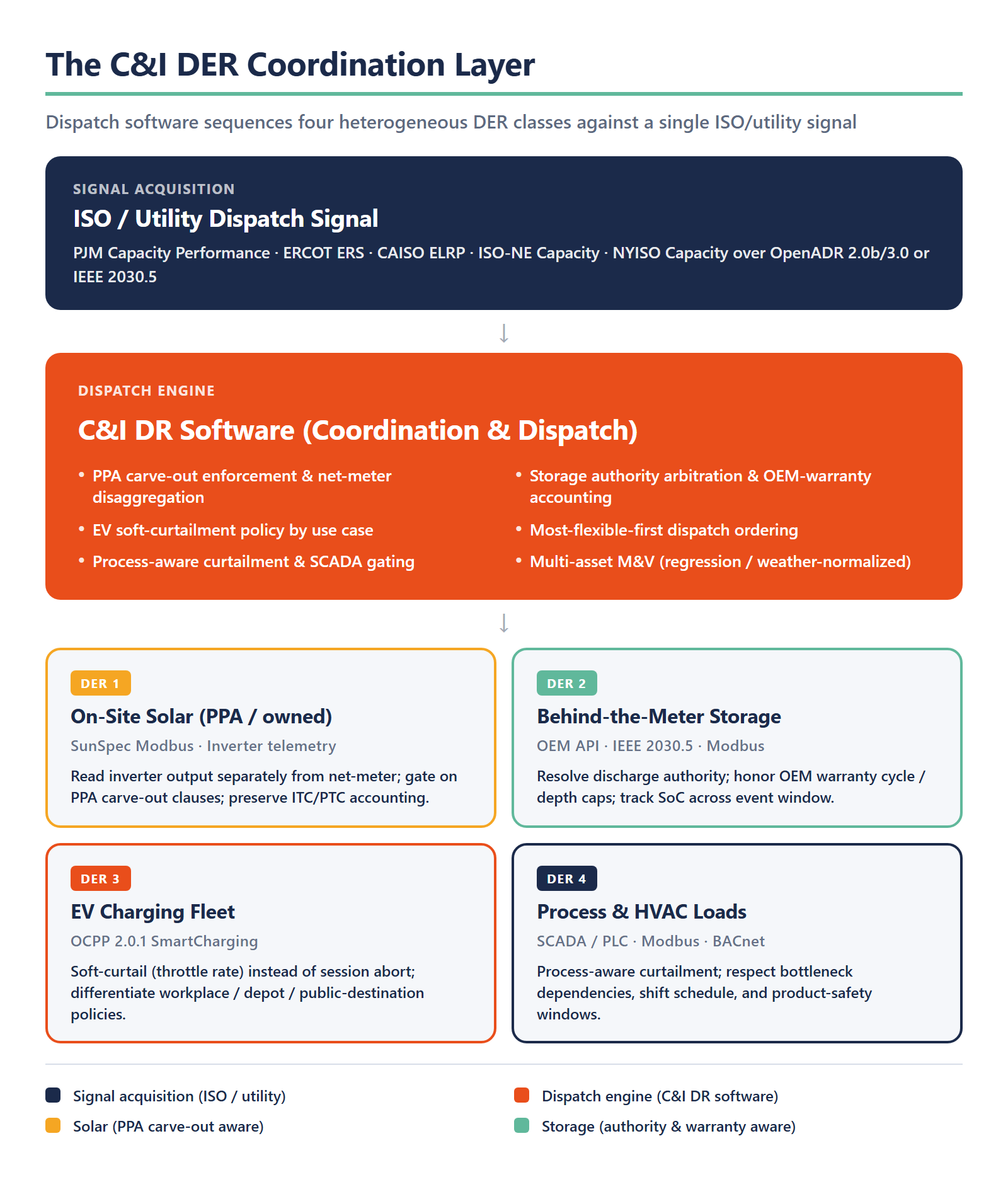
The dispatch ordering logic is where vendors differentiate. “Most-flexible-first” means start with assets that have the lowest restoration cost — typically EV charging soft curtailment and HVAC pre-cooling. “Lowest-cost-first” means start with assets where the marginal cost of reduction is lowest — often storage discharge during peak pricing. “OEM-warranty-aware” means the software respects each asset’s permissible cycle count for the year before pulling on it. Production-grade automated demand response programs implement at least two of these and let the operator switch policy by event class.
Dispatch Ordering: Why “Most-Flexible-First” Beats “Lowest-Cost-First” In Practice
Lowest-cost-first sounds optimal until the third event of the month, when the storage system has hit its monthly cycle ceiling and the only remaining flexibility is HVAC. Most-flexible-first preserves option value across the program window — at modest first-event cost — and is the policy most C&I energy managers prefer once they’ve operated through a full PJM Capacity Performance season.
M&V Baselines Under Multi-Asset Participation
Customer Baseline Load (CBL) calculations were designed for single-load curtailment. Multi-asset participation breaks CBL when solar generation varies the meter reading independently of consumption. The fix is regression-based or weather-normalized baselines that disaggregate generation from consumption — and the DR protocol certification layer that makes the underlying telemetry trustworthy enough to settle.
SaaS C&I DRMS vs Custom Build vs Accelerator-Led Integration: The Buy-Build Decision
The procurement decision falls into three patterns. SaaS C&I DRMS — Honeywell SmartConnect, Itron, Tantalus, AutoGrid, Uplight, GridPoint, and adjacencies — works for single-site or homogenous multi-site portfolios where the program participation is straightforward and the integration surface is small. Custom build pays off for process-coupled industrial sites, multi-market portfolios, and operators with proprietary dispatch logic that’s a competitive advantage. Accelerator-led integration — protocol kernel (OpenADR/IEEE 2030.5/OCPP) + custom integration layer — is the middle path for buyers who need the speed-to-market of SaaS without the multi-tenant constraints.
This is the decision matrix most procurement teams reach for when they evaluate demand response software for commercial buildings:
| C&I buyer profile | Recommended path | What you trade | Typical timeline to first dispatch |
|---|---|---|---|
| Single-site commercial (office tower, retail flagship, hospitality property; under 1 MW curtailable) | SaaS C&I DRMS (Honeywell SmartConnect, Itron, Tantalus, AutoGrid, Uplight, GridPoint and adjacencies). | Limited control over dispatch logic; multi-year licensing; integration depth capped at the SaaS connector library. | 2–4 months |
| Multi-site commercial (retail chain, hospitality portfolio, fleet of similar buildings; aggregate 1–20 MW across hundreds of sites) | SaaS C&I DRMS or accelerator-led partnership. | SaaS gives faster fleet onboarding; accelerator-led preserves codebase ownership when the portfolio adds asset classes (BESS, EV charging) over time. | 3–6 months |
| Single-site industrial (manufacturing plant, cold-storage warehouse, water/wastewater facility; 1–50 MW process-coupled) | Accelerator-led custom integration (certified protocol stack + SCADA/PLC adapter + process-aware curtailment logic). | Higher upfront engineering cost; preserves process-coupled control logic and operator-trust requirements that off-the-shelf SaaS rarely meets. | 4–9 months |
| Multi-site industrial portfolio (multi-market participation, proprietary dispatch logic, BTM solar + storage + EV across sites) | Custom build with accelerator-led protocol kernel. | Highest cost; full control over multi-asset coordination, multi-market settlement, OEM-warranty-aware dispatch ordering, and proprietary optimization that drives margin. | 6–12 months |
For the full vendor-category disambiguation across the C&I DR ecosystem, see the demand response companies vendor selection guide. For the architecture-level companion piece focused on the EU/UK aggregator side of this market, see the demand side response platform architecture guide.
Six Vertical-Specific Selection Criteria for C&I Demand Response Software
Industry-specific demand response software isn’t marketing differentiation — it’s a real architectural distinction. Six verticals dominate C&I program participation, and each one constrains the software differently.
- Manufacturing. Process-aware curtailment plus SCADA/PLC integration. The software has to model the production line — knowing which assets are upstream of bottlenecks, which can be deferred without quality impact, and which trigger downstream cascades if interrupted. Coordinate with shift schedules and order book.
- Cold storage and food. Temperature-window safety logic plus permissible curtailment depth. Refrigeration loads can flex within a tight temperature band; exceed it and product quality degrades or food-safety regulations force a recall. The software has to read product-specific safety thresholds, not one global setpoint.
- Data centers. UPS-coordinated dispatch plus cooling-load deferral. Compute load itself rarely curtails (SLAs forbid it), but cooling can lead the load by 15–20 minutes through pre-cooling, and onsite UPS/BESS can ride through short events. The software has to coordinate the cooling thermal mass with the storage state-of-charge.
- Retail. Multi-site fleet management plus capacity-bid market participation. Hundreds or thousands of small sites with similar load profiles aggregate into a single capacity bid. The software has to reliably dispatch across the fleet, settle by site, and survive site-level outages without dropping the aggregate commitment.
- Healthcare. Life-safety carve-outs plus tiered curtailment by clinical priority. Patient-care loads and life-support equipment never curtail; HVAC in non-clinical spaces can. The software has to encode the building hierarchy and refuse dispatches that violate it — even when the operator confirms.
- Multi-market C&I portfolios. Simultaneous PJM Capacity Performance, ERCOT ERS, CAISO ELRP, and ISO-NE Capacity Market participation. The software has to settle across markets, resolve conflicts when two markets call simultaneously, and prevent double-counting of the same MW.
The C&I Question Is The Heterogeneity Question In Disguise
Every commercial demand response software decision is a decision about how many heterogeneous DER classes the platform can coordinate without breaking PPA, warranty, or driver UX constraints. With PJM clearing capacity at $120,147/MW-year for 2026/2027, ERCOT ERS open through summer, and CAISO ELRP running through 2027, the program-side economics support more aggressive C&I integration than the market has seen since 2010 — and the integration software is what closes the gap between theoretical revenue and earned revenue.
If you’re scoping c&i demand response integration services or evaluating an OpenADR Accelerator path, the right starting question isn’t “which DRMS?” — it’s “which DERs do I have, and what does each one demand of the dispatch software before it’ll perform reliably?” Get that catalog right and the procurement decision falls out cleanly. Get it wrong and the software you buy will fail the way most C&I DR deployments fail: not in the lab, in event #4 of a hot August week.
For the broader demand response software pillar, see the umbrella architecture guide; for the commercial and industrial energy management systems foundation that DR sits on top of, see the EMS companion piece.
Frequently Asked Questions
Commercial demand response is the participation of commercial-sector electricity customers — offices, retail, hospitality, light commercial, and multi-tenant buildings — in utility or ISO programs that pay for verified reductions in electricity demand during specific event windows. Programs include capacity bidding (PJM, ISO-NE), emergency load reduction (CAISO ELRP), economic curtailment, and ancillary-service participation. The full architecture is covered in the demand response software pillar.
Commercial DR typically involves smaller per-site loads (often under 1 MW), large fleets of similar buildings, and fast software-mediated control of HVAC, lighting, and behind-the-meter assets. Industrial DR involves larger per-site loads (often 1–50+ MW), process-coupled curtailment that must respect production schedules, and SCADA/PLC integration. Programs, tariff structures, and software stacks differ accordingly — though the term “C&I” is used as shorthand for both.
Not always — but often. SaaS C&I DRMS works for industrial sites with simple curtailment profiles (single chiller, single compressor, lighting). Process-coupled industrial sites with SCADA/PLC integration, complex baseline customization, or proprietary dispatch logic typically benefit from accelerator-led custom integration on top of certified protocol stacks (OpenADR 3.0, IEEE 2030.5). The DRMS evaluation guide covers the SaaS-vs-custom decision in detail.
The DR software has to disaggregate facility consumption from solar generation in real time, respect the PPA’s curtailment rights (or lack of them), and ensure that DR baselines are calculated against controllable load — not net consumption. Most utility-side DRMS treats the meter as the source of truth, which fails when behind-the-meter generation is large. Purpose-built C&I DR integration software reads inverter telemetry separately and gates dispatch decisions on the PPA contract terms.
Yes — and increasingly profitably, especially for workplace, depot, and overnight charging. The integration uses OCPP 2.0.1’s SmartCharging profile to throttle charging rates rather than abort sessions (“soft curtailment”), preserving driver experience while freeing flexibility for the DR program. Public destination charging at retail and hospitality sites is harder to flex without merchant-side coordination. See the demand response aggregator business models overview for how aggregators stack EV-charging flexibility into capacity bids. —