Demand Side Response Platform: Automated Dispatch, OpenADR Integration & Software Architecture for 2026

The era of demand side response as an operator phone call is over. By 2026, demand side response (DSR) means automated, sub-second dispatch across thousands of distributed assets coordinated through OpenADR 3.0, IEEE 2030.5, and FERC-Order-2222-aligned aggregation logic. The SERP has not caught up. Search for “demand side response” today and almost every top result still answers a 2018 question: what is it? Few describe the platform that actually runs DSR at scale.
That gap matters. The platform an aggregator or utility picks now is the difference between scaling past a few hundred sites and hitting a ceiling at the boundary of one program. It also decides how many markets the buyer can compete in three years from now. This guide walks through the software architecture an EU or UK aggregator, a US utility, or a global automaker building a managed-charging program is actually procuring or building today. Codibly’s work with optimizers and aggregators demonstrates how platform design enables the multi-market participation that drives aggregator economics.
Our demand response software & platform pillar covers the head-term category; this spoke is the architecture-level deep dive that the pillar deflects to a specialist.
Why “Demand Side Response Platform” Means Something Different in 2026 Than It Did in 2018
The phrase “demand side response platform” has carried two completely different meanings in the last decade. Until roughly 2018, the platform was an aggregator’s spreadsheet, a CRM, and a phone tree: industrial sites signed bilateral curtailment contracts, an operations team called them when the grid asked, and the aggregator settled monthly with the system operator. Anything that looked like software was on the back office side — billing, settlement reconciliation, customer reporting.
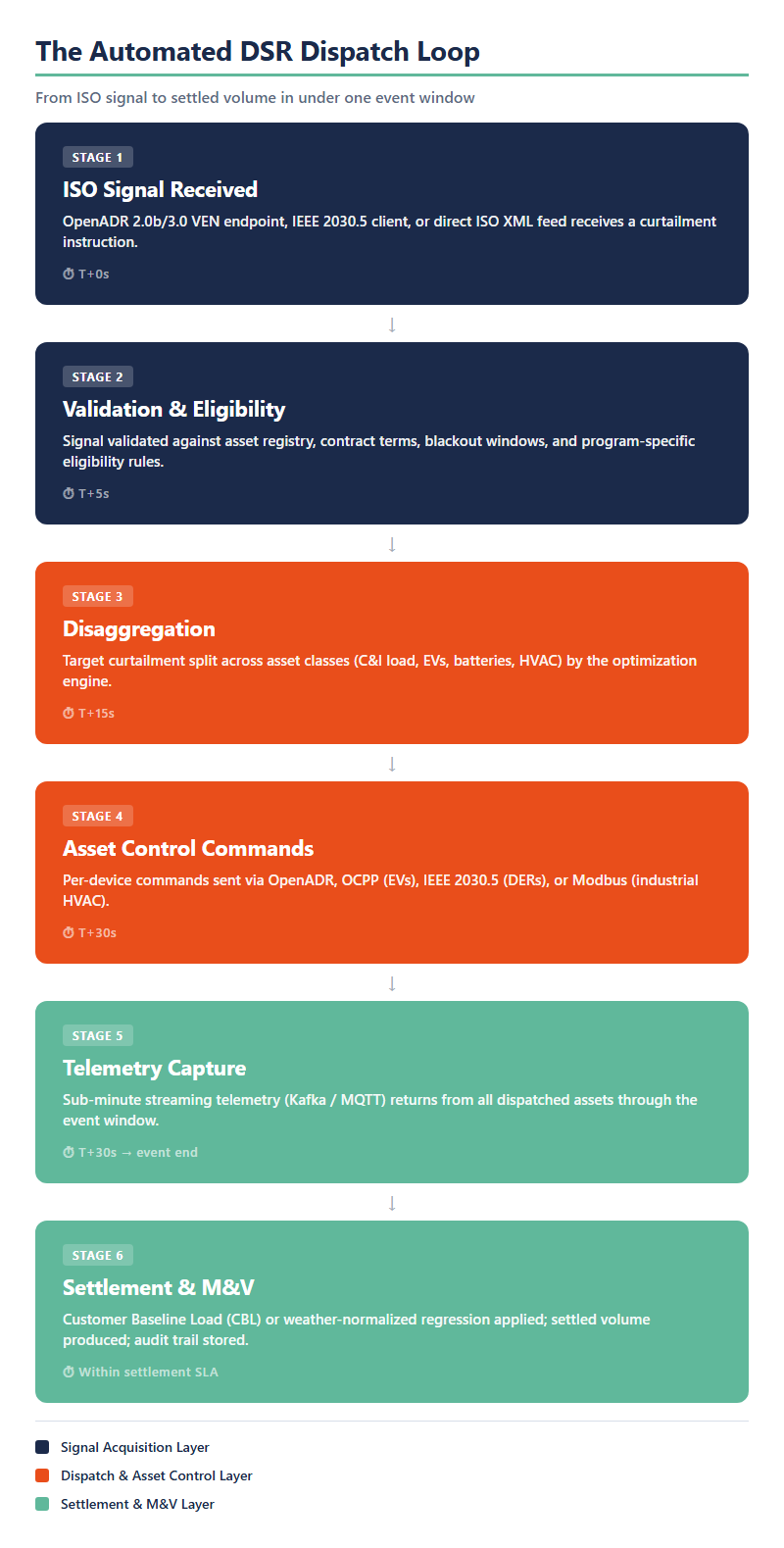
By 2026 the phrase means something operationally different. A DSR platform now runs an end-to-end automated loop: it ingests dispatch signals from the system operator (OpenADR 3.0 from a national grid, IEEE 2030.5 from a US ISO, OCPP for charge point fleets), validates eligibility against the asset registry, disaggregates the curtailment target across thousands of behind-the-meter devices, sends control commands within seconds, captures sub-minute telemetry, and runs the measurement-and-verification baseline that determines settlement. The work that used to take a phone call and a forty-eight-hour reconciliation now happens inside one minute, on software your operations team rarely sees.
Most of the SERP missed the transition. Definitional pages from EU and UK aggregators, regulators, and EV-charging glossaries were written between 2014 and 2020 and frame DSR as a programs-and-incentives question. The platform question — what software does this take, who builds it, who buys it — sits underneath that older framing and is the one buyers in 2026 are actually procuring against.
From phone calls to OpenADR signals — the 2020–2026 platform-maturity arc
Three things changed between 2020 and 2026. First, OpenADR 2.0b matured into widespread certified deployments and OpenADR 3.0 (released 2024) added asset-level granularity, sub-second responsiveness for some signal types, and tighter alignment with IEEE 2030.5. Second, the asset mix expanded: residential EV chargers, behind-the-meter batteries, heat pumps, and managed thermostats joined the C&I curtailable load that DSR had historically targeted, each with its own latency profile and protocol. Third, FERC Order 2222 in the US and the EU Clean Energy for All Europeans Package both forced multi-asset DER aggregation as a market-eligible model, lifting DSR out of “industrial demand response” and into something closer to a portfolio asset class.
A working definition: signal acquisition layer + asset control layer + settlement layer
A DSR platform in 2026 has three load-bearing layers. The signal acquisition layer translates incoming dispatch instructions from system operators and capacity markets into internal control intent. The asset control layer translates that intent into per-device commands, with protocol adapters handling OpenADR, IEEE 2030.5, OCPP, Modbus, and proprietary OEM APIs. The settlement layer takes the telemetry that comes back, runs baseline-versus-actual calculations, and produces the data the system operator settles against. Everything else — the operator console, the asset registry, the optimization engine — wraps these three layers.
The Automated Dispatch Loop: From ISO Signal to Asset Curtailment in Under a Minute
The operational core of a DSR platform is the automated dispatch loop. When a system operator issues a curtailment signal, the platform has to validate it, disaggregate the target across enrolled assets, push control commands, capture telemetry, and run settlement — all without operator intervention for the routine cases. Latency targets vary by program: a UK Capacity Market or US PJM Emergency Load Response event might allow thirty-minute notification and two-hour ramp, while a Synchronized Reserve event requires sub-second response. The platform that wins a multi-program portfolio handles both.
Active vs passive DSR — and why “automated” requires both protocol and telemetry
Industry vocabulary still uses “active” and “passive” DSR to distinguish dispatch-driven curtailment from price-tariff-driven behavior change. The line matters less than it used to. A modern DSR platform supports both, and the engineering challenge is the same in either case: you cannot run dispatch (active) or attribute response to a price signal (passive) without real-time telemetry from the asset. Older platforms ran dispatch on assumed performance — they sent the signal, scheduled the event, and trusted the customer to comply. New platforms close the loop with sub-minute telemetry, which is what makes baseline-vs-actual settlement defensible to a regulator.
The settlement loop is the part most platforms get wrong
The dispatch half of the loop is the visible engineering — protocols, latency, control commands. The settlement half is where most platforms underdeliver. Settlement requires a measurement-and-verification baseline (commonly a customer baseline load or “CBL”, weather-normalized regression, or a synthetic baseline from comparable assets), the actual telemetry, and the audit trail to defend the settled volume against system-operator dispute. Get the baseline wrong and you either undersettle (revenue leak) or oversettle (penalty risk). The settlement layer is the part of the platform that turns dispatch into cash and is the most common reason aggregators outgrow vendor SaaS.
The Five Layers of a Modern Demand Side Response Platform
A production-grade DSR platform separates into five distinct subsystems, each with its own scaling and failure profile. We design platforms around these five layers because the boundaries are where build-vs-buy and accelerator decisions actually fall — a buyer who treats the platform as a single monolith ends up locked into one vendor’s design choices on the layer they most needed flexibility.
| Layer | Function | Canonical protocols / standards | Build-vs-buy decision driver |
|---|---|---|---|
| 1. Signal Acquisition | System-operator interface: ingests dispatch signals from ISOs, utilities, and capacity markets; exposes endpoints for OpenADR VEN, IEEE 2030.5 client, and direct ISO XML feeds. | OpenADR 2.0b / 3.0; IEEE 2030.5; ISO-specific XML/JSON APIs | Buy or accelerator: protocol certification cost is the highest single line item; building from scratch rarely pays back unless the signal mix is exotic. |
| 2. Asset Registry & Telemetry | Data backbone: stores enrollment, contract terms, asset metadata; runs the streaming pipeline that ingests sub-minute device telemetry. | Kafka or MQTT for streaming; OCPP for EVs; Modbus for industrial; OEM-proprietary for residential devices | Build or hybrid: enrollment-data model and asset-class coverage are where vendor SaaS most often fails to fit a specific aggregator’s portfolio. |
| 3. Dispatch & Optimization Engine | Decision layer: runs multi-program portfolio optimization; decides which sites curtail for which program at which moment given protocol latency, contract penalties, and forecast performance. | Internal optimization stack; OR integer/linear programming solvers; portfolio-level rules engine | Build: this is where proprietary dispatch logic lives. Vendors rarely expose the optimization layer for customization. |
| 4. Settlement & M&V | Cash layer: applies measurement-and-verification baselines (CBL, weather-normalized regression, synthetic comparable) to telemetry; produces settled volumes; runs dispute workflows. | Customer Baseline Load (CBL) methodologies; ISO-specific M&V protocols; audit trail storage | Build or accelerator: regulatory politics around baseline methodology make this the most-customized layer in mature aggregators. |
| 5. Operator Console & APIs | Control surface: dispatch override, dispute workflow, customer-facing reporting; APIs for downstream BI, ERP, and CRM. | REST / GraphQL APIs; role-based access; SSO; standard reporting/BI integrations | Buy: most aggregators do not differentiate at the console layer. Off-the-shelf or accelerator-led implementation is appropriate. |
The signal acquisition layer is the platform’s entry point. It hosts OpenADR Virtual End Node (VEN) endpoints, IEEE 2030.5 client implementations, and any direct ISO/utility integrations. The asset registry and telemetry layer is the data backbone — it holds enrollment status, contract terms, and the streaming pipeline (typically Kafka or MQTT) that ingests sub-minute device data. The dispatch and optimization engine is where multi-program portfolio decisions get made: which sites curtail for which program at which moment, given protocol latency, contract penalties, and forecast performance. The settlement and M&V layer applies baselines and produces the settled volumes. The operator console is the override path, the dispute workflow, and the customer-facing reporting surface.
This layered model is implemented in our OpenADR Accelerator and the broader demand response software & platform pillar covers protocol comparison in depth.
Multi-Asset DER Aggregation: How DSR Platforms Coordinate EVs, Heat Pumps, and Batteries Under One Roof
Three years ago a DSR platform was effectively a curtailable-industrial-load platform with a thin EV charging adapter bolted on. By 2026 the same platform has to dispatch across at least four asset classes — C&I curtailable load, residential thermostats and HVAC, EV charging fleets (often through OCPP), and behind-the-meter batteries — each with different latency, persistence, and protocol profiles. A residential thermostat reaches steady-state curtailment in minutes; a behind-the-meter battery responds in milliseconds; an EV charger has to negotiate the OCPP control loop and respect the driver’s session preferences. Treating them as one homogeneous “asset pool” is how platforms underdeliver on settled volume.
The integration tax is real. A platform that supports OpenADR, OCPP, IEEE 2030.5, and Modbus simultaneously needs cross-protocol signal translation, harmonized state models, and a shared semantic layer over what each protocol calls a “session,” “schedule,” or “event.” Most legacy platforms ducked this by handling one or two protocols natively and proxying the rest through brittle adapters. The result is a portfolio-wide performance ceiling that surfaces only after the aggregator has signed contracts assuming higher delivery.
Why FERC Order 2222 and the EU Clean Energy Package are forcing convergence
In the US, FERC Order 2222 requires regional transmission organizations to allow DER aggregations to participate in wholesale energy, capacity, and ancillary-services markets — which means a DSR platform must now look more like a demand response aggregator software stack than a single-program tool. In the EU, the Clean Energy for All Europeans Package frames “demand side flexibility” as the regulatory category, and member states are translating that into capacity-mechanism rules that explicitly accommodate aggregated DER. The two regimes are converging on the same software requirement: a platform that can simultaneously handle multi-asset, multi-protocol, multi-market participation.
Cross-protocol signal translation — the integration tax
In practical engineering terms, a DSR platform handling a US PJM Capacity Performance event and a UK Capacity Market event in the same hour translates an OpenADR 2.0b “load reduction” signal into an OCPP SetChargingProfile for the EV fleet, an IEEE 2030.5 DER curtailment for the rooftop solar+storage portfolio, and a Modbus register write for the C&I HVAC chillers — and reconciles all of them against a single settlement baseline by the end of the event. This is not glamorous work. It is the work that decides whether a DSR portfolio scales.
The EU and UK DSR Market Is the Live Lab for What Is Coming to the US
If you want to see where US DSR platforms will be operationally in three years, watch the UK and the EU. The vocabulary itself is regional (“demand side response” is the UK and EU term; “demand response” is the US one), but the divergence runs deeper than naming. The UK has run a sophisticated DSR market for over a decade through National Grid ESO’s Balancing Services portfolio: Frequency Response, Short Term Operating Reserve (STOR), and the Capacity Market all accept aggregated demand-side resources, and the auction mechanics have been refined through dozens of iterations.
For the US-side companion view — the C&I-buyer architecture that integrates DSR software with on-site solar, behind-the-meter storage, and EV charging in PJM, ERCOT, and CAISO programs — see our commercial & industrial demand response software guide, which covers the integration problems the EU aggregator stack does not have to solve as directly because EU regulator-mandated flexibility is largely device-level rather than facility-level.
The EU is moving in the same direction faster than most US buyers realize. The Clean Energy for All Europeans Package gave independent aggregators explicit market-participant status. Germany’s §14a EnWG (in force 2024) requires every grid-connected heat pump, EV charger, and home battery system above 4.2 kW to be DSO-controllable, putting a flexibility hook in millions of devices by regulatory mandate rather than market negotiation. France’s Mécanisme de Capacité runs aggregated demand-side resources alongside generation in capacity auctions. Italy’s UVAM pilots converged into permanent rules. Each of these mechanisms procures a flexibility-platform capability that the 2018-era DSR architecture does not deliver.
For a US aggregator or utility, the practical implication is that the UK STOR and Frequency Response markets, plus the German §14a fleet, are the closest live analogue to where PJM’s Synchronized Reserve Market and CAISO’s Emergency Load Reduction Program are heading. The platform features UK aggregators built over the last decade (sub-second response certification, multi-second settlement granularity, baseline methods robust enough to survive regulator audit) are the features US aggregators are now asking vendors for. EU aggregators including GridBeyond, Drax, Flexitricity, Centrica Business Solutions, and Limejump operate at this maturity level today and inform the platform requirements buyers are bringing to US procurement.
Demand side flexibility as the EU regulator’s preferred framing
The EU’s regulatory shift from “demand response” toward “demand side flexibility” is more than a rebranding. It signals the inclusion of distributed storage, behind-the-meter generation, and EV charging on the same procurement footing as curtailable industrial load. The UK is following a similar trajectory: National Grid ESO’s Demand Flexibility Service treats residential and commercial flexibility as a single procurement pool. A platform built only around 2018-era DSR (industrial curtailable load and a few hundred C&I sites) is not what these regulators are now buying. They are buying flexibility platforms, and the difference is architectural.
What UK STOR, Frequency Response, and Germany §14a teach US PJM and CAISO buyers
Three transferable lessons. First, multi-second settlement granularity is not optional once Synchronized Reserve volume scales, and the platforms that deferred this hit a ceiling at a few dozen MW of registered capacity. Second, baseline methodology is regulatory politics: the UK refined its CBL methodology over years of aggregator-regulator negotiation, and US ISOs are now in the same conversation. Third, multi-program portfolio optimization (deciding which assets serve which program at which moment) is what separates a single-market aggregator from a national-scale one. The platforms that handle it well were built with optimization as a first-class subsystem, not a back-office report. The hardware and software OEMs treating this as a roadmap item rather than a launch requirement will learn the same lesson Germany §14a is teaching the EU heat-pump market: you cannot retrofit dispatchability into firmware that was never designed for it.
SaaS DRMS vs Custom DSR Platform: The Build-vs-Buy Decision for Aggregators and Utilities
A DSR platform is one of the few software stacks where the build-vs-buy decision is not obvious. SaaS DRMS vendors (the category includes Honeywell SmartConnect, Itron, Tantalus, AutoGrid, and Uplight, among others — neutral category framing; AutoGrid and Uplight are Codibly ecosystem partners) ship competent products that handle the standard mid-market case well. They are usually the right answer for a utility running internal DR programs at moderate scale, or a mid-sized aggregator with a single-market portfolio and standard certification needs. Custom development is the right answer when proprietary dispatch logic, multi-market participation at scale, or OEM-specific integrations make the SaaS roadmap a constraint rather than an enabler.
The middle path that most buyers underweight is accelerator-led partnership: starting from a certified protocol stack and building the dispatch, optimization, and settlement layers around it. For aggregators and utilities evaluating the best SaaS energy platform for demand response against custom-build options, the accelerator path collapses the protocol-certification timeline (which is the single biggest driver of build risk) while preserving the codebase ownership and roadmap control that drove the build decision in the first place.
| Buyer profile | Recommended path | What you trade | Typical timeline to first dispatch |
|---|---|---|---|
| Utility running internal DR programs at moderate scale | SaaS DRMS (Honeywell SmartConnect, Itron, Tantalus, AutoGrid, Uplight, etc.) | Roadmap dependency, multi-year licensing, limited control over dispatch logic. Standard programs and standard protocols are well covered. | 3–6 months |
| Mid-sized aggregator, single market, standard certification | SaaS DRMS or accelerator-led partnership | SaaS gives faster time-to-market; accelerator-led preserves codebase ownership when the portfolio is expected to grow. | 4–8 months |
| Multi-market aggregator outgrowing single-program SaaS | Accelerator-led custom platform (certified protocol stack + bespoke dispatch, optimization, settlement) | Higher upfront engineering cost; preserves multi-protocol coverage and proprietary optimization logic that drives margin. | 6–12 months |
| Hardware OEM or automaker building managed-charging or VPP program | Accelerator-led with deep OEM integration | Codebase ownership and protocol independence; OEM-specific telemetry pipelines beyond what SaaS exposes. | 6–12 months |
| National-scale or multi-region aggregator with proprietary algorithms | Custom in-house platform | Highest cost; full control over optimization, settlement methodology, and roadmap. Justified by margin sensitivity at scale. | 9–18 months |
For the broader vendor-category disambiguation across the DSR market, our demand response companies vendor selection guide covers aggregator, DRMS, and software-partner categories in detail.
What to Look for in a Demand Side Response Platform Before Procurement
Six questions every procurement team should bring to vendor evaluation, drawn from the implementation patterns that decide whether a DSR platform scales past its first program:
- Which protocols are certified, and at which version? OpenADR 2.0b and 3.0, IEEE 2030.5, OCPP 1.6 and 2.0.1, and Modbus are the realistic floor. Certification matters more than support — uncertified support fails settlement audit.
- What latency targets does the platform meet per program? Sub-second for Synchronized Reserve, sub-minute for Emergency Load Response, continuous for Capacity Performance. Ask for production telemetry, not vendor specs.
- What is the M&V baseline approach, and is it auditable? CBL, weather-normalized regression, or synthetic comparable. Whichever the vendor uses, the audit trail is what the system operator settles against. DR protocol certification is the parallel concern at the signal-acquisition layer.
- Telemetry backbone and resolution. Kafka, MQTT, or proprietary streaming SQL — at what granularity, and with what backfill behavior when device connectivity drops. Sub-minute resolution is the floor for any program that settles on five-minute or finer intervals.
- Settlement and dispute workflow. What happens when the system operator disputes a settled volume. The presence of a dispute workflow tells you the platform has operated through real settlement events; the absence usually means it has not.
- Multi-market readiness. Can the same platform bid PJM Capacity Performance, CAISO Emergency Load Reduction, UK Capacity Market, and Frequency Response simultaneously, or does each market need a separate deployment? The answer determines whether the platform supports a multi-market growth path.
The Platform Question Is the Multi-Market Question in Disguise
The DSR platform a buyer picks today is, in practice, a decision about how many markets the buyer will be able to participate in three years from now. Single-program platforms ship faster and cost less, but they cap portfolio growth at the boundary of the program they were designed for. Multi-program platforms cost more upfront and demand more from the procurement team, but they preserve the optionality that matters once an aggregator outgrows its first market or a utility starts serving DERs across a regulatory boundary.
The architectural decisions that separate the two are visible in procurement. They sit in the five-layer model above and surface in the six selection questions. The buyers who get this right treat the DSR platform as a strategic grid asset, not a back-office tool. The winners in the 2026 flexibility market will be the ones whose software stack was built for a grid that talks back. For teams scoping the next DSR build or procurement, our demand response software providers practice page and the OpenADR Accelerator are the implementation entry points.
Frequently Asked Questions
Demand side response (DSR) is the coordinated reduction or shifting of electricity consumption in response to a system-operator signal or market price, used to balance grid supply and demand. In 2026 it covers everything from industrial curtailable load to residential EVs and behind-the-meter batteries, dispatched automatically through standardized protocols rather than operator phone calls. For the architectural picture, see our demand response software & platform pillar.
Yes, they are semantically equivalent — the difference is regional vocabulary. “Demand side response” and “DSR” are the prevalent terms in the UK and EU, while “demand response” and “DR” are the US convention. The underlying market mechanisms (capacity, energy, ancillary services) and the platform requirements are the same.
A DSR platform is the software stack that runs an aggregator’s or utility’s automated dispatch operations: ingesting system-operator signals, controlling distributed assets through standardized protocols, capturing telemetry, and settling against a measurement-and-verification baseline. In 2026 it sits across five layers — signal acquisition, asset registry, dispatch and optimization, settlement, and operator console — and supports multi-asset, multi-protocol, multi-market participation.
A DSR aggregator pools enrolled demand-side resources — industrial sites, commercial buildings, residential devices, EVs, batteries — and bids the aggregate capacity into utility or system-operator programs. The aggregator handles enrollment, dispatch, settlement with the system operator, and revenue distribution to participants. Aggregator economics are covered in detail in our demand response aggregator business models breakdown.
OpenADR is the standardized protocol most DSR platforms use to receive dispatch signals from system operators or utilities and to send control commands to enrolled assets. The current generation, OpenADR 3.0 (released 2024), supports asset-level granularity and tighter alignment with IEEE 2030.5 — which together make automated, multi-asset DSR operationally practical at scale. DR protocol certification is what turns OpenADR from a specification into a market-eligible signal path.