Renewable Energy Asset Management Software: From Monitoring to Orchestration
Renewable energy asset management software grew up doing one job well: watch the fleet. Is the turbine spinning, is the inverter clipping, is this site underperforming its model? For a portfolio of one technology that you own and operate, a monitoring dashboard that answers those questions is most of what you need. But the asset base stopped being one technology. Portfolios now stack solar, wind, and storage behind the same interconnection, with grid-service obligations layered on top — and the operative question has shifted from “is the asset running?” to “what should this portfolio do in the next market interval?” That second question is a control decision, and it’s not the one the monitoring-era platforms were built to make. This is a look at where renewable asset software is going, and how to decide whether you buy that capability, build it, or integrate your way to it.
What “Asset Management” Means Once a Renewable Portfolio Stops Being One Technology
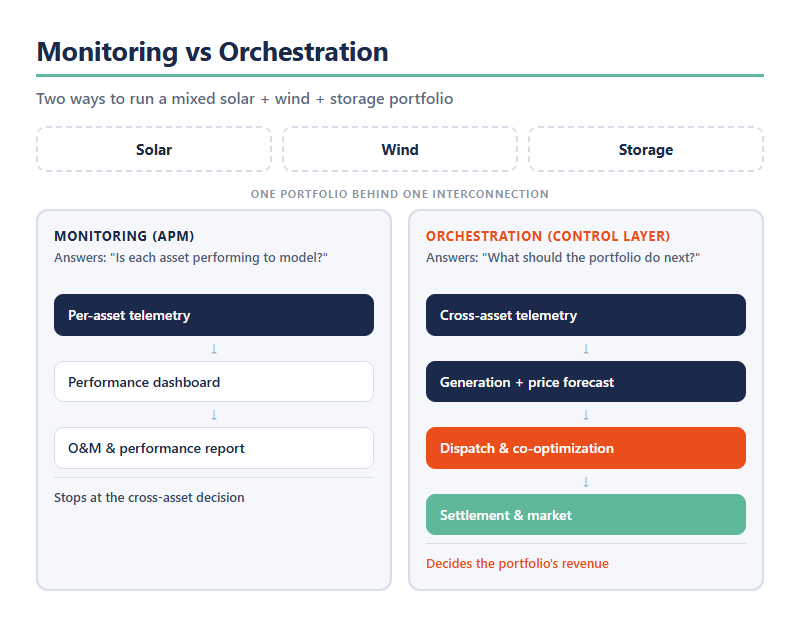
For a single-technology fleet, asset management and asset monitoring are nearly the same thing: collect telemetry, compare against expected performance, flag the gaps, schedule the truck roll. The software that does this well — the energy management control layer‘s monitoring-focused cousin — is mature and widely sold. The category gets harder the moment a portfolio mixes assets that can trade off against each other. A solar site, a wind site, and a battery behind the same point of interconnection aren’t four independent dashboards; they’re one dispatchable position, and someone has to decide, continuously, how they cooperate. That decision is asset management in the newer sense — orchestration — and it’s a different software problem from monitoring.
| Monitoring-era APM | Orchestration-era control | |
|---|---|---|
| Core job | Is each asset performing to model? | What should the portfolio do next? |
| Data | Per-asset telemetry, availability, O&M | Telemetry + forecasts + market/grid signals |
| Decision | Flag underperformance, schedule O&M | Dispatch, curtail, co-optimize across assets |
| Built for | Single-technology fleets you operate | Mixed solar/wind/storage + grid obligations |
| Build-or-buy default | Buy off-the-shelf | Integrate or build when the mix is yours |
What the Monitoring Platforms Do Well — and Where They Stop
It’s worth being precise about what the established platforms are good at, because the answer for many operators is still “buy one.” Asset performance management tools track availability and production, normalize against weather and irradiance models, surface underperforming strings and gearboxes, and turn all of it into the reports lenders and owners expect. For a wind or solar operator whose job is to run those assets to their performance envelope, that’s a solved problem and a reasonable purchase. Where these tools stop is the cross-asset decision. A monitoring platform tells you the battery is at 60% state of charge and the solar site is curtailing; it does not decide whether that battery should be charging from the clipped solar, holding for the evening price peak, or bidding into a grid service — because that was never its job. The further a portfolio moves toward mixed assets and market participation, the more that gap becomes the whole point.
The Orchestration Layer a Mixed Renewable Portfolio Actually Needs
The orchestration layer runs the same loop a grid-edge energy management system runs, scoped to renewable assets: ingest telemetry from every asset regardless of vendor, forecast generation and price, decide what each asset does in the coming intervals, and settle the result against the market or offtake terms. The hard parts are specific to renewables. Telemetry arrives in different protocols and cadences from multi-vendor hardware, so normalization is real engineering, not a connector checkbox. Forecasting has to fuse generation (irradiance, wind) with price and curtailment risk. And the dispatch decision has to co-optimize assets that compete for the same interconnection — which is where battery storage dispatch stops being a standalone question and becomes part of a portfolio one. At fleet scale, the same coordination problem is what a distributed energy resource management platform solves on the network side. The orchestration layer is where a renewable portfolio’s value is actually decided, and it’s the layer the monitoring vendors leave to you.
Build, Buy, or Integrate Your Renewable Asset Software
The decision comes down to how much of your portfolio’s value lives in the orchestration logic. If you operate a single-technology fleet and your job is performance and O&M, buy an off-the-shelf asset performance platform — the category is good and rebuilding it is waste. If your portfolio mixes vendors and technologies but follows a standard operating pattern, the realistic path is integrate: keep the monitoring tools you like and build the cross-asset decision layer on top, rather than forcing one vendor’s platform to own assets it doesn’t model well. And if storage plus market participation make dispatch the thing that determines your revenue, the orchestration logic is your edge and belongs in software you control — which is when custom energy software development pays for itself, not as a rebuild of monitoring but as the decision layer above it. Where the mixed portfolio includes storage, the EMS layer deserves its own evaluation — the subject of our BESS energy management system guide.
| Portfolio profile | Path | What you trade | When it pays back |
|---|---|---|---|
| Single-technology fleet, O&M focus | Buy APM platform | Cross-asset orchestration | Immediately — don’t rebuild monitoring |
| Multi-vendor mixed portfolio, standard ops | Integrate a decision layer | Single-vendor simplicity | When no platform models your full mix |
| Storage + market participation | Build the orchestration layer | Time-to-deploy | When dispatch logic is your revenue edge |
The middle path is where most growing renewable operators land: the monitoring is bought, and the orchestration is integrated on top by a partner who can speak to multi-vendor telemetry and the market interfaces without handing you a black box.
The Question Moved From “Is It Running?” to “What Should It Do Next?”
The renewable asset software market still mostly answers the first question, because for a decade that was the question. As portfolios mix technologies and take on grid-service revenue, the second question is the one that decides margin — and it’s a control decision the monitoring platforms were never built to make. Choosing renewable energy asset management software in 2026 is really choosing how that decision gets made: inside a platform you bought, inside logic you built, or inside an integration layer you own that sits above the tools you kept. That’s the conversation Codibly’s custom energy software work starts from — not another monitoring dashboard, but the orchestration layer your portfolio’s economics now depend on.
Frequently Asked Questions
It’s software that tracks, manages, and increasingly orchestrates renewable energy assets — solar, wind, and storage. Traditionally it focused on performance monitoring and O&M (is each asset performing to model?); newer systems add the orchestration layer that decides what a mixed portfolio should do across market intervals.
Monitoring answers “is each asset performing as expected?” — telemetry, availability, and performance reporting. Orchestration answers “what should the portfolio do next?” — dispatching, curtailing, and co-optimizing assets that share an interconnection or grid obligation. Most established platforms do the first well; the second is where mixed portfolios outgrow them.
Single-technology fleets are well served by off-the-shelf performance platforms. The need changes when a portfolio mixes solar, wind, and storage behind the same interconnection — at that point the assets trade off against each other, and you need a cross-asset decision layer the single-technology tools don’t provide.
Buy when you operate a single-technology fleet and need monitoring and O&M. Integrate a decision layer when you run a multi-vendor mixed portfolio. Build when storage plus market participation make dispatch your revenue edge and the orchestration logic should be software you control.
A BESS-EMS dispatches one battery; a DERMS coordinates a fleet of distributed resources on the network; renewable asset orchestration co-optimizes a mixed generation-plus-storage portfolio. They share the same ingest-forecast-dispatch-settle loop, scoped to different boundaries — and a portfolio that mixes all three increasingly needs them to interoperate.