VPP Platforms for Large Utilities: Why Enrollment Decides Program ROI

A virtual power plant program succeeds or fails before its first dispatch event. The pattern repeats across the United States: a utility wins regulatory approval, sets an incentive rate the finance team can defend, announces a megawatt target, and then watches enrollment stall at a fraction of the addressable device fleet. The post-mortem almost never blames the incentive. It blames the enrollment funnel, the device eligibility list, and the integration layer that was supposed to connect customer batteries and thermostats to the dispatch platform. Those are software and product decisions, and they are routinely made last, after the tariff design has consumed a year of attention. For the utility program manager, that ordering is the single most expensive mistake available.
Key Takeaways
- Roughly half of U.S. states now host an enrollable virtual power plant (VPP) program, per the Clean Energy States Alliance’s program table, yet capacity targets are missed far more often at enrollment than at dispatch.
- The device eligibility list caps program capacity before marketing spends a dollar; every excluded original equipment manufacturer (OEM) is megawatts you chose not to recruit.
- Compensation design is a churn problem. Upfront payments buy signups, performance payments buy persistence, and the model has to survive a full event season, never just the launch quarter.
- Texas, California, Colorado, and Illinois have produced three structurally different program designs. The choice between them is a software architecture decision as much as a regulatory one.
Forty-Eight Programs In, the Virtual Power Plant Program Playbook Is Still Missing
The market signal is unambiguous. The Clean Energy States Alliance’s program summary table tracks 48 virtual power plant programs across U.S. states and territories as of its February 2026 update, noting that battery owners in approximately half the states can now enroll, provide grid services, and be compensated in return. The Department of Energy’s Loan Programs Office finances VPP-related projects directly, treating aggregations of distributed energy resources (DERs) as infrastructure worthy of federal credit support. FERC Order 2222 opened wholesale markets to those aggregations, and the DOE’s Pathways to Commercial Liftoff analysis frames VPPs as one of the cheapest sources of new grid capacity available this decade.
What the market has not produced is a shared playbook for running these programs well. The catalog of programs is public; the catalog of program-design lessons is not. Utilities entering the space today inherit the regulatory templates, the device standards, and the virtual power plant software category that operates the assets, and still have to answer the hard questions alone: which devices to admit, how to pay for participation, and what the program’s software stack must do on day one versus year three. The programs that hit their megawatt targets treat those as product decisions with owners and deadlines. The programs that stall treat them as procurement details.
The Enrollment Funnel Is the Program: Device Eligibility Decides Your Capacity
Every utility VPP program is, mechanically, a funnel. Eligible customers become aware of the program, a fraction of them apply, a fraction of those clear approval, a fraction of the approved devices actually connect, and a fraction of connected devices remain enrolled a year later. Each transition leaks. Program design that obsesses over the incentive rate is optimizing one variable in a five-stage chain, and rarely the leakiest one. The DERMS vs VPP vs ADMS comparison draws the line between grid-operator-facing orchestration and market-facing aggregation — the distinction that decides which platform a program actually needs.
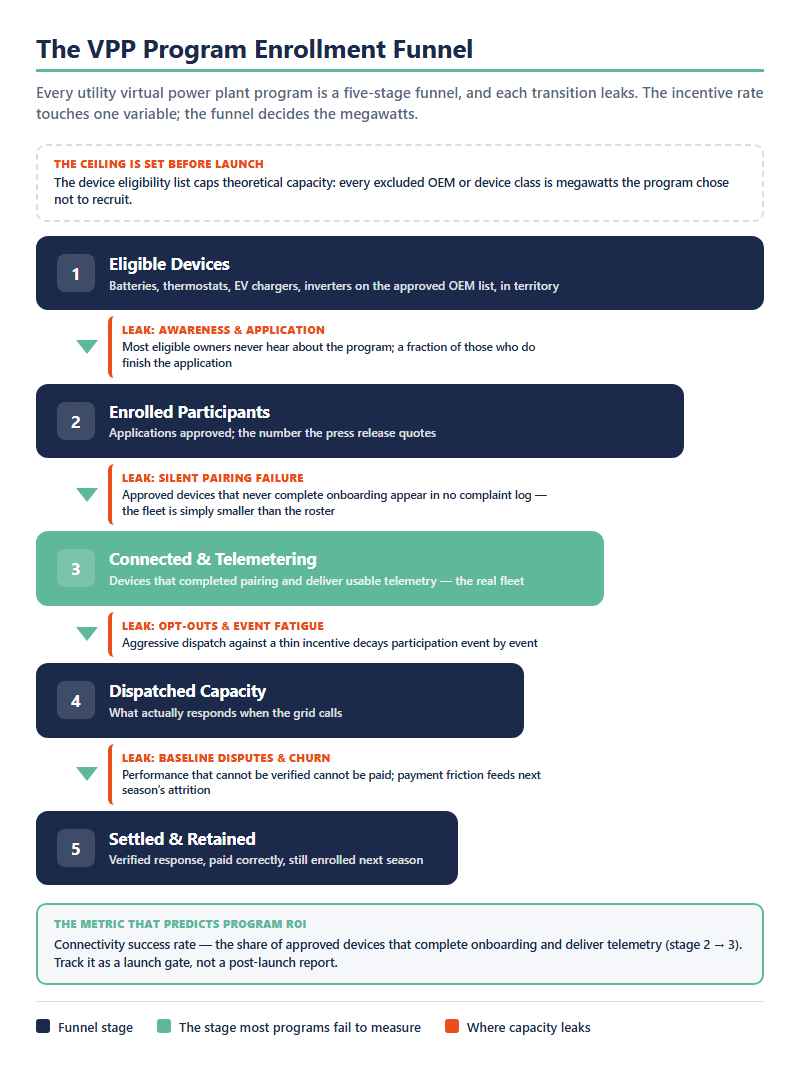
The funnel’s ceiling is set before launch, in the device eligibility list. A utility virtual power plant program that admits two battery OEMs and one thermostat brand has capped its theoretical capacity at whatever those fleets represent in its service territory, and no marketing budget changes that arithmetic. Widening the list is not free: every additional OEM is another cloud API or local protocol to integrate, another certification pathway, another telemetry format to normalize. That trade-off between eligibility breadth and integration cost is the central engineering economics of the program, and it is exactly the problem space covered in our analysis of distributed energy resources integration, where DER programs most often die quietly in the connectivity layer.
The stage after approval deserves particular attention, because it fails silently. A customer who applies, is accepted, and then abandons a broken device-pairing flow shows up in no complaint log. The program simply records a connected fleet smaller than its enrolled fleet. Connectivity success rate, the percentage of approved devices that complete onboarding and deliver telemetry, is the single most predictive operational metric a program team can track, and most programs do not track it at all.
Compensation Models That Survive a Full Season
Participant compensation is where program economics meet behavioral reality. The incentive structures in use across the CESA-tracked programs sort into four families, and each buys a different behavior.
| Compensation model | Mechanics | What it buys | Churn risk | M&V burden |
|---|---|---|---|---|
| Upfront enrollment payment | One-time payment or device rebate at signup | Fast enrollment and device acquisition | High: the customer is paid before the first dispatch event | Low: payment is not performance-linked |
| Seasonal capacity payment | Recurring payment per kilowatt of enrolled capability, per season or year | Predictable participation and a fleet the utility can plan around | Moderate: payout is distant from the enrollment decision | Moderate: requires verified availability, not per-event baselines |
| Per-event performance payment | Payment per dispatch event, based on measured response | The tightest link between grid value and customer reward | Low per event, but opt-out fatigue compounds across a heavy season | High: every payment depends on a defensible baseline |
| Hybrid | Modest enrollment incentive plus a performance or capacity stream | Signup momentum and persistence in one structure | Lowest overall when the performance stream is meaningful | High: inherits the performance model’s measurement requirements |
Upfront enrollment payments are the strongest signup motivator and the weakest persistence tool; the customer has already been paid when the first uncomfortable summer event arrives. Seasonal capacity payments, typically structured per kilowatt of enrolled capability, align better with how the utility itself earns on the program but require the customer to trust a payout months away. Per-event performance payments create the tightest link between grid value and customer reward, and they impose the heaviest measurement and verification (M&V) burden, because every payment now depends on a defensible baseline. Hybrid structures, increasingly the default in newer programs, pay a modest enrollment incentive and a larger performance stream.
The design question underneath all four is opt-out fatigue. A program that dispatches aggressively against a thin incentive will watch participation decay event by event, and re-acquiring a churned participant costs more than acquiring a new one, because the customer now has evidence. This is the same economics that governs aggregator-mediated portfolios, covered in depth in our analysis of demand response aggregator business models: the revenue stack only works when the underlying asset fleet persists. FERC Order 2222 adds a wholesale dimension to that stack, letting aggregated fleets bid into markets directly, which raises the value of every persistent enrolled device and sharpens the penalty for churn.
Texas, California, Colorado, Illinois: What the State Map Teaches Program Designers
The state-level record is the closest thing the industry has to a controlled experiment, because four leading markets chose four different answers to the same design questions.
| State | Program model | Who operates the fleet | What program designers learn |
|---|---|---|---|
| Texas | Market-direct: ERCOT’s aggregated DER (ADER) pilot routes fleets toward wholesale participation | Aggregators | Success depends on aggregator economics and telemetry quality, not a utility tariff |
| California | Portfolio of state-backed demand-side programs layered over IOU initiatives | Mixed: state programs, utilities, and aggregators | Program stacking confuses customers; the enrollment experience must disambiguate which program a device serves |
| Colorado | Utility-led: Xcel Energy’s aggregated virtual power plant initiative across customer-sited DERs | The utility itself | Utility-run designs internalize the software stack: enrollment, dispatch, and M&V become utility capabilities |
| Illinois | Regulatory-infrastructure first: aggregation and interconnection rules standardized ahead of program scale | Aggregators, under standardized protocol requirements | Protocol plumbing standardized early lowers integration cost for every later program |
Texas runs the market-direct experiment. ERCOT’s aggregated distributed energy resource (ADER) pilot routes residential fleets toward wholesale participation through aggregators, which makes the program’s success a function of aggregator economics and telemetry quality rather than a utility tariff. California operates at portfolio scale, with state-backed demand-side programs and investor-owned utility initiatives layered over the country’s largest residential battery fleet; its lesson is that program stacking creates customer confusion, and the enrollment experience has to disambiguate which program a device serves. Colorado’s model is utility-led: Xcel Energy’s aggregated virtual power plant initiative makes the utility itself the program operator across customer-sited DERs, part of a broader pattern we examined in our review of state-level DER program opportunities.
Illinois illustrates the regulatory-infrastructure path, where aggregation rules and interconnection requirements were rebuilt first, on the theory that programs scale only after the protocol plumbing is standardized. Our analysis of Illinois’s DER aggregation rules covers what that preparation demands from aggregators in practice. The transferable lesson from all four states is uncomfortable for anyone hoping to copy a template: utility-run, aggregator-mediated, and market-direct designs impose different software requirements, different M&V regimes, and different customer relationships. The design choice has to be made deliberately, and early, because the program’s entire technology stack inherits it.
The Program Launch Is a Software Launch
Strip away the tariff filing and a virtual power plant program is five software systems that have to work in sequence: an enrollment experience customers can finish, a device integration layer that connects the approved OEM list, a dispatch engine that turns grid needs into device commands, telemetry and M&V that prove what happened, and settlement that pays people correctly. Utilities discover the hard version of this list mid-launch, when the program team learns that core utility systems were never designed to exchange data with thousands of cloud-connected consumer devices, and that the protocol layer, OpenADR for program signaling and IEEE 2030.5 for inverter-class DER communication, is its own engineering discipline.
This is buildable, and the build is faster when it does not start from zero. When APG&E, a Texas retail energy provider, needed to stand up a DER orchestration program from scratch, Codibly delivered the full operational chain: device enrollment and management, dispatch event scheduling with rollback capability, real-time telemetry and participation tracking, and an internal operations console, architected to extend to new DER classes and ready for the OpenADR and IEEE 2030.5 standards its market will demand. The engagement detail is in the DER orchestration program Codibly built for APG&E. The same integration discipline, packaged as pre-built protocol components and program tooling, is what our demand response program integrations practice exists to compress: the undifferentiated plumbing gets accelerated so the utility’s attention can stay on program design, where its judgment actually differentiates.
The sequencing recommendation is blunt. Scope the program’s software stack in the same quarter you model the incentive budget, and treat connectivity success rate as a launch gate, not a post-launch metric. A program that cannot connect devices reliably at one hundred participants will not survive contact with ten thousand.
Choosing a VPP Platform at Utility Scale: Five Tests Before the Contract
Large utilities shopping for the best VPP platform tend to compare dispatch features, because dispatch is what the vendor demo shows. Dispatch is rarely where programs fail. The five tests below follow the enrollment funnel instead, and most of them map to a stage where capacity leaks.
- The cost of the next OEM. Ask what it takes to add one battery or thermostat manufacturer after go-live: weeks of vendor work, a change order, or a configuration change. The answer sets the program’s capacity ceiling for the next three years.
- Connectivity success rate, reported by default. The platform should show, without a custom report, how many approved devices completed onboarding and are sending telemetry. A platform that cannot show this number will hide one of the program’s largest leaks.
- Native protocol support. Ask how the platform handles OpenADR and IEEE 2030.5. Native support, tested against each standard, costs less over a program’s life than adapters built project by project.
- M&V and settlement that match the compensation model. A hybrid or performance-based program needs baselines, event-level verification, and participant payments that reconcile. If settlement runs in a spreadsheet outside the platform, the compensation design will shrink to what the spreadsheet can handle.
- Integration with utility systems, and a clean exit. The platform has to exchange data with the customer information system, billing, and increasingly the ADMS or DERMS. The contract should state who owns the data the program generates, and how that data leaves the platform.
Each test calls for a written answer from the vendor, and those answers usually rule out more platforms than a vendor ranking or a feature matrix.
A VPP Program Is a Product Launch, Not a Tariff Filing
The utilities winning this category run their virtual power plant programs the way a software company runs a product: the participant is a user, the device list is an integration roadmap, enrolled and connected megawatts are conversion metrics, and seasonal retention is the health indicator that matters. The regulatory work remains necessary, and it is the smaller half of the job. With 48 programs live and federal capital flowing toward DER aggregation, the differentiator is no longer permission to run a program. It is the operational capability to enroll, connect, dispatch, and pay at scale, season after season. Utilities that scope that capability early, with the program’s three-year device roadmap in view, will spend their incentive budgets on participants instead of rescue engineering.
Frequently Asked Questions
There is no single best platform. The right one is the platform that fills the enrollment funnel for your device mix. Test it on five points before signing: the cost of adding the next device manufacturer, whether it reports connectivity success rate by default, native OpenADR and IEEE 2030.5 support, M&V and settlement that match your compensation model, and clean integration with utility systems, including data exit terms.
Most utilities should buy or reuse the undifferentiated layers: device integrations, protocol handling, and telemetry pipelines. Device eligibility, compensation design, and the customer experience define the program, and those decisions should stay with the utility. A common middle path is a platform assembled on pre-built protocol components, which shortens the launch while keeping program logic under the utility’s control. Our guide to virtual power plant software maps the layers involved.
At minimum, OpenADR for program and price signaling, and IEEE 2030.5 for inverter-based resources such as batteries and solar; California’s Rule 21 already sets IEEE 2030.5 as the default protocol for smart inverter communication. Many residential devices also arrive through manufacturer cloud APIs, so the platform needs a repeatable way to add those as the eligible device list grows.
Three, tracked from launch: connectivity success rate (approved devices that complete onboarding and send telemetry), the gap between enrolled and connected megawatts, and seasonal participant retention. Dispatch performance matters too, but a utility whose platform scores well on dispatch while these three numbers slip is running a smaller program than it thinks it has.
Demand response programs primarily reduce load during grid stress events, historically through interruptible rates or direct load control. A VPP program is broader: it aggregates DERs into a dispatchable resource that can reduce load, shift it, or inject energy, and may participate in wholesale markets. The categories increasingly overlap in practice; our guide to demand response software covers the program tooling on the demand response side.