§14a EnWG: What Germany Now Asks of Wallboxes, Heat Pumps, and Batteries

A German grid operator may now turn a new wallbox, heat pump, or home battery down to 4.2 kilowatts (kW) when a local line or transformer is close to overload. It may not go lower, and it may not switch the device off. In return, it can no longer refuse or delay the device’s grid connection because the local grid is short of capacity. The rule behind this trade is §14a EnWG, a paragraph of the Energiewirtschaftsgesetz (Energy Industry Act).
Almost everything written about the rule in Germany is written for households: which tariff to choose and how much the grid fee falls. Read from the other side, it is a product requirement for wallbox, heat pump, and battery makers who sell into Germany from abroad. For them, the 4.2 kW figure is the easy part. The harder questions are how the control signal reaches the device, what happens when several devices share one connection, and how much of the product has to change.
Germany gave grid operators a dimmer
Under the old version of §14a, a household paid a reduced grid fee for a heat pump or storage heater, and the grid operator could block its supply for set periods, usually through a ripple control receiver (Rundsteuerempfänger). The device was either running or off.
The reformed rule replaces that switch with a dimmer. The Bundesnetzagentur (Federal Network Agency) set out the details in two determinations in November 2023, one on grid access and one on grid fees. The operator may limit a device’s power draw while an overload risk lasts, never below a guaranteed minimum. A heat pump keeps heating. A wallbox keeps charging, more slowly.
A compliant device must accept a power limit, hold it, and ideally report what it actually draws. A relay input that drops it to a preset level is still legal and the cheapest way to comply. The difficulty starts when one household connection also serves a wallbox, a battery, and an energy management system (EMS).
What §14a EnWG requires
The legal text of §14a EnWG, shortened in German conversations to 14a EnWG or Paragraph 14a, is brief. The detail lives in the determinations, which the regulator summarizes on its overview page for controllable devices. It binds grid operators and device owners. The duty reaches manufacturers through the installer, who registers the device and picks products that make that easy.
Which devices count as controllable
The law calls them steuerbare Verbrauchseinrichtungen (controllable consumption devices). Four classes are covered when put into service on or after January 1, 2024, with a connected load above 4.2 kW:
- Wallboxes: private charging points for electric vehicles (EVs). Public charge points are excluded.
- Heat pumps (Wärmepumpen): including auxiliary electric heaters.
- Air conditioning: systems for room cooling.
- Battery storage (Batteriespeicher): for the power drawn from the grid.
German buyers search for “§14a EnWG Wärmepumpe” and “14a EnWG Batteriespeicher” by name. The rule has become a purchase criterion.
The 4.2 kW guarantee
Under direct control, the operator may reduce each device to no lower than 4.2 kW. Heat pumps and air conditioning units with a connected load above 11 kW keep a higher floor: 40% of that load.
Meeting the number takes engineering. A heat pump compressor has to run usefully at that level instead of cycling. A wallbox has to turn a power limit into a charging current the vehicle accepts.
The three grid-fee modules
In exchange, the household pays lower grid fees through one of three modules.
| Module | Grid-fee benefit | Condition | For the device |
|---|---|---|---|
| Module 1 | Fixed annual reduction | None. The default | No metering change |
| Module 2 | 60% off the per-kWh grid fee | Separate meter point | Metered on its own circuit |
| Module 3 | Time-variable fee, since April 1, 2025 | Smart meter. Only with Module 1 | Rewards shifting load into cheap windows |
The control obligation is the same in all three. What differs is how much the household gains from a device that can measure and shift its own load, which becomes part of the maker’s sales argument.
Devices installed before 2024
Devices that already received a reduced grid fee under the old §14a may stay on those terms until December 31, 2028. From 2029, the new rules apply to the controllable ones, mostly heat pumps. Older devices without such an arrangement are not covered, although their owners may opt in.
For a maker with an installed base in Germany, that is a product deadline, met by a firmware update, a retrofit module, or a replacement sale. A relay-only product installed in 2026 joins the same base. Planning the upgrade path now costs a design decision. Planning it in 2028 costs a field campaign.
How the control signal reaches the device
The signal travels in two legs. The first runs from the grid operator to a smart meter gateway (Smart-Meter-Gateway) over Germany’s regulated metering infrastructure, and on to a control box (Steuerbox) next to the meter. This leg does not use EEBUS, and none of it is the device maker’s to build.
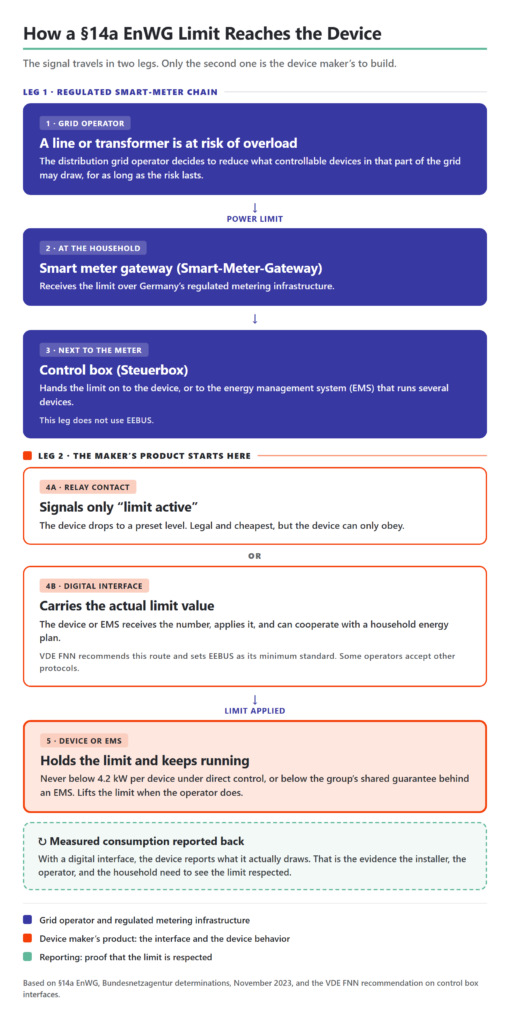
The second leg runs from the control box to the device, or to the EMS. This is where the maker’s product starts. One option is a relay contact that signals “limit active.” The other is a digital interface. VDE FNN, the grid technology forum of the German electrical engineering association, recommends it as the preferred route and sets EEBUS as its minimum standard. The International Electrotechnical Commission has adopted EEBUS for the link between charging stations and local energy management systems as IEC 63380. A relay is still legal, and some operators accept other protocols.
An EEBUS wallbox receives the actual limit, applies it, and reports its consumption back. A relay-controlled wallbox learns only that a limit is active and falls to a preset level. The first can cooperate with a household energy plan. The second can only obey.
A limit that nobody can see being honored is weak evidence for the installer and the operator. Codibly’s EEBUS integration service therefore scopes limiting and reporting together, and fits the EEBUS stack to the maker’s own firmware and release process. The protocol is well defined. Fitting it to a specific product sets the size of the project.
Great Britain took a different route, writing demand response into the charger itself and leaving the signal path to the energy supplier, as Codibly’s article on UK smart charging regulations explains.
One minimum power, several devices
The 4.2 kW figure applies per device under direct control. The alternative connects the control box to one home energy management system (HEMS), which manages the wallbox, heat pump, and battery. The operator then sends one limit for the group.
The group shares one guaranteed amount. Annex 1 of the grid-access determination sets it at 4.2 kW for the first device, plus 4.2 kW times a simultaneity factor (Gleichzeitigkeitsfaktor) for each further device. The factor is 0.8 for two devices, 0.75 for three, 0.7 for four, 0.65 for five, 0.6 for six, 0.55 for seven, 0.5 for eight, and 0.45 for nine or more. Two devices behind an EMS share 7.56 kW, and three share 10.5 kW.
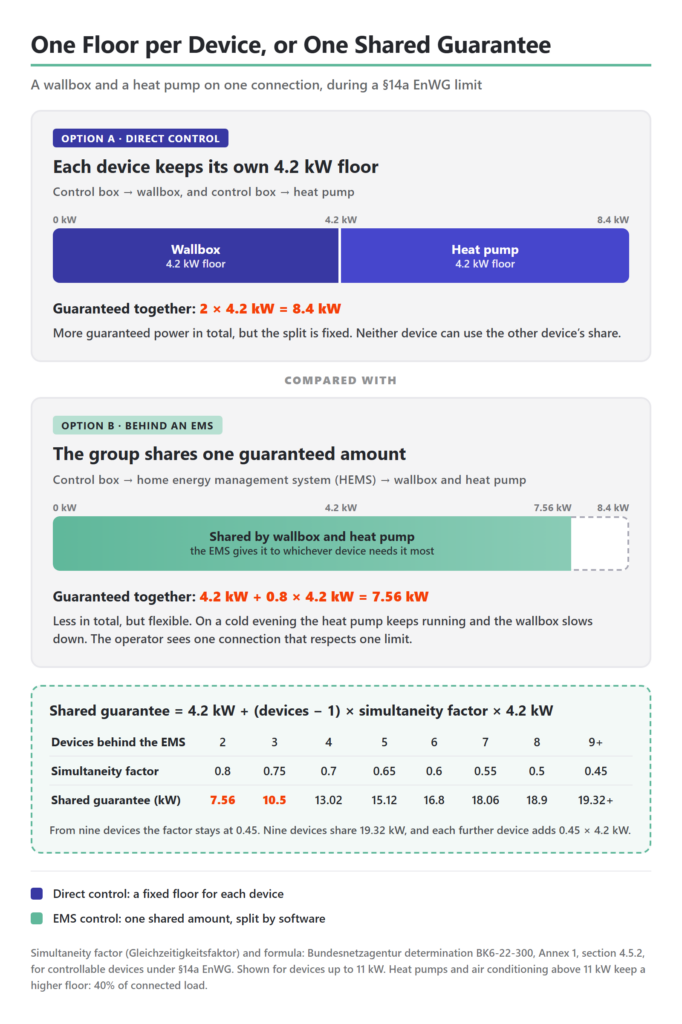
That is the trade. Two devices under direct control keep 8.4 kW between them. Behind an EMS they share 7.56 kW, and the EMS may give it to whichever device needs it most. On a cold evening the heat pump keeps running and the wallbox slows down. The operator sees one connection that respects one limit.
So which product in the house is the EMS? Some wallbox makers ship their own HEMS, some battery makers let the inverter play that role, and other households buy a third-party system. A device that assumes it is the only controllable load will work against whichever EMS is installed.
In real buildings, often only some equipment speaks EEBUS, while the battery and solar inverter speak Modbus or a vendor protocol. The EMS translates, so the building appears to the grid as one participant. The allocation logic is the discipline of dynamic load management, covered in Codibly’s article on EV charging load management: one ceiling, several loads, and software deciding the split.
What device makers have to change
A §14a-compliant wallbox (a “14a EnWG konforme Wallbox” in German listings) is defined by its behavior on the grid, and so are heat pumps and batteries. For a maker from outside Germany, the changes follow an order:
- Choose the device’s role. Controlled directly, controlled through an EMS, or the EMS itself. Every later decision depends on this one.
- Make power a settable value. Accept a limit, run usefully at 4.2 kW or a share of a group limit, and recover when it lifts.
- Pair the limit with measurement. Report what the device actually draws.
- Define behavior when the link drops. Stay predictable if contact with the control box or EMS is lost.
- Keep the German interface separable. Build it as a module, so other markets can connect a different upstream protocol.
The last step carries the most business weight. Grid-interactive behavior is now a condition of market access in more than one market, as Codibly’s analysis of demand response certification as a market access requirement set out. SolarEdge met a version of this in Australia, where several regional grid operators set their own requirements. As technical partner, Codibly adapted the architecture of SolarEdge’s IEEE 2030.5 client to connect to those networks. Germany has several hundred distribution grid operators, and a modular design limits the cost of differences between them.
Many makers will buy a ready protocol module and fit it late. That can work for a relay. For an EEBUS interface working with an EMS, steps one and four shape the firmware, so they belong at the start of a product cycle. Codibly’s energy standards implementation work starts there.
§14a EnWG is one of several rulebooks now deciding how energy devices behave on the grid. Codibly’s white paper on where grid functions should live sets them side by side, from ISO 15118 in the EU to the UL standards in the US.
A device that the grid can only switch off is a weakness its maker has to explain to every customer. A device that accepts a limit, keeps running, and earns the household a lower grid fee gives the sales team something to sell.
Frequently Asked Questions
Devices put into service from January 1, 2024, with a connected load above 4.2 kW: private EV charging points, heat pumps, room air conditioning, and battery storage. Public charge points are excluded.
The grid operator may reduce the device’s power draw when the local grid risks overload, but may not switch it off. Under direct control, each device keeps at least 4.2 kW. Behind an energy management system, the devices share one guaranteed amount, for example 7.56 kW for two devices.
Yes. The wallbox receives a power limit over EEBUS, applies it, and reports its consumption back. The VDE FNN recommendation sets EEBUS as the minimum standard for the digital interface. A simple relay is still legal, and some operators accept other protocols.
The household chooses. Module 1, a flat annual reduction, is the default and needs no extra meter. Module 2 cuts the per-kWh grid fee for the device by 60% and needs a separate meter point, so it tends to suit high-consumption devices.
Devices with a reduced grid fee under the old §14a keep those terms until the end of 2028; then the new rules apply. Older devices without one are not covered unless their owners opt in.