UK Smart Charging Regulations: What Charger Makers Must Build In

What happens to your charger’s demand response the day its owner switches energy supplier?
Under the UK smart charging regulations, the charger must keep its smart functions, demand response included. The Electric Vehicles (Smart Charge Points) Regulations 2021, usually called the smart charge point regulations, made every home and workplace electric vehicle (EV) charger sold in Great Britain since 30 June 2022 a device the grid can schedule. Most makers built the device features years ago. The supplier-switch clause reaches further, into your platform. It shapes the signal path, and whether one product can sell in the EU too.
Every home charger in Great Britain is already a grid device
Smart functionality has been the legal baseline since 30 June 2022, with security requirements from 30 December 2022, according to the government’s guidance. The statute leaves the chain behind the charger to you: your platform, the supplier or aggregator, and the network operators that buy flexibility. That chain sets the cost of every supplier integration. The same split between charger and platform applies under ISO 15118.
What the Smart Charge Point Regulations require
The smart charging regulations set eight requirements. The table shows where each one lives in the product.
| Requirement | What the charger must do | Where it lives |
|---|---|---|
| Smart functionality | Send and receive data; respond to signals on rate or timing | Charger and platform |
| Supplier interoperability | Stay smart after a supplier switch | Platform and supplier link |
| Continued charging | Charge without a network connection | Firmware |
| Off-peak defaults | Default hours outside weekday peaks; the owner accepts, removes, or changes them | Firmware; app prompt |
| Randomized delay | Random delay of up to 600 seconds by default; the owner can cancel it | Firmware |
| Demand side response | Change the rate or timing of charging on a signal | Charger executes; platform originates |
| Measuring system | Measure energy and charging time; show the owner 12 months of data | Metering; app |
| Security | Meet Schedule 1, based mostly on ETSI EN 303 645 | Charger and platform |
Sources: the Regulations and the Office for Product Safety and Standards (OPSS) guide. The third column is Codibly’s design reading.
Default off-peak hours
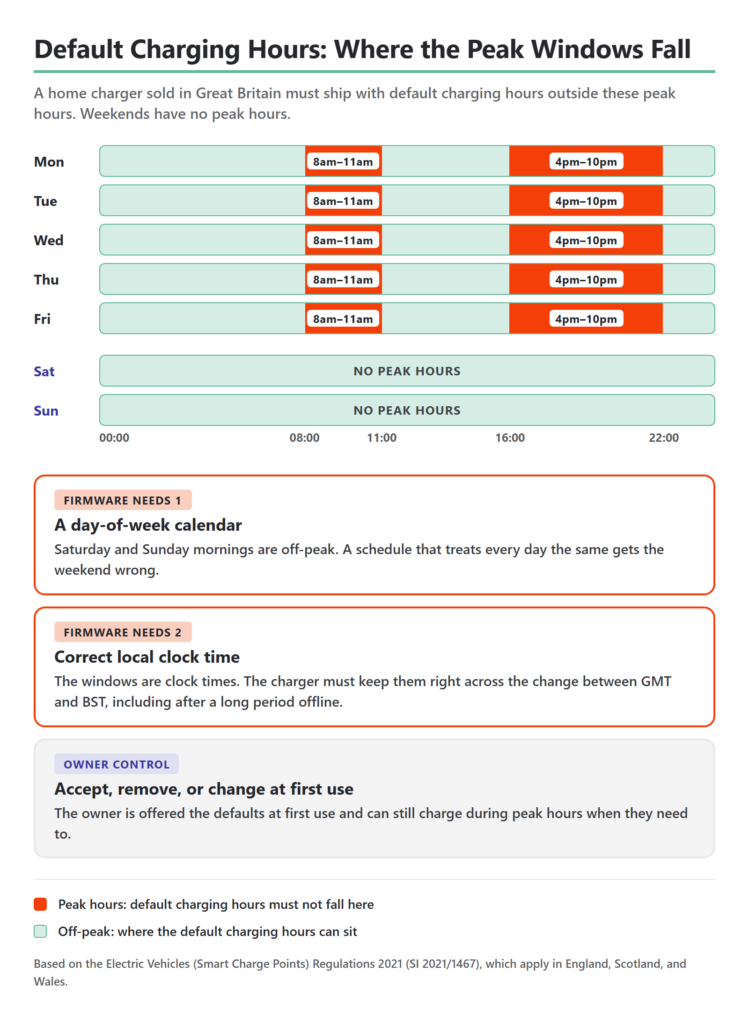
Peak hours are 8am to 11am and 4pm to 10pm on weekdays, with none at weekends. The firmware needs a day-of-week calendar and correct local time across the clock change, even after a long period offline. At least one widely read guide puts the morning peak at weekends. Use the statute.
Randomized delay
At each start of charging and each change in rate, the charger applies a random delay of up to 600 seconds (10 minutes) by default. The owner can cancel it, and the maximum must be adjustable remotely up to 1,800 seconds. The delay stands down during a fast response service, such as frequency response, or when an equivalent random delay was already applied. So decide which layer owns the staggering, and keep the statement of compliance in line with the firmware.
Demand side response
The EV smart charging regulations require capability and leave participation to the owner. The charger accepts a limit or schedule, applies it within its safety limits and the owner’s settings, and reports what happened. Whoever pays for flexibility needs that evidence.
Security and the measuring system
Schedule 1 draws mostly on ETSI EN 303 645, the European security standard for consumer connected devices, and adds tamper protection and a security log. Updates and credentials live in your platform, so firmware and backend teams share the work. The measuring system records energy and charging time and reports power every second over the network. A supplier verifying a demand response event needs the same data, so build that path once.
Who the regulations cover, and who they leave out
The Regulations cover private charge points, including smart cables, sold in Great Britain. Northern Ireland is outside their scope, and so are public charge points, rapid charge points of 50 kW or more, and units sold for export. The duty falls on anyone who sells, offers, or advertises a charger anywhere in the supply chain, so a maker selling through installers carries it too.
England made a second regulation change for EV chargers in new homes. Since 15 June 2022, Part S of the Building Regulations has required most new homes with parking to have a charge point, rated at least 7 kW under Approved Document S. Public chargers fall under separate electric vehicle charging regulations in the UK, mainly the Public Charge Point Regulations 2023, covered in Codibly’s guide for charge point operators.
How a demand response signal reaches the charger
The statute names the behavior and none of the protocols. Supplier interoperability narrows the choice: demand response that works through one supplier’s private integration stops when the owner moves. The signal takes one of three routes.
| Route | In the charger | In the platform |
|---|---|---|
| Open Charge Point Protocol (OCPP) | OCPP client; local limits, defaults, and delay | Supplier integrations, optimization, OpenADR translation |
| Maker’s cloud API | Cloud link; the same local rules | One API for any supplier |
| OpenADR on the device | Virtual End Node (VEN) and reporting | Registration and updates |
Deciding which chargers to slow, and by how much, belongs in the platform, because tariffs change faster than firmware can safely ship. Upstream, Great Britain’s network operators, through the Energy Networks Association (ENA), chose OpenADR for a common flexibility dispatch standard. Elexon, market facilitator for flexibility since December 2025, is taking it forward. On the OCPP route, a protocol bridge in the platform turns OpenADR events into OCPP charging profiles.
Codibly’s OpenADR accelerators cover both ends. Codibly OpenADR VTN 2.0b (Firmware 1.0) has been certified since September 2026, and the VEN code is pre-certified. The same approach took a major US pool equipment manufacturer’s OpenADR 2.0b VEN through certification in six weeks.
The platform side is the same work at a larger scale. Codibly built a utility-ready managed EV charging platform for Banyon Power, the layer that decides which chargers slow down and by how much.
One product for Great Britain and the EU
EU markets add their own rules. The Alternative Fuels Infrastructure Regulation (AFIR) requires ISO 15118-20 at new and renovated public charge points from 1 January 2027, a date CharIN has asked the Commission to postpone. In Germany, §14a of the Energiewirtschaftsgesetz (EnWG) lets grid operators limit wallboxes, though never below 4.2 kW under direct control.
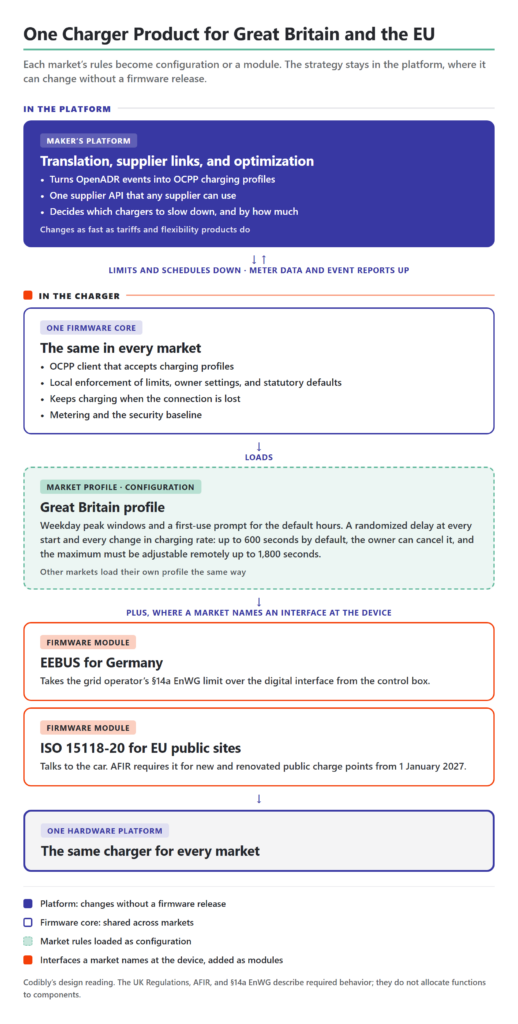
Security overlaps most. The EU Radio Equipment Directive has required cybersecurity protections for connected radio equipment since August 2025, and the EN 18031 standards overlap much of ETSI EN 303 645. Control splits. A British charger takes demand response through a supplier. A German wallbox takes a grid operator’s limit, typically over EEBUS. An EU public charger speaks ISO 15118-20 to the car.
The design rule: one hardware platform, one firmware core, and each market’s rules as configuration. Interfaces a market names at the device become firmware modules. Translation, supplier APIs, and optimization stay in the platform, where they change without a firmware release.
What OPSS checks
OPSS can demand information and inspect or seize products. It can issue compliance notices that can require a recall or withdrawal and impose civil penalties of up to £10,000 per non-compliant charge point.
Under the EV charger regulations in the UK, the proof has three parts: a statement of compliance with every charger, a technical file that records the software version at the time of sale, and a register of every charger sold in the past ten years. The exposure sits in what OPSS can check later: a supplier switch that disables demand response, or a technical file describing a delay the current firmware no longer applies.
Build the rules into the charger and the strategy into the platform
In Great Britain the device work is largely done. What remains is architecture: an interface any supplier can use, local enforcement of the statutory defaults, and optimization in a platform that changes as fast as tariffs do. The split carries to Germany, to EU public sites, and to the US, where an exporting charger must pass the UL rules for inverters.
Codibly works with charger makers on that boundary, from the OCPP client in the charger to the demand response integration behind it. The cheapest moment to set it is before your next firmware freeze.

Frequently Asked Questions
A home or workplace charger sold in Great Britain must be smart, stay smart after a supplier switch, charge offline, and support demand side response. It needs off-peak default hours, a default random delay of up to 600 seconds, a measuring system, and security based on ETSI EN 303 645.
The Smart Charge Point Regulations have covered private chargers since 30 June 2022. The Public Charge Point Regulations 2023 cover public chargers, including 99% reliability across each operator’s rapid network. In England, Part S has required charge points in most new homes with parking since June 2022.
No. Rapid charge points of 50 kW or more are excluded, and so are all public charge points.
Ten years for the register of sales, which every seller must keep and show OPSS on request. The Regulations set no fixed period for the statement of compliance or the technical file, so keep each one matched to its firmware version.