UL 9741 and UL 1741 SC: Certifying a Bidirectional EV Charger

The certificate should be the last thing a maker of a bidirectional EV charger chooses. Most roadmaps run the other way. They name the target listing first, UL 9741 plus some version of UL 1741, and then design the product to pass it. For a charger that only draws power, that order works. For one that sends power back to the grid, it invites a second round of lab work.
Once a charger exports, US certification judges it as part of an inverter system. What the product does on the grid then decides which certificate applies: how it responds to voltage and frequency, how it takes settings from the utility, and how it supervises the car during discharge. UL 1741 Supplement SC, the newest route for AC chargers, makes that plain. It certifies the charger for a behavior.
When a charger starts exporting, it becomes an inverter
A one-way charger is a load. UL 2594 covers AC electric vehicle supply equipment (EVSE), UL 2202 covers DC charging equipment, and neither expects current to flow into a building or a feeder.
A Vehicle-to-Grid (V2G) charger reverses the flow and runs in parallel with the utility. The utility then asks what it asks of any distributed energy resource (DER): stay within voltage and frequency limits, stop exporting when the grid goes down, and accept settings from the operator. That is an inverter’s job, and the US standard for inverters is UL 1741. The protocol layers a V2G transaction needs come on top of it.
So a V2G EV charger competes on export capacity, vehicle compatibility, and program eligibility, and each depends on its certificates. Codibly’s work on V2X (vehicle-to-everything) solutions starts there: the export function sets the certification scope, so it must be settled before the hardware is frozen. Where each grid function should live is the subject of our white paper ISO 15118 Is Now Law. Where Should the Grid Functions Live?
A maker can also sell home backup only. The charger then powers the house through a transfer switch while the home is cut off from the grid, a mode in which some vehicle-to-home (V2H) systems run only when the grid is down, as UL Solutions describes it. Where no local program pays for exported energy, that is a sound choice. Exporting later is a second certification project, because UL 9741 relies on UL 1741 for grid interconnection, and the utility then needs an interconnection application as well.
What UL 9741 covers
UL 9741 is the standard for electric vehicle power export equipment: the hardware that takes energy from a vehicle battery and delivers it to loads or to the grid. It addresses the hazards of reverse power flow. Fermata Energy’s bidirectional charger was the first certified to it, in 2020, UL Solutions announced.
Grid behavior is a separate question. Ride-through, voltage and frequency response, anti-islanding, and remote settings sit in UL 1741, which is why UL Solutions’ guidance on bidirectional chargers presents the two together. UL 9741 answers whether the export hardware is safe. UL 1741 answers whether the utility will let it connect.
UL 1741 SA, SB, and SC: which one applies to your charger
UL 1741 is the US standard for inverters, converters, controllers, and interconnection system equipment used with DERs. Its supplements add grid behavior:
- UL 1741 SA (2016) tested grid support functions against source requirement documents such as California’s Rule 21.
- UL 1741 SB (2021 edition) tests against IEEE 1547.1-2020, the test procedure for IEEE 1547-2018, including the utility communication interface.
- UL 1741 SC (2026) covers AC bidirectional EVSE working with vehicles whose onboard inverter meets SAE J3072.
For a new product, the UL 1741 SA vs SB question is largely settled. Rules that adopt IEEE 1547-2018 reference SB, so a new DC bidirectional charger should plan for SB.
Two routes to certification
The new route runs through UL 1741 SC, which UL Standards & Engagement published on May 21, 2026. The charger is certified as an “oversight supervisor” for a vehicle built and tested to SAE J3072, and this route does not rely on certifying one vehicle and charger as a single system, the Vehicle-Grid Integration Council (VGIC) explains. UL Solutions launched a certification program on the supplement in September, pv magazine USA reported.
The older route certifies charger and vehicle together as a multipiece DER system under UL 1741, with UL 9741 for the export equipment. UL Solutions still offers it. It suits a maker with one vehicle partner or a fleet on one model. In a mixed retail market, the pairing limits who the product can serve.
The AC path and the DC path
Where the inverter sits decides the path.
| Path | Where the inverter sits | Charger certified as | Main standards |
|---|---|---|---|
| DC bidirectional | In the charger | The inverter itself | UL 9741 and UL 1741 SB |
| AC, UL 1741 SC route | In the vehicle, built to SAE J3072 | Supervisor of the vehicle’s export | UL 1741 SC |
| AC, multipiece route | In the vehicle | Part of a certified charger-and-vehicle pair | UL 1741 multipiece DER system and UL 9741 |
The grid functions behind the certificate
Most of what those certificates test is software.
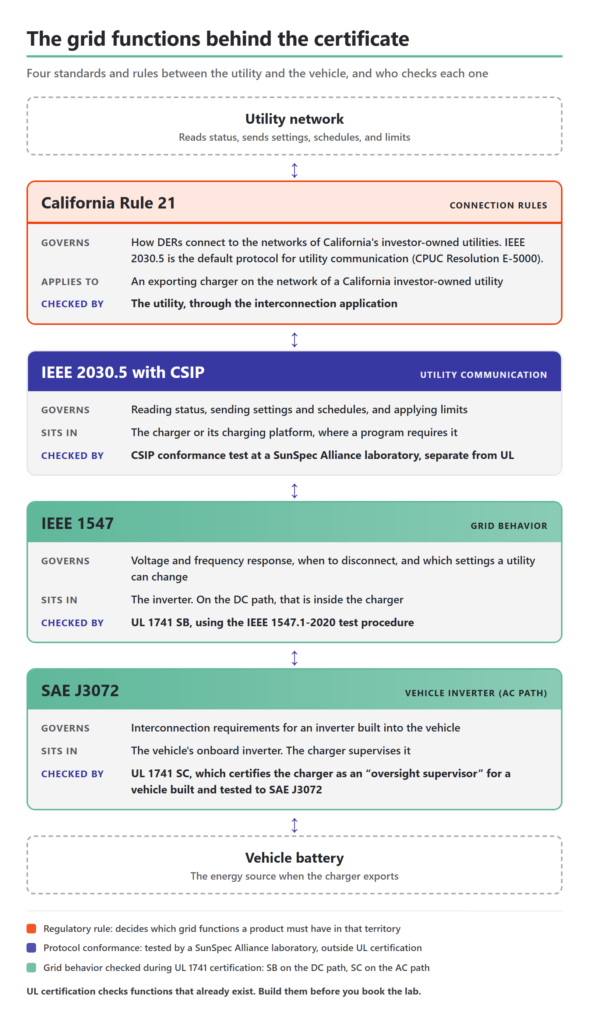
IEEE 1547. The national interconnection standard defines how a DER responds to voltage and frequency, when it disconnects, and which settings a utility can change. UL 1741 SB tests it. See how it pairs with IEEE 2030.5 in renewable integration.
SAE J3072. It sets the interconnection requirements for an inverter built into the vehicle. Under UL 1741 SC, the charger’s supervision of that vehicle is what gets certified.
California Rule 21. This tariff governs how DERs connect to California’s investor-owned utilities, and an exporting charger falls under it. IEEE 2030.5 is its default application-level protocol for utility communication, with others allowed by mutual agreement, as CPUC Resolution E-5000 confirms.
IEEE 2030.5 and CSIP. The Common Smart Inverter Profile (CSIP) narrows IEEE 2030.5 to what utilities use with DERs: status, settings, schedules, and limits. SunSpec Alliance laboratories test CSIP conformance, separately from UL certification, as our CSIP certification guide explains.
UL certification checks grid functions that already exist. A team that books a lab before its grid software is finished finds the gaps at the most expensive point.
A certification sequence for charger makers
The order of work runs from software to certificate:
- Scope: grid export, home backup, or both; target territories and programs.
- Path: DC with UL 1741 SB, or AC through UL 1741 SC or the multipiece route.
- Grid software: IEEE 1547 settings, J3072 supervision on AC, and an IEEE 2030.5 and CSIP client where programs require it.
- Protocol conformance: CSIP testing at a SunSpec Alliance Authorized Test Laboratory.
- Product certification: UL 9741 and UL 1741 listings from a Nationally Recognized Testing Laboratory (NRTL), such as UL Solutions.
- Interconnection: certificates go with utility and program applications.
Codibly works on steps three and four. Our IEEE 2030.5 client code is pre-certified and delivered through the IEEE 2030.5 accelerator. Codibly is also a SunSpec Alliance Authorized Test Laboratory, so the same team can run IEEE 2030.5 and CSIP conformance testing. Codibly does not perform UL certification; those listings come from an NRTL. The same split applies to our regulatory compliance and protocol implementation work.
OpConnect, a US EV charging company, worked through steps three and four. Codibly extended its IEEE 2030.5 client accelerator for OpConnect’s chargers and backend, covering CSIP and CSIP-AUS, and led the SunSpec certification testing as an Authorized Test Laboratory, as the OpConnect case study records.
Some makers will wait. Bidirectional testing is young: at CharIN’s Arnhem Testival in May 2026, 13 of 23 DC and 7 of 11 AC systems supported bidirectional energy flow, and CharIN still sees V2G compliance testing against European grid requirements as early stage, electrive reported. Waiting is defensible for the certificate, but steps three and four take engineering time that no change of route removes.
Decide the grid functions, then book the lab
UL 1741 SC frees the AC charger’s certificate from any single vehicle. The DC path still runs through UL 9741 and UL 1741 SB. Both reward the maker that already knows which grid functions its product performs, where, and over which protocol. For makers also selling in Great Britain, UK Smart Charging Regulations: What Charger Makers Must Build In sets out that rulebook.
Frequently Asked Questions
One-way chargers fall under UL 2594 (AC) and UL 2202 (DC). A charger that also exports vehicle power needs UL 9741, plus a UL 1741 listing if it runs in parallel with the utility.
UL 1741 is the US safety standard for inverters and interconnection equipment used with DERs, including bidirectional chargers. Supplement SB covers IEEE 1547-2018; SC covers AC bidirectional chargers supervising SAE J3072 vehicles.
SA (2016) tested grid support against state documents such as California’s Rule 21. SB (2021 edition) tests against IEEE 1547.1-2020, including the utility communication interface. New products should plan for SB.
UL 1741, typically with Supplement SB for grid-connected units. A DC bidirectional EV charger contains an inverter, so it is evaluated under UL 1741 as well as UL 9741.