Economic vs Emergency Demand Response: Software Architecture for Day-Ahead Bidding, Real-Time Dispatch & Revenue Stacking

Economic demand response and emergency demand response sound like two flavors of the same program, but they are two separate software stacks disguised as one acronym. Economic DR pays aggregators to offer load reduction at competitive prices in day-ahead and real-time energy markets — the software has to forecast, bid, win or lose, and dispatch on the cleared schedule. Emergency DR dispatches only when the grid is under stress, with sub-minute response SLAs and steep non-performance penalties — the software has to be reliability-first. Most aggregator marketing flattens this distinction into “demand response programs”; the procurement decision is much sharper than that. The aggregator that treats economic and emergency as variations of the same platform either overbuilds for emergency reliability or underbuilds for economic-bidding sophistication, and loses margin in the program that pays better. This guide describes both software stacks and how a multi-program demand response aggregator business models builds them on one operational platform.
Economic DR vs Emergency DR: The FERC Taxonomy and Why It’s Operationally Real
The Federal Energy Regulatory Commission has a clean taxonomy for demand response: price-based DR (which earns revenue by responding to wholesale price signals through day-ahead and real-time markets) and incentive-based DR (which earns revenue by being available to dispatch during emergencies, with payments tied to availability rather than realized energy). Economic DR is the price-based half. Emergency DR is the incentive-based half — though most US ISOs operate emergency programs with both reliability triggers and capacity-payment structures.
This is not regulatory theater. The two halves have fundamentally different software requirements. Price-based requires forecasting, bidding logic, settlement against locational marginal price (LMP), and the operator-console workflow for daily market participation. Incentive-based requires reliability-engineered dispatch, sub-minute telemetry, and the M&V audit trail that survives a non-performance dispute. Aggregators that build one stack and try to bolt on the other discover the gaps under load — usually during the first economic bidding window after a quiet emergency-program winter, or during the first emergency event after a profitable economic-bid summer.
The FERC Order 745 + Order 2222 framing
FERC Order 745 (2011) established that economic DR — load reduction offered into the wholesale energy market — must be paid at LMP minus a “G” threshold (essentially the retail rate the customer would have paid). The order is what made economic DR commercially viable at scale. FERC Order 2222 (2020) extended the principle to distributed energy resource aggregations, which made the economic stack the bigger growth surface — DERs (BESS, EV charging, controllable HVAC, on-site generation) earn continuous revenue from the energy market, not only during emergencies.
Where the two streams converge (and where they don’t)
The shared layer is real-time dispatch capability — both economic and emergency events require the platform to actually curtail enrolled assets on schedule. The divergent layers are upstream (forecasting + bidding for economic; reliability engineering for emergency) and downstream (settlement against LMP for economic; non-performance penalty defense for emergency). Most aggregator software vendors built emergency stacks first because emergency programs predate organized energy markets in many ISOs; economic stacks were built later and frequently as add-ons rather than first-class subsystems.
Emergency Demand Response: Reliability-First Software Architecture
Emergency DR programs dispatch when the grid is under stress — capacity shortfalls, unplanned generator outages, extreme weather, transmission constraints. The dispatch trigger comes from the ISO under formal emergency declarations (PJM Capacity Performance non-performance events, ERCOT ERS deployments, CAISO Emergency Load Reduction Program calls, ISO-NE Capacity Performance Hour calls). Response time SLAs run 10 minutes for the fastest tiers; non-performance penalties are steep and material to aggregator P&L.
The software architecture for emergency DR is reliability-engineered first. Sub-minute streaming telemetry on every enrolled asset; certified protocol-stack adapters; redundant dispatch pathways; M&V baseline methodology that holds up against ISO audit. The dispatch engine prioritizes show-up reliability over optimization sophistication — a 95% bid-acceptance rate on a clever optimization model is worth less than a 99.5% reliable dispatch on a less-clever model. The software pattern is closer to the reliability discipline of automated demand response programs and certified demand response management system deployments than to algorithmic energy-market trading.
Why emergency software is reliability-engineered first, optimization-engineered second
Emergency DR programs reward the aggregator that delivers the bid MW reliably across many events; they punish the aggregator that misses an event with non-performance penalties that can erase a year of capacity payments. The software design choice is to engineer for the worst case (a hot August Tuesday with simultaneous events across multiple ISOs and one TDSP outage corrupting telemetry) rather than to optimize the average case.
PJM Capacity Performance + ERCOT ERS + CAISO ELRP as examples
PJM Capacity Performance is the canonical capacity-market emergency program, with non-performance enforcement that drove a record $120,147/MW-year clearing price for 2026/2027 — the platform that wins PJM is the one that makes the bid + delivers reliably enough to keep the cleared revenue. ERCOT ERS runs four service types (10/30-minute, weather-sensitive/non) with quarterly procurement; the PJM demand response aggregator software guide covers PJM in detail, with the ERCOT companion piece covering ERS, LaaR/CLR, the ADER pilot, and 4CP-driven C&I behavioral DR. CAISO ELRP runs May–October at $2/kWh through October 2027.
Economic Demand Response: Forecasting + Bidding Software Architecture
Economic DR pays into the wholesale energy market through day-ahead bidding (cleared at LMP for the next day’s hourly schedule) and real-time bidding (5-minute granularity in some ISOs) when the aggregator’s offered load reduction is competitive with the marginal generator. The software requirements are an order of magnitude more complex than emergency DR’s reliability-first architecture, because the platform now has to forecast, bid intelligently, and settle against a market price.
Three subsystems define economic DR software. The load forecasting model predicts day-ahead load profiles for each enrolled asset under expected weather, market, and operational conditions; without an accurate forecast the bid is either too low (leaving margin on the table) or too high (winning at a loss). The day-ahead bidding optimizer translates the forecast into an offer curve, decides which assets to bid into which hours, and submits the offer to the ISO before the day-ahead market clears. The real-time market interface handles intra-day re-bidding when conditions diverge from the forecast and the aggregator can capture additional spread.
| Software capability | Economic DR | Emergency DR | Multi-program platform |
|---|---|---|---|
| Load forecasting | Production-grade — accuracy floor drives bid margin; weather-adjusted, asset-level. | Adequate is fine — emergency programs reward show-up reliability, not forecasting precision. | Production-grade economic forecast feeds emergency availability calc; do not share the same model output unfiltered. |
| Bidding optimizer | Day-ahead offer-curve construction; intra-day re-bidding; intelligent capacity allocation across hours. | Not applicable — emergency programs are availability-based, not market-bid. | Economic-side first-class subsystem; not coupled to emergency dispatch sequencer. |
| Real-time dispatch | Cleared economic bid triggers same dispatch path as emergency event; difference is in trigger source. | ISO emergency declaration triggers; sub-minute response SLA; reliability-engineered. | Shared layer — both economic and emergency dispatch flow through the same engine. |
| Telemetry pipeline | Sub-minute streaming for settlement-quality M&V; analytics-grade. | Sub-minute streaming with reliability-engineering — 5-nines availability and durable replay required for non-performance dispute defense. | Shared layer — reliability-engineered SLA serves both stacks. |
| M&V baseline | LMP-minus-G settlement against energy-market clearing; per-interval reconciliation. | Customer Baseline Load (CBL) or weather-normalized regression against capacity-payment availability; per-event reconciliation. | Two distinct subsystems sharing the asset registry and telemetry; do not unify the calculation. |
| Settlement reconciliation | Hourly or 5-minute settlement files; ISO-specific reconciliation cycles. | Per-event capacity reconciliation; non-performance penalty defense audit trail. | Unified back-office subsystem that produces ISO-specific settlement files for both stacks. |
The settlement layer is where economic DR diverges most sharply from emergency. Economic settlement happens hourly (or 5-minute in some ISOs) at the locational marginal price minus the FERC Order 745 G threshold — the math is granular and accumulates across thousands of intervals per month. Emergency settlement happens per-event with capacity reconciliation. The reconciliation logic, accounting infrastructure, and audit trail are different stacks, not configurations of the same stack.
Day-ahead bidding software is a different beast than emergency dispatch software
Day-ahead bidding requires a forecasting accuracy floor that emergency dispatch does not — emergency dispatch can underbid the available MW by 20% and still hit the program reliability target; economic bidding that underbids 20% leaves all the margin on the table for the next aggregator. The software optimization problem is fundamentally different: emergency optimizes for reliable show-up; economic optimizes for accurate forecasting + intelligent bidding curve construction. Most off-the-shelf DRMS platforms have an emergency-grade forecast (acceptable for capacity-payment availability) and treat the economic forecast as a downstream feature; aggregators that compete in economic markets typically rebuild the forecasting subsystem.
Real-Time Dispatch and the Sub-Minute Telemetry Layer Both Stacks Share
The point of convergence is real-time dispatch. Both economic DR (when an aggregator’s day-ahead bid clears) and emergency DR (when an ISO declares an event) require the platform to actually curtail enrolled assets on schedule. The shared layer is sub-minute streaming telemetry, a unified asset registry, the dispatch engine that sends control commands, and the operator console that monitors event-window performance.
The telemetry backbone (Kafka or MQTT for streaming, plus the protocol adapters for OCPP, OpenADR, IEEE 2030.5, Modbus, and OEM-proprietary APIs) serves both stacks. The asset registry that tracks enrollment, eligibility, and contractual terms across programs is shared infrastructure. The dispatch engine that translates ISO commands into per-device control instructions is shared. This is the architecture pattern covered in the demand side response platform architecture guide — a five-layer reference architecture that splits cleanly between shared infrastructure and program-specific subsystems.
Where the two stacks share infrastructure (and where they shouldn’t)
The shared infrastructure is real, but the temptation to share too much is the largest design mistake aggregator software architects make. The forecasting model for economic should not feed the same baseline calculation as the emergency M&V, because the two settlement methodologies are fundamentally different (LMP minus G versus capacity payment with non-performance reconciliation). The bidding optimizer for economic should not be entangled with the emergency dispatch sequencer, because emergency events trigger differently and the queueing logic is different. Aggregator stacks that share the asset registry, telemetry backbone, and dispatch engine — but isolate the forecasting / bidding subsystem and the M&V / settlement subsystem per program — scale better than monoliths that try to unify everything.
FERC Order 2222 and DER Aggregation: How Economic DR Is Becoming a Bigger Stack Than Emergency
FERC Order 2222 (2020) directed every US ISO to allow distributed energy resource aggregations to participate in wholesale energy and capacity markets. Implementation timing varies — NYISO (2023), ISO-NE (2024), PJM (staggered through 2026), MISO (in implementation), CAISO (existing rules, expanded), ERCOT (parallel ADER pilot path since ERCOT is non-FERC-jurisdictional). The implication for aggregator software is that economic DR is becoming the bigger growth surface, because Order 2222 expanded the addressable market for DER aggregations by an order of magnitude.
Capacity-market revenue (the emergency DR engine in most ISOs) is annual, predictable, and capped by program design. Energy-market revenue (the economic DR engine) is event-by-event, volatile, and uncapped — it pays continuously across the year, every hour the aggregator’s offer clears against the marginal generator. As Order 2222 implementations mature, aggregators with sophisticated economic-DR software extract margin that aggregators with emergency-only stacks miss entirely. The gap is widening fastest in PJM (where the implementation is most advanced) and in ERCOT (where the ADER Pilot Phase 3 cap was raised to 500 MW in March 2026). For the C&I-buyer side of this same story — where on-site flexibility integrates into both economic and emergency stacks — see the commercial & industrial demand response software guide.
Why Order 2222 implementation timing matters for the aggregator software roadmap
An aggregator building software in 2026 faces a moving target across ISOs. The platform that’s certified for PJM’s DER aggregation rules today may need significant rework for MISO’s implementation when it lands; the platform built for ERCOT’s ADER pilot path is effectively building for a different regulatory regime than the FERC ones. Software roadmaps that treat Order 2222 as one regulatory milestone routinely underbudget the per-ISO implementation cost.
Stacking Programs: How an Aggregator Builds Software That Wins Both Economic and Emergency Revenue
The hardest part of multi-program aggregator software is operating economic and emergency simultaneously on the same platform — same QSE / Curtailment Service Provider, same enrolled assets, same control plane. The platform has to handle simultaneous calls (an emergency event during a cleared economic bid hour), conflict resolution (economic bid commits the asset for the cleared interval; emergency event needs the same asset for reliability), and settlement reconciliation (the same MW delivered earns one stream of revenue, not two — the FERC double-compensation rule).
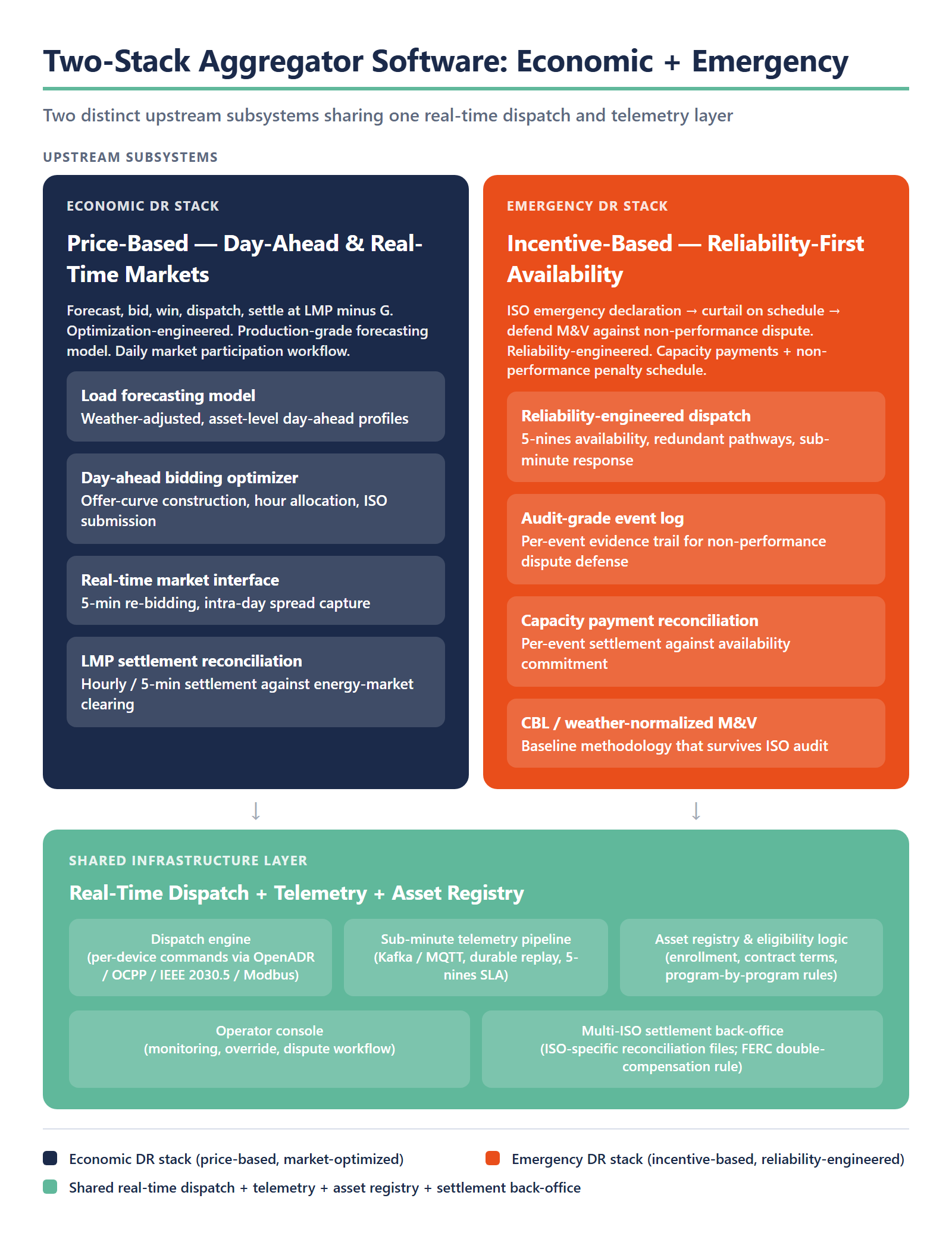
Software that handles this well isolates the two upstream subsystems (forecasting + bidding for economic; reliability + dispatch sequencing for emergency) and treats the shared real-time dispatch layer as the contention point. The conflict-resolution logic is operational guidance — not a regulatory rulebook — and aggregators that encode it as configuration (event-priority rules, asset-by-asset eligibility, settlement reconciliation logic) outperform aggregators that hard-code program-specific behavior into the dispatch engine.
| Aggregator portfolio | Economic DR fit | Emergency DR fit | Software stress points when stacking both |
|---|---|---|---|
| C&I curtailment-only aggregator (single-ISO focus, mostly industrial loads) | Accessible — most C&I sites can support day-ahead offer curves; forecasting is the early build investment. | Default starting position — emergency capacity payments are how this segment historically built revenue. | Conflict resolution between cleared economic bids and emergency events on the same site; settlement reconciliation per program. |
| BTM storage / VPP aggregator (battery- or solar+storage-led) | Strong fit — storage is the asset class economic markets reward most directly through energy arbitrage. | Strong fit — storage is the asset class emergency programs accept on the shortest response-time tiers. | Storage discharge authority arbitration; OEM warranty cycle-count accounting across both stacks. |
| EV-charging aggregator (workplace, depot, public) | Emerging fit — soft-curtailment policies via OCPP 2.0.1 SmartCharging make economic participation viable for workplace + depot fleets. | Fit is workplace + depot only; public destination charging breaks emergency reliability profile (driver UX). | Use-case-specific dispatch policy; settlement attribution between facility and driver. |
| Multi-ISO multi-asset portfolio aggregator (PJM + ERCOT + CAISO + ISO-NE simultaneously) | The biggest growth surface — Order 2222 implementations are maturing across ISOs, and economic energy-market revenue is uncapped. | Capacity-payment baseline; needed for portfolio diversification and to anchor economic upside. | Per-ISO settlement reconciliation; per-program M&V baseline methodology coverage; FERC double-compensation rule enforcement. |
Settlement reconciliation across the two streams
Economic DR settles hourly at LMP minus G; emergency DR settles per-event against capacity payments and non-performance penalty schedules. Combined revenue stacking requires the platform to track which MW delivered in which interval against which program, and to produce settlement files for each ISO’s reconciliation cycle. Aggregators that build this reconciliation as a unified subsystem (rather than per-program back-office workflows) settle cleanly across markets and produce the audit trail regulators ask for during disputes.
Selecting Aggregator Software for Economic + Emergency: Six Criteria
The procurement decision falls along six criteria, each one addressing a real architectural distinction.
- Day-ahead bidding optimizer. Forecasting accuracy floor for the load model; offer-curve construction logic; intra-day re-bidding interface. Most emergency-grade DRMS platforms have a basic version of this; aggregators competing in cleared energy markets need a production-grade version.
- Real-time market interface latency. 5-minute granularity in some ISOs requires the platform to handle re-bidding and settlement on tighter cycles than emergency programs assume. Vendors that ship “real-time” features sometimes mean “real-time monitoring of an emergency dispatch,” not “real-time energy-market participation.”
- Sub-minute telemetry pipeline. Shared between economic and emergency, but the SLA contract is reliability-grade (5-nines availability) rather than analytics-grade (best-effort streaming).
- M&V baseline methodology coverage. Customer Baseline Load (CBL) methodologies for emergency programs; weather-normalized regression for some programs; LMP-minus-G settlement for economic. The platform that can produce settlement output across all three is rare; most vendors specialize in one.
- Multi-ISO settlement reconciliation. PJM, MISO, ERCOT, CAISO, NYISO, ISO-NE — the aggregator running across multiple ISOs needs the platform to produce ISO-specific settlement files and to reconcile against ISO-specific accounting cycles. This is back-office engineering; vendors that started as front-of-meter dispatch tools typically have weak reconciliation.
- FERC Order 2222 readiness. Per-ISO implementation tracks vary in timing and detail; the platform that abstracts the DER aggregation interface and lets the aggregator add ISOs by configuration (rather than per-ISO custom builds) wins on time-to-market.
The demand response software & platform pillar covers the broader vendor landscape against these criteria. The accelerator-led path — certified protocol stack plus custom integration layer through an OpenADR Accelerator — remains the most common route for aggregators with multi-program ambitions and proprietary forecasting/bidding logic.
The Program Question Is the Software-Stack Question in Disguise
Every aggregator software decision is a decision about which programs the aggregator participates in and how the software stacks them. Economic DR and emergency DR are two fundamentally different software subsystems sharing real-time dispatch infrastructure — the platform that treats them as variations of one stack either overbuilds for emergency reliability or underbuilds for economic bidding sophistication, and loses margin in the program that pays better.
If you are scoping aggregator software against a multi-program portfolio, start the procurement conversation by mapping which economic markets you’re bidding into (day-ahead and real-time, per ISO), which emergency programs you have capacity commitments in, and which DER aggregation rule sets are evolving in your participation footprint. Then evaluate vendors against the six criteria. The demand response companies vendor selection guide covers the broader vendor disambiguation when the procurement has narrowed to a shortlist.
For the architecture-level companion piece on the multi-asset coordination layer that handles real-time dispatch across heterogeneous DERs, see the demand side response platform architecture guide. For DR program integration services, or to walk through a specific economic + emergency stacking decision, the conversation starts with the program map.
Frequently Asked Questions
Economic demand response pays aggregators to offer load reduction at competitive prices in the wholesale energy market — the platform forecasts load, bids day-ahead and real-time, and settles at LMP minus the FERC Order 745 G threshold. Emergency demand response pays for availability to dispatch during grid stress events, with sub-minute response SLAs and steep non-performance penalties. The two have different software requirements: forecasting and bidding sophistication for economic; reliability engineering and audit-grade telemetry for emergency.
Economic demand response is the FERC-defined price-based DR product where aggregated load reduction is offered into the wholesale energy market and clears against the marginal generator. Aggregators submit day-ahead offers, the ISO clears them at LMP, and the aggregator dispatches the cleared MW for settlement at LMP minus the G threshold. Real-time bidding is supported in most US ISOs at 5-minute granularity. Economic DR is becoming the bigger growth surface for DER aggregations following FERC Order 2222.
Economic DR software has three subsystems above the shared real-time dispatch layer: a load forecasting model that predicts day-ahead asset profiles; a day-ahead bidding optimizer that constructs offer curves and submits to the ISO; and a real-time market interface that handles intra-day re-bidding. The settlement layer reconciles delivered MW at LMP minus the G threshold across thousands of intervals per month. Most off-the-shelf DRMS platforms have a basic version of this and rebuild the forecasting subsystem when their aggregator customers compete in economic markets seriously.
Price-based DR is the FERC taxonomy term for programs where load reduction earns revenue by responding to wholesale price signals — economic DR is the canonical example. The alternative category is incentive-based DR, where load reduction earns revenue from program payments tied to availability rather than realized energy. Most US ISOs operate emergency programs as incentive-based with capacity-payment structures; energy-market participation programs are price-based.
Yes — most US aggregators run both. Capacity-market emergency revenue is annual, predictable, and pays for availability; energy-market economic revenue is event-by-event and pays continuously. Combining the two on one platform requires careful conflict resolution (an emergency event during a cleared economic bid hour) and settlement reconciliation (the same MW delivered earns one stream of revenue, not two — the FERC double-compensation rule). The architecture pattern is covered in the body of this guide; the PJM demand response aggregator software guide covers the largest US-market implementation in detail.