Grid-Code Compliance Is Now a Software Deliverable

On October 1, 2026, a North American Electric Reliability Corporation (NERC) reliability standard called PRC-029 takes effect, and inverter-based resources that do not ride through a grid disturbance the way the standard specifies will be out of compliance. There is a date on the calendar. In Europe, the revised Requirements for Generators network code (NC RfG 2.0) is finalizing in the same window, with a grid-forming obligation attached to new plants above one megawatt. Two continents, two regulatory traditions, one shared shift: behavior that grid operators used to request from inverters they now mandate, and they have written test regimes to prove it.
For a hardware manufacturer, this is a quieter change than it sounds, and a more expensive one. The inverter on the shelf has not changed. What changed is that its response to a voltage sag, a frequency excursion, or a reactive-power command is now a graded exam with a pass mark, administered country by country. Grid-code compliance has moved from a line in a design specification to a binding deliverable with a deadline, and the work of meeting it lands almost entirely in software: control settings, models, validation studies, and the toolchain that keeps all of it consistent across a dozen markets. This is the part OEMs and project developers consistently underestimate.
| Grid code / standard | Region | Applies to | Status / effective date |
|---|---|---|---|
| NERC PRC-029-1 (ride-through) | United States (bulk system) | Inverter-based resources | Approved via FERC Order 909 (24 Jul 2025); effective 1 Oct 2026 |
| IEEE 2800-2022 / 2800.2 | United States (transmission) | Inverter-based resources | 2800 published 2022; 2800.2 conformance procedures published |
| NC RfG 2.0 (Requirements for Generators) | European Union | New plants > 1 MW (grid-forming obligation) | Finalizing in 2026 |
| EN 50549 | European Union (distribution) | Distribution-connected generation | In force; national variations apply |
From design spec to binding mandate: how the codes acquired a deadline
For most of the inverter era, grid-code requirements read like guidance. A utility would publish interconnection rules, an OEM would tune its product to clear them, and the relationship between the two was mostly local and mostly negotiable. The disturbances that exposed how much had changed under that arrangement arrived later, and they arrived at scale.
The 28 April 2025 blackout across the Iberian Peninsula concentrated the regulatory mind. The European Network of Transmission System Operators for Electricity (ENTSO-E) framed the event as multi-factor in its reporting, pointing to oscillatory instability and inadequate voltage and reactive-power control rather than any single cause, and its analysis concluded that even substantially higher system inertia alone would not have prevented the loss of synchronism. What the post-mortems made unavoidable was a structural fact: as synchronous machines retire and inverter-based resources carry more of the grid, the control behavior of those inverters becomes the thing that holds the system together or lets it fall apart. The control-loop decision behind that behavior, whether an inverter forms voltage or merely follows it, is a product question in its own right. The regulatory response treated it as non-negotiable.
That response is now codified, and it is dated. In the United States, NERC PRC-029-1 sets ride-through requirements for inverter-based resources; it was approved through Federal Energy Regulatory Commission (FERC) Order 909 on 24 July 2025 and becomes effective 1 October 2026. IEEE 2800-2022 defines the interconnection and performance requirements for inverter-based resources connected to the bulk system, and IEEE 2800.2 adds the conformance-and-validation procedures that turn those requirements into something testable. In Europe, NC RfG 2.0 carries a grid-forming obligation for new plants above one megawatt, layered on top of national codes and the EN 50549 family for distribution-connected generation. The direction is set on both sides of the Atlantic. The deadlines are the part that no longer slips quietly.
This is the same pattern that has played out in adjacent corners of the energy transition, where a protocol or a certification quietly turns into a market-access ticket. The mechanism by which European regulations convert grid-readiness into market access is well documented, and grid codes are now firmly inside that mechanism. A product that cannot demonstrate compliant behavior cannot interconnect, and a product that cannot interconnect cannot be sold into that market.
What the codes actually demand of inverter-based resources
Strip away the standard numbers and the codes converge on a short list of behaviors. The difficulty is that each behavior is now a software setting with a defined envelope, and each envelope is verified.
The first demand is ride-through. When grid voltage dips (low-voltage ride-through, or LVRT) or spikes (high-voltage ride-through, or HVRT), the inverter must stay connected and keep operating within a specified time-voltage curve rather than tripping offline to protect itself. The cascading trips that turned a regional disturbance into a wide-area event in earlier blackouts are exactly the failure mode ride-through requirements exist to prevent. PRC-029 and IEEE 2800 both define these curves; the inverter’s job is to follow them, and following them is a matter of how the protection and control logic is configured, not what silicon is inside.
The second demand is active and reactive power control, usually written as P/Q. The resource must hold or adjust real power (P) on command and supply or absorb reactive power (Q) to support voltage, including specified power-factor ranges and response times. The third, closely related, is dynamic voltage support: fast injection of reactive current during a fault to help arrest a voltage collapse, which is precisely the capability ENTSO-E’s analysis of the Iberian event flagged as decisive and which inertia alone cannot provide. Frequency response, ramp-rate limits, and harmonic and flicker limits round out the list.
None of these is a hardware feature in the way a heatsink or a contactor is. Each is a parameterized behavior of the control system, and the same physical inverter can pass in one regime and fail in another purely on how it is configured and validated. That is the quiet reframing at the center of all of this: grid-code compliance is now a configuration, modeling, and verification problem expressed in software, and the cost of getting it wrong is a closed market. Anyone who has watched a protocol certification harden into a market-access ticket will recognize the shape of it.
Why the compliance study is where projects stall
OEMs tend to budget for the engineering of compliant behavior and forget to budget for proving it. The proof is where schedules slip.
A modern interconnection process does not take a manufacturer’s word that an inverter rides through a fault. It requires a grid-code compliance study: a validated electromagnetic transient (EMT) model of the resource, run against the disturbance scenarios the code specifies, with results that match the hardware’s actual measured behavior to within a defined tolerance. EMT models capture the fast, sub-cycle dynamics that matter for ride-through and dynamic voltage support, and they are demanding to build, parameterize, and validate. The transmission operator reviews the model. If it does not match the hardware, or does not converge, or omits a control mode the operator cares about, the study comes back, and the interconnection waits.
Then comes the part that turns a hard problem into an unbounded one. There is no single global exam. Each market runs its own test regime against its own code: the US bulk-system regime under IEEE 2800 and PRC-029, the EU framework under NC RfG with national variations on top, distribution-level testing under EN 50549, and country-specific procedures layered over all of it. The same inverter may need a differently parameterized EMT model, a different validation report, and a different conformance dossier for Germany, Spain, Texas, and California. A manufacturer selling one product into eight markets is not running one compliance study. It is running eight, each with its own data formats, its own acceptance criteria, and its own review cycle, and it is the same fragmentation that turned a single state’s interconnection mandate into a national trajectory, reproduced now at the grid-code layer.
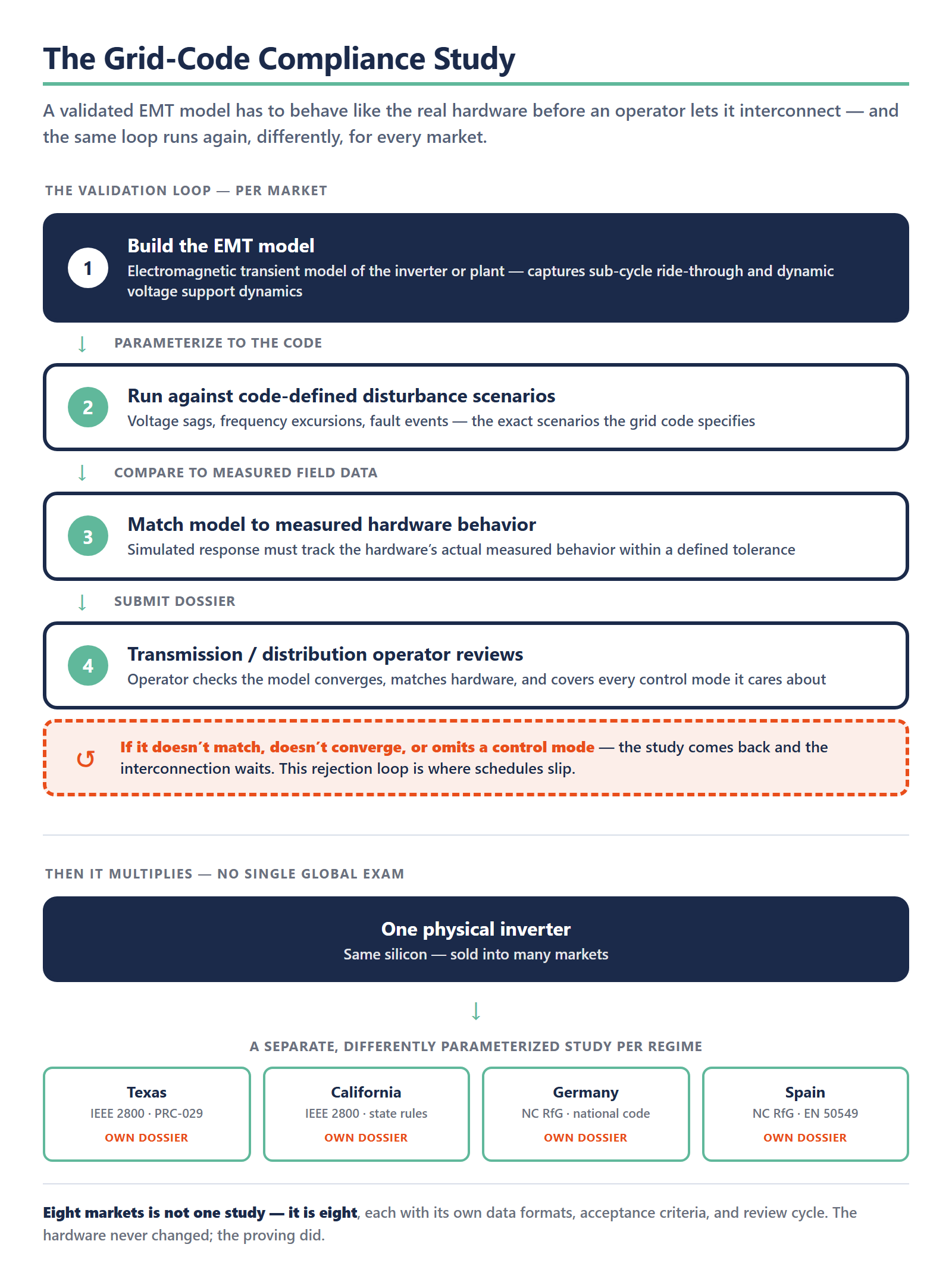
This is the integration discipline that the hardware-versus-software framing of grid-forming tends to obscure, and it is why grid resilience has become a controls-software problem rather than a hardware-procurement one. The control law that produces compliant behavior is the OEM’s power-electronics work. The model that demonstrates that behavior to a regulator, the validation that ties the model to measured field data, the version control that keeps a setting change from silently invalidating a study approved six months ago, and the toolchain that lets one product clear many regimes without re-engineering each from scratch: that is a software-delivery problem, and it is where projects stall.
| Compliance demand | What the code requires | Where the work actually lives |
|---|---|---|
| Ride-through (LVRT / HVRT) | Stay connected and operating through voltage and frequency disturbances along a defined time-voltage curve | Protection and control configuration; validated EMT model proving the curve is met |
| Active / reactive power control (P/Q) | Hold or adjust real power on command; supply or absorb reactive power within specified ranges and response times | Control parameters; conformance dossier per regime |
| Dynamic voltage support | Fast reactive-current injection during a fault to arrest voltage collapse | Fast control logic; EMT validation against operator scenarios |
| Compliance study (per market) | Validated EMT model matched to measured hardware behavior, reviewed by the operator | Maintained, version-controlled modeling toolchain; one study per regime |
One product, many markets: a compliance toolchain that survives every regime
The reflex, when a new market opens, is to treat its compliance study as a fresh project. Hire a local consultant, rebuild the model in their preferred tool, assemble the dossier by hand, and submit. It works once. It does not scale, and it does not survive the first firmware update, because a tuning change made for one market can quietly break an approved model in another with no one the wiser until a re-validation fails.
The more durable approach treats compliance as a product capability rather than a per-deal exercise. That means a maintained, version-controlled library of validated EMT models for the product line, tied to the firmware versions they represent, so that a control change triggers a known re-validation rather than a surprise. It means a toolchain that can re-parameterize and re-export a model into the format a given regime expects, instead of rebuilding it. It means automated regression of compliance behavior in the development pipeline, so a setting that breaks ride-through in Spain is caught before it ships, not at interconnection. And it means treating the conformance dossier as structured, queryable data rather than a folder of PDFs assembled under deadline pressure.
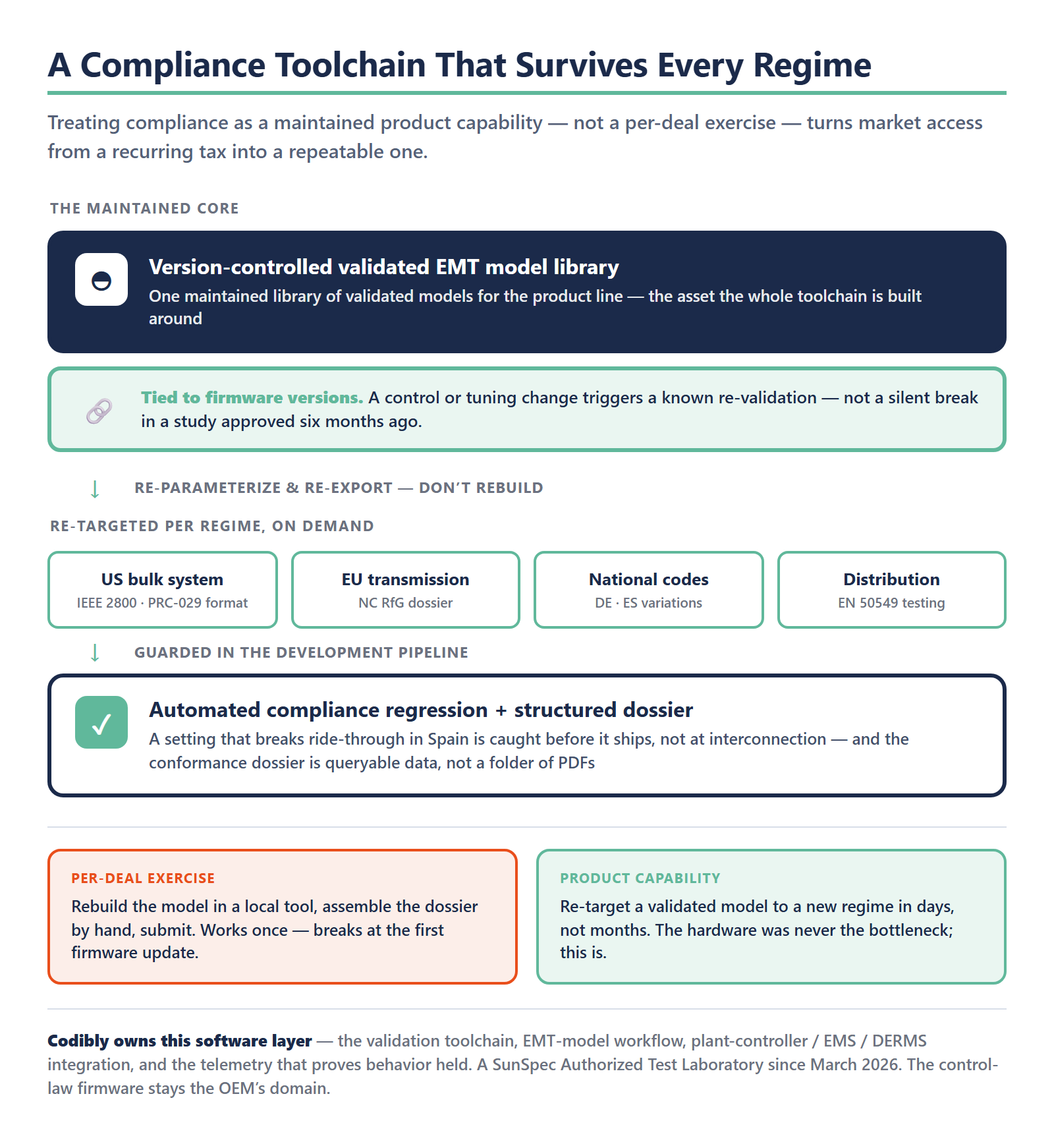
This is the layer Codibly builds. We do not manufacture inverters, and we do not author the control-law firmware that lives inside them; that is the OEM’s power-electronics domain. We own the software around it: the compliance-implementation and validation toolchain, the EMT-model validation workflow, the integration of inverter and storage fleets into the plant-controller, energy-management, and DERMS software that has to command compliant behavior in the field, and the telemetry layer that proves the behavior held. That toolchain is credentialed work. Codibly became a SunSpec Authorized Test Laboratory in March 2026, which places our certification and validation capability inside the same standards ecosystem that governs the protocols these codes rely on. It is the same discipline we bring to protocol conformance elsewhere in the portfolio, where multi-protocol compliance is fundamentally an architectural decision rather than a feature to be bolted on late.
The payoff is concrete. A manufacturer that can re-target a validated model to a new regime in days rather than rebuilding it over months turns market access from a recurring tax into a repeatable capability. The hardware was never the bottleneck. The software that makes one product compliant across many regimes, and keeps it compliant as the codes evolve, is the asset that determines how many markets a manufacturer can actually reach.
The deadline rewards the manufacturer who starts early
It is tempting to bet that the deadlines will slip. US energy programs have been volatile, and European codes move slowly enough that “finalizing” can feel like an invitation to wait. The bet is poorly priced. PRC-029 is approved and dated for 1 October 2026; NC RfG 2.0 is finalizing with its grid-forming threshold defined; IEEE 2800.2 conformance procedures are published. The direction is not in question, and the deadline risk runs toward the manufacturer who waits, because compliance studies are not work that compresses. An EMT model takes the time it takes to build and validate, an operator’s review queue takes the time it takes, and a multi-market dossier multiplies both. A team that starts the toolchain build a quarter before the deadline discovers that the regime they most need is the one with the longest review cycle.
Real-world deployment has already overtaken the debate about whether this behavior is achievable. The Australian Energy Market Operator reported ten grid-forming battery sites totaling 1,070 megawatts operational as of December 2025. The capability is in the field at scale today. What separates the manufacturers who reach these markets from those who stall at interconnection is no longer the inverter. It is whether grid-code compliance was built as a maintained software capability, proven and version-controlled across regimes, or improvised one study at a time under a deadline that does not move. Building it as a capability rather than a scramble is the renewable-energy compliance and integration work Codibly partners with OEMs to deliver.
Frequently Asked Questions
Grid-code compliance is the demonstrated conformance of a generating resource (increasingly an inverter-based resource such as a solar inverter or battery storage system) to the technical rules a grid operator sets for connecting to and operating on the network. Those rules cover behaviors like staying connected through voltage and frequency disturbances, supporting voltage with reactive power, and controlling real-power output. Today, compliance is rarely a paper assurance; it is proven through validated models and test regimes, which makes it largely a software, modeling, and validation task rather than a hardware one.
PRC-029 is a North American Electric Reliability Corporation reliability standard that sets ride-through requirements for inverter-based resources on the bulk power system, specifying how those resources must remain connected and keep operating during voltage and frequency disturbances rather than tripping offline. It was approved through Federal Energy Regulatory Commission Order 909 on 24 July 2025 and becomes effective on 1 October 2026. (US regulatory timelines can shift; verify the current effective date against NERC and FERC sources before relying on it.)
IEEE 2800-2022 defines uniform interconnection and performance requirements for inverter-based resources connected to the transmission and sub-transmission system. Its requirements span voltage and frequency ride-through, active-power and reactive-power (P/Q) control, dynamic voltage support during faults, frequency response, ramp-rate limits, and power-quality limits such as harmonics and flicker. The companion document, IEEE 2800.2, adds the conformance and validation procedures that turn those requirements into testable, demonstrable criteria, which is why meeting IEEE 2800 is as much a modeling and validation exercise as an engineering one.
A grid-code compliance study is the formal analysis that proves a resource will behave as the applicable grid code requires before it is allowed to interconnect. In practice it centers on a validated electromagnetic transient (EMT) model of the inverter or plant, run against the disturbance scenarios the code specifies, with simulated behavior matched to the hardware’s measured response within a defined tolerance. The transmission or distribution operator reviews the model and the validation evidence. Because each market runs its own regime against its own code, a manufacturer selling into multiple regions typically needs a separate, differently parameterized study for each, which is why a maintained, version-controlled modeling toolchain matters far more than running each study by hand.