The PJM Capacity Auction Made Demand Response a Data Center Purchase

PJM’s capacity auction for the 2028/2029 delivery year cleared at its $325/MW-day price cap and ended 6,831 megawatts (MW) short of the reliability requirement. The highest price the market allows did not buy enough supply. Three months later, Google expanded its virtual power plant (VPP) with Voltus to about 1 GW in PJM, under a contract that runs until 2040, and the megawatts it pays for sit in buildings Google does not own. When the PJM capacity auction falls short at its ceiling, the customers whose load drives the shortage buy demand response directly, from the aggregator that can register, dispatch, and prove distributed capacity.
Key takeaways
- The 2028/2029 auction was the third in a row to clear at the cap, and it ended 6,831 MW short.
- The Federal Energy Regulatory Commission (FERC) rejected PJM’s proposed capacity rules for new large loads, so hyperscalers buy capacity by voluntary contract.
- A distributed megawatt earns capacity revenue only after it is registered, accredited, and has performed. Each step runs on data that PJM and the buyer can both audit.
What the 2028/2029 PJM capacity auction showed
PJM Interconnection runs the grid and wholesale electricity market for all or part of 13 states and Washington, D.C. The last three PJM capacity auction results tell one story: each cleared at the cap, and the shortfall grew from marginal to several thousand megawatts.
| Delivery year | Clearing price | Against the reliability requirement |
|---|---|---|
| 2026/2027: auction held July 2025 | $329.17/MW-day, at the cap in every zone | Marginal: an 18.9% reserve margin against a 19.1% target |
| 2027/2028: auction held December 2025 | $333.44/MW-day, at the cap; $16.4 billion in total | 6,623 MW short, the first time the whole footprint missed it |
| 2028/2029: auction held July 2026 | $325/MW-day, at the cap | 6,831 MW short of a 156,013 MW requirement |
Sources: PJM auction results for 2026/2027, 2027/2028, and 2028/2029.
Only 525 MW of new generation and uprates cleared for 2028/2029. More money will not move new plants through an interconnection queue faster. Demand response is built from load already connected to the grid, which is why the buyers who need capacity soonest now pay for it.
How the Base Residual Auction works
The PJM Base Residual Auction (BRA) is the main auction in PJM’s capacity market. PJM sets a reliability requirement for each delivery year (June 1 to May 31). Power plants, batteries, and demand response offer capacity, and each cleared resource is paid the clearing price per megawatt-day in return for an obligation to perform. The auction normally runs three years ahead of delivery.
Why capacity prices sit at the cap
The PJM capacity price is high because demand for capacity is growing faster than new supply can connect, and data centers account for much of that growth. The Dominion zone, which includes Northern Virginia’s data center cluster, showed it first: in 2025/2026, the last auction before the current cap, it cleared at $444.26/MW-day against $269.92 for PJM as a whole (PJM). In its analysis of the 2027/2028 auction, PJM’s Independent Market Monitor (IMM), Monitoring Analytics, found that existing and forecast data center load added $6.5 billion, about 40% of the $16.4 billion total.
At the cap, the clearing price stops showing how short the system is. The shortfall does that job now. Demand response has been paid accordingly: the IMM’s 2025 State of the Market report found that PJM demand response revenue rose 240.6%, from $153.7 million in 2024 to $523.6 million in 2025.
High prices can correct themselves. They attract new generation, and the price collar behind the cap runs only through 2029/2030. Neither helps a buyer whose load arrives before new plants do.
Why a hyperscaler pays for capacity in other people’s buildings
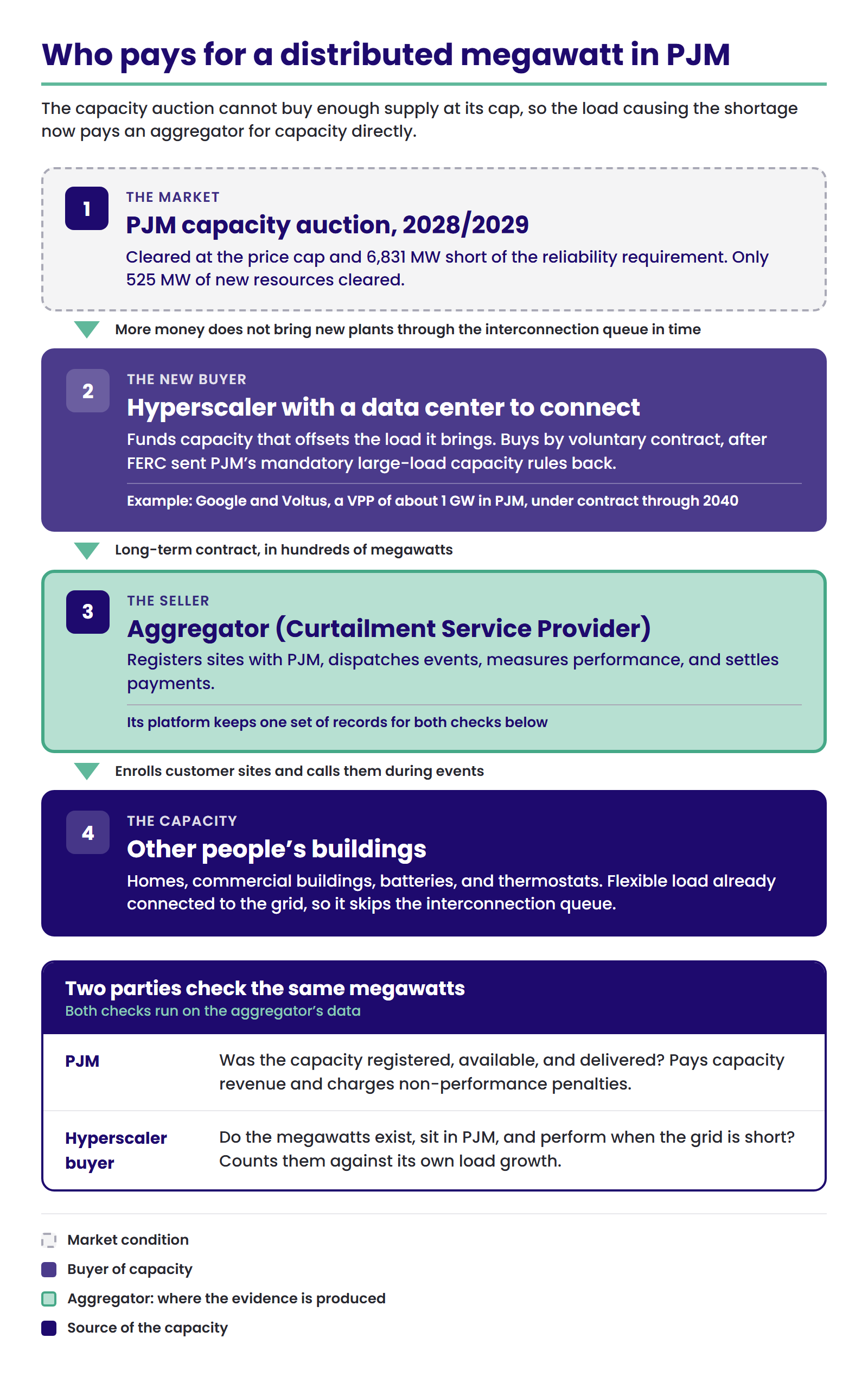
A hyperscaler, a large cloud and AI data center operator, faces two constraints in PJM. Uptime commitments keep most of its load firm, and its new load is a large part of why the auction is short. Bring your own capacity answers both: the data center owner pays for capacity that offsets its load, here a VPP built from other customers’ flexible demand.
Google and Voltus have signed a large public example. As Utility Dive reported, their 100 MW agreement from June 2026 grows by 1,070 MW to a VPP of about 1 GW, under contract through 2040. No price was published.
The contract route matters because the rule route is closed for now. On October 9, 2026, FERC rejected PJM’s proposed Interim Resource Adequacy Service (IRAS) and its Bring Your Own New Capacity rules, accepting only a 50 MW large-load definition and a registry. PJM may refile. Codibly’s white paper on large-load flexibility sets out what that leaves utilities to operate.
Aggregators gain a new kind of customer. It buys in hundreds of megawatts, commits for more than a decade, and wants evidence that each megawatt exists and performs. It also adds a buyer to the revenue streams set out in how demand response aggregators make money. Some data center owners will build on-site batteries instead. Bought capacity is the route an aggregator can sell.
What makes distributed capacity count in PJM
Enrolling a device does not make it capacity. Demand response earns PJM capacity revenue only after three steps, and each can cut the megawatts an aggregator counted on. First, a Curtailment Service Provider (CSP) registers customer sites as a demand resource, with location, zone, and committed load reduction. Second, PJM accredits the resource by effective load carrying capability (ELCC), the share of a nameplate megawatt that counts in the hours of highest risk, and pays only on that share. Third, the resource must perform when PJM calls an event, and non-performance penalties can erase a year’s capacity revenue.

Demand response in PJM covers the program mechanics, from Capacity Performance to the Emergency Load Response Program. Each step depends on data before it depends on hardware: site and meter records for registration, availability and past behavior for accreditation, and interval meter data against a reference load for performance. Two aggregators with the same thermostats and batteries can end the year with very different results if only one keeps clean records.
What the aggregator’s platform has to prove
A hyperscaler contract adds a second party checking the aggregator’s work. PJM checks that the capacity was registered, available, and delivered. The buyer checks that the megawatts it paid for exist and performed, because it counts them against its own load growth. Both checks run on the same data, so the platform should produce the evidence once.
That evidence comes from five records: a site and device registry tied to PJM registrations and the contract; event dispatch to every device class, with acknowledgments and rollback; time-stamped interval data from meters and devices, with gaps flagged; baselines that can be recalculated from raw data; and one settlement record that reconciles PJM payments, buyer invoices, and customer payouts.
Virtual power plant software usually starts with dispatch, the visible part of the job. The last three records decide a hyperscaler contract, because they turn operations into evidence. A platform that can recalculate a baseline from raw interval data will hold up when a buyer audits a 1 GW portfolio.
Codibly builds this layer for optimizers and aggregators. For APG&E, a retail energy provider operating in PJM, Texas, and New York, Codibly built a custom distributed energy resource management system (DERMS) in 12 weeks, covering device enrollment through Enode, event scheduling with rollback, and participation tracking. Where an aggregator dispatches over OpenADR, the Codibly OpenADR VTN 2.0b (Firmware 1.0) is a certified server for sending those events.
Hyperscalers will audit the megawatts they buy
PJM’s next auctions face the same conditions: load arriving faster than plants can connect, and a cap that holds the price. Hyperscalers have shown they will pay for capacity in the meantime, on contracts longer than a decade. For a VPP company, the records it gives PJM now have to satisfy that buyer too, starting with the site registry, the interval data, and the settlement trail.

Frequently Asked Questions
The PJM capacity auction, formally the Base Residual Auction, is how PJM buys capacity to meet peak demand in a future delivery year, paying cleared resources the clearing price in return for an obligation to perform. The 2028/2029 auction cleared at the $325/MW-day cap and 6,831 MW short of the reliability requirement.
Demand for capacity is growing faster than new supply can connect, and data center load drives much of that growth. The last three auctions cleared at the price cap, and only 525 MW of new generation and uprates cleared for 2028/2029 against a 6,831 MW shortfall.
Bring your own capacity is an arrangement in which a large electricity user, such as a hyperscaler, pays to add capacity that offsets its load. In PJM, Google’s contract with Voltus funds a virtual power plant of about 1 GW through 2040. It is a voluntary deal, separate from PJM’s Bring Your Own New Capacity rules, which FERC rejected in October 2026.