Large Loads, Flexible Terms: What Utilities Must Operate

Executive Summary
Texas now asks every new large load of 75 MW or more two questions before it connects. What backup generation does the site have, and will it run as a controllable load resource? Under the rule the Public Utility Commission of Texas (PUCT) adopted on September 18, 2026, staff at the PUCT and the Electric Reliability Council of Texas (ERCOT) may audit the first answer. The second decides whether the grid operator can dispatch the site.
Those two questions sum up a new bargain. AI data centers want power sooner than utilities can build for it, and regulators ask them to give some back when the system is tight. Texas writes curtailment into the connection rule. PJM proposed similar terms, which the Federal Energy Regulatory Commission (FERC) sent back in October. Virginia’s two largest utilities must offer voluntary flexibility programs to customers of 25 MW and more.
Signing the bargain is the easy part. A large-load tariff with flexibility terms is a demand response program with a few very large participants. It works only if the utility can dispatch each site, see it respond, measure the response against a baseline, and settle the result.
Key takeaways
- US thresholds run from 25 MW in Virginia to 75 MW in Texas, and flexibility is becoming part of the price of a faster connection.
- Data centers flex mainly through on-site batteries, backup generators, and flexibility bought from other customers.
- Dispatch, telemetry, baselines, and settlement each fail differently at this scale. Specify them before the first contract.
Why grid operators now trade connection speed for flexibility
A large load is a single customer site big enough for the grid to be planned around it, and most new ones are data centers whose requests arrive faster than generation and transmission can be built. On firm terms, the grid operator must find capacity for the site’s full peak in every hour. On flexible terms, it needs capacity only for the hours the load will not give back.
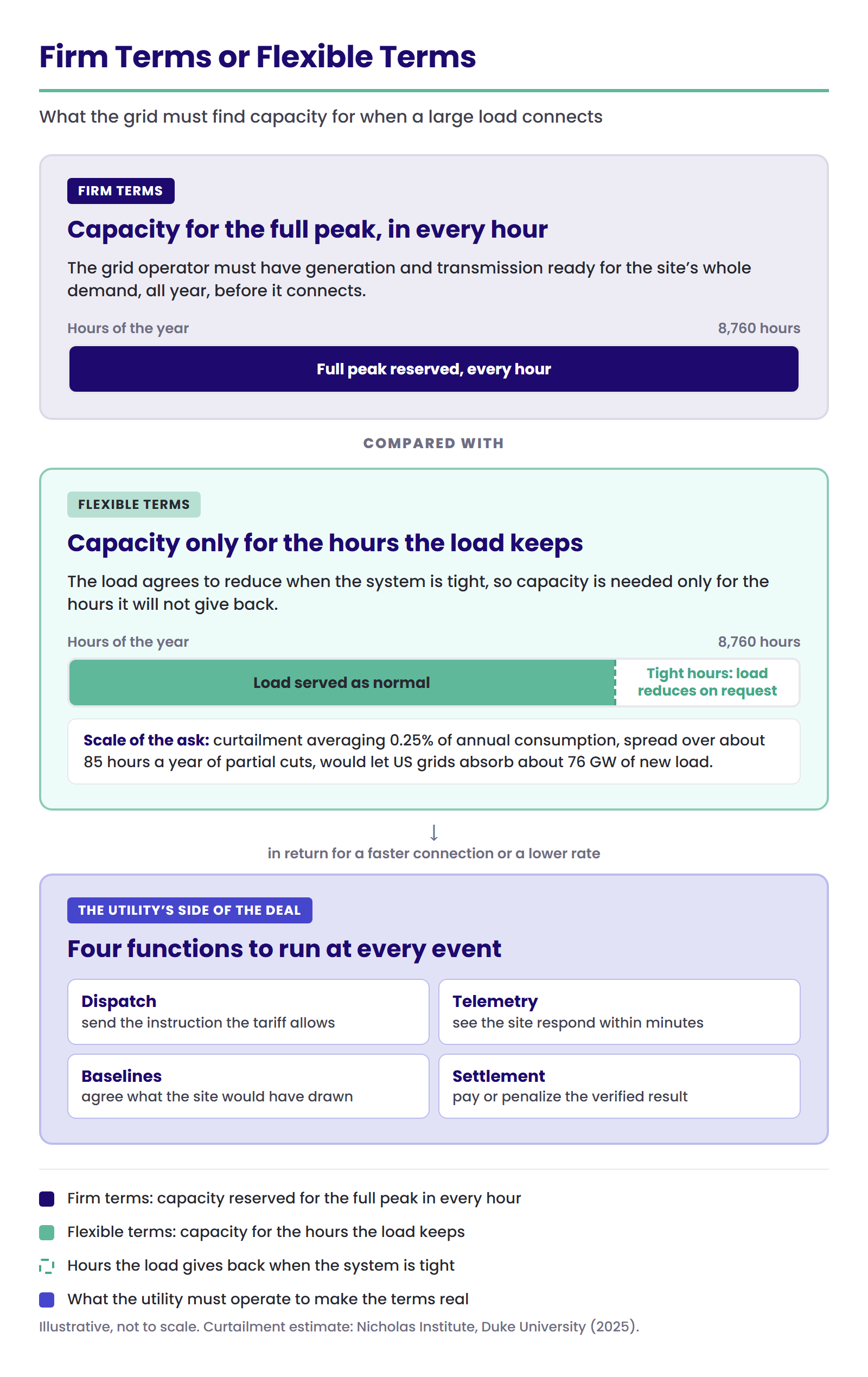
Generation accepted that trade first, as Codibly’s white paper on what conditional grid access requires sets out. Large load interconnection rules now apply it to loads, in four places.
| Jurisdiction | Rule | Threshold | What the load agrees to |
|---|---|---|---|
| Texas (ERCOT) | SB 6; PUCT rule 16 TAC §25.194, adopted September 18, 2026 | 75 MW and more | Refundable financial security of $50,000 per MW of contracted peak or the allocated upgrade costs, whichever is greater, plus a $100,000 study fee (20% of the security returned at energization, the rest in 20% steps); disclosure of backup generation, which ERCOT and PUCT staff may audit; a declared choice on running as a controllable load resource; exposure to curtailment in a grid emergency |
| PJM | Large Load definition and Large Load Registry, accepted by FERC on October 9, 2026 (ER26-3515) | 50 MW and more at one site | Registration. The proposed Interim Resource Adequacy Service (new capacity or curtailment in a shortfall) and the Bring Your Own New Capacity rules were rejected; PJM may refile a modified version |
| Virginia | HB284/SB371 (2026 session); SCC rate class GS-5 from January 1, 2027 | 25 MW and more, with a load factor of 75% or more | Voluntary demand flexibility programs that the state’s two largest investor-owned utilities must propose to the SCC by January 15, 2027 (cooperatives by January 1, 2029); incentive costs may not be shifted to other customers |
| Federal (FERC) | Section 206 show-cause orders to PJM, MISO, SPP, CAISO, ISO-NE, and NYISO, June 18, 2026; rulemaking RM26-4 still open | Not settled | Terms not yet set; responses were due August 17, 2026 |
| Reliability (NERC) | Level 3 alert on computational loads, May 4, 2026; proposed Computational Load Entity registration category; Standards Project 2026-02 | Computational loads connected to the bulk power system | Seven essential actions, with reports due August 3, 2026; the proposed category would register the loads themselves |
Texas: curtailment written into the connection rule
Texas Senate Bill 6 (SB 6), passed in 2025, exposes loads of 75 MW and more to curtailment in a grid emergency. The PUCT’s rule, 16 Texas Administrative Code (TAC) §25.194, adds refundable financial security of at least $50,000 per megawatt of contracted peak, which makes a speculative request expensive. Its backup-generation disclosure tells the grid operator what the site could run on if asked to step off.
For an ERCOT large load, the operating decision is the controllable load resource election: such a resource follows ERCOT dispatch instructions and sends telemetry ERCOT can see. In competitive parts of ERCOT, the instruction and the proof that the load came off pass between ERCOT, the wires utility, and the customer’s retailer.
PJM: an interruptible-capacity rule FERC sent back
PJM’s case for large-load flexibility is scarcity. Its 2028/2029 Base Residual Auction (BRA) cleared at the $325/MW-day price cap and came in 6,831 MW short of the reliability requirement (PJM). PJM’s answer was the Interim Resource Adequacy Service (IRAS): a new large load would bring new capacity or accept curtailment in a shortfall.
On October 9, 2026, FERC accepted only part of the filing: the definition of a PJM large load, 50 MW or more at one site, and a Large Load Registry. It rejected IRAS and the related Bring Your Own New Capacity rules, and PJM may refile. Commissioner David Rosner’s concurrence set a test for any new version: justify curtailing IRAS load before load enrolled voluntarily in demand response.
Virginia and the state programs
Virginia chose the program route. HB284 and SB371, passed in the 2026 session, define a high energy demand customer as one with 25 MW or more of demand and a load factor of 75% or more. The state’s two largest investor-owned utilities must petition the State Corporation Commission (SCC) for demand flexibility programs by January 15, 2027.
These are voluntary programs the utilities must offer, and the clause with the most operating weight bars shifting incentive costs to other customers. Settlement becomes a compliance record of what the utility paid, event by event, and who funded it.
Reliability rules are catching up
On June 18, 2026, FERC issued show-cause orders under Section 206 of the Federal Power Act to PJM, MISO, SPP, CAISO, ISO-NE, and NYISO (FERC). Its large-load rulemaking, RM26-4, remains open. Codibly’s analysis of the Department of Energy’s case for FERC jurisdiction over large loads covers the earlier stage.
Grid reliability belongs to the North American Electric Reliability Corporation (NERC). NERC’s Large Loads Task Force has studied these customers, and the NERC large loads action plan sets out the follow-up. On May 4, 2026, NERC issued a Level 3 alert after events in which more than 1,000 MW of computational load dropped off the grid (American Public Power Association).
Losing 1,000 MW of load at once pushes frequency up, the way losing a large generator pushes it down. A utility running a large-load program has to see load that leaves unasked as quickly as load that fails to leave when asked.
What a data center can actually flex
Data center operators push back. Hyperscale data centers sell uptime under service-level agreements (SLAs), and no operator will slow those servers because the grid is tight.
About the servers, the operators are largely right. Workload flexibility exists: model training and batch processing can pause or move to another region, while inference that answers users in real time cannot wait. At most sites the movable share is small, and it changes by the hour.
Data center flexibility therefore comes mostly from the equipment around the servers and from contracts:
- On-site batteries. Batteries bought for backup can carry part of the site through a short event. Codibly’s analysis of data center energy storage covers how one battery serves both jobs.
- Backup generators. They can carry a site for hours, but air permits limit how often they run outside an emergency.
- Flexibility bought elsewhere. A data center owner can pay other customers to reduce demand on its behalf.
The volume asked is modest. In February 2025 the Nicholas Institute at Duke University estimated that the 22 largest US balancing areas could absorb about 76 GW of new load if those loads accepted curtailment averaging 0.25% of their maximum annual consumption, spread over about 85 hours a year of partial curtailment. Load flexibility on that scale is something a site can plan around.
A large-load tariff is a demand response program with a few very large participants
Most large-load tariffs were written to protect other customers, with minimum bills, long contracts, collateral, and exit fees. DSIRE Insight’s review of large-load tariffs found a flexibility element in 25% of them in the second quarter of 2026.
Once a tariff pays for reducing load on request, or offers a lower rate for accepting curtailment, it is a demand response program.
Demand response began in this shape: interruptible rates for a few large industrial customers, where an event was a phone call to the plant. Large-load tariffs return to a handful of participants, but one may now be hundreds of megawatts, and the grid operator, the state commission, and NERC all want to know whether it responded.
Codibly’s article on what utilities ask for across demand response programs describes today’s programs: thousands of small devices enrolled through aggregators, where an error in one home averages out. A large-load program has no fleet to average across, and each participant can contest every megawatt in settlement.
In many utilities, key-account and rates teams negotiate the tariff while the operating knowledge sits with the demand response team. Every term should pass that team’s test, whether it can be dispatched, measured, and settled, before it is fixed. Codibly’s demand response program integration work covers that operating layer.
Four things the utility has to operate
Every flexibility term in a large-load tariff lands on four functions. Table 2 shows what each means for an illustrative 300 MW campus.
| Function | What it means for a large load | What fails at 300 MW (illustrative site) |
|---|---|---|
| Dispatch | An instruction the site’s control system accepts, within the notice, duration, and ramp the tariff allows, issued in the order the rules set when several programs call at once | A late or missed instruction leaves the grid short by as much as a mid-sized generating unit; calling the wrong program first breaches a curtailment order a regulator may require |
| Telemetry | Near-real-time measurement at the point of connection, plus separate readings for on-site batteries and generators | Next-day meter data shows only afterward whether 300 MW came off; a site that drops off unasked goes unseen until frequency moves |
| Baselines | An agreed estimate of what the site would have drawn without the event, built for one flat, high-load-factor profile and adjusted for on-site supply | With one participant, errors do not average out: a 2% baseline error is 6 MW, paid or penalized as if it were real |
| Settlement | Credits, penalties, and program costs calculated per event and per participant, and reconciled with any wholesale enrollment of the same load | The same megawatts paid twice, in the tariff and in a wholesale program, or incentive costs shifted to other customers, which Virginia’s law forbids |
Dispatch is where existing tools fall short first: a large-load program needs a logged curtailment order across tariffs, voluntary programs, and emergency instructions. A distributed energy resource management system (DERMS) optimizes for grid reliability and a virtual power plant (VPP) for market revenue. A large-load program needs both views, as Codibly’s comparison of DERMS, VPP, and advanced distribution management systems (ADMS) explains.
The signal should use a standard the site’s energy management system already speaks. The Codibly OpenADR VTN 2.0b (Firmware 1.0) is certified by the OpenADR Alliance for the utility side, the Virtual Top Node (VTN). Codibly’s OpenADR accelerators add pre-certified code for the customer side, the Virtual End Node (VEN).
Telemetry and baselines decide whether anyone believes the response. Interval meter data read the next day is enough for a thermostat program and too late for a site the grid operator must see within minutes. If a battery or generator supplies the reduction, the utility needs separate readings for each to tell lower consumption from on-site supply.
Settlement is where the cost rules apply: the same megawatts may sit in a retail tariff and a wholesale program, and Virginia bars passing incentive costs to other customers.
Codibly has built these functions. For APG&E, a retail energy provider active in ERCOT, PJM, and NYISO with no demand response infrastructure, Codibly delivered a custom DERMS platform with event scheduling and rollback, real-time telemetry, and participation tracking, production-ready within 12 weeks. That platform dispatches home devices. At a 300 MW campus the functions are the same, and the tolerance for error is far lower. For a major US utility, Codibly’s EDGE decision-support platform brought more than 70 datasets into one governed platform for regulatory reporting. Large-load settlement needs that kind of single record of meter, event, and payment data.
Who carries the flexibility: the site, its batteries, or someone else’s homes
A tariff can state how much flexibility it wants but rarely where it comes from, and each source changes what the utility must verify.
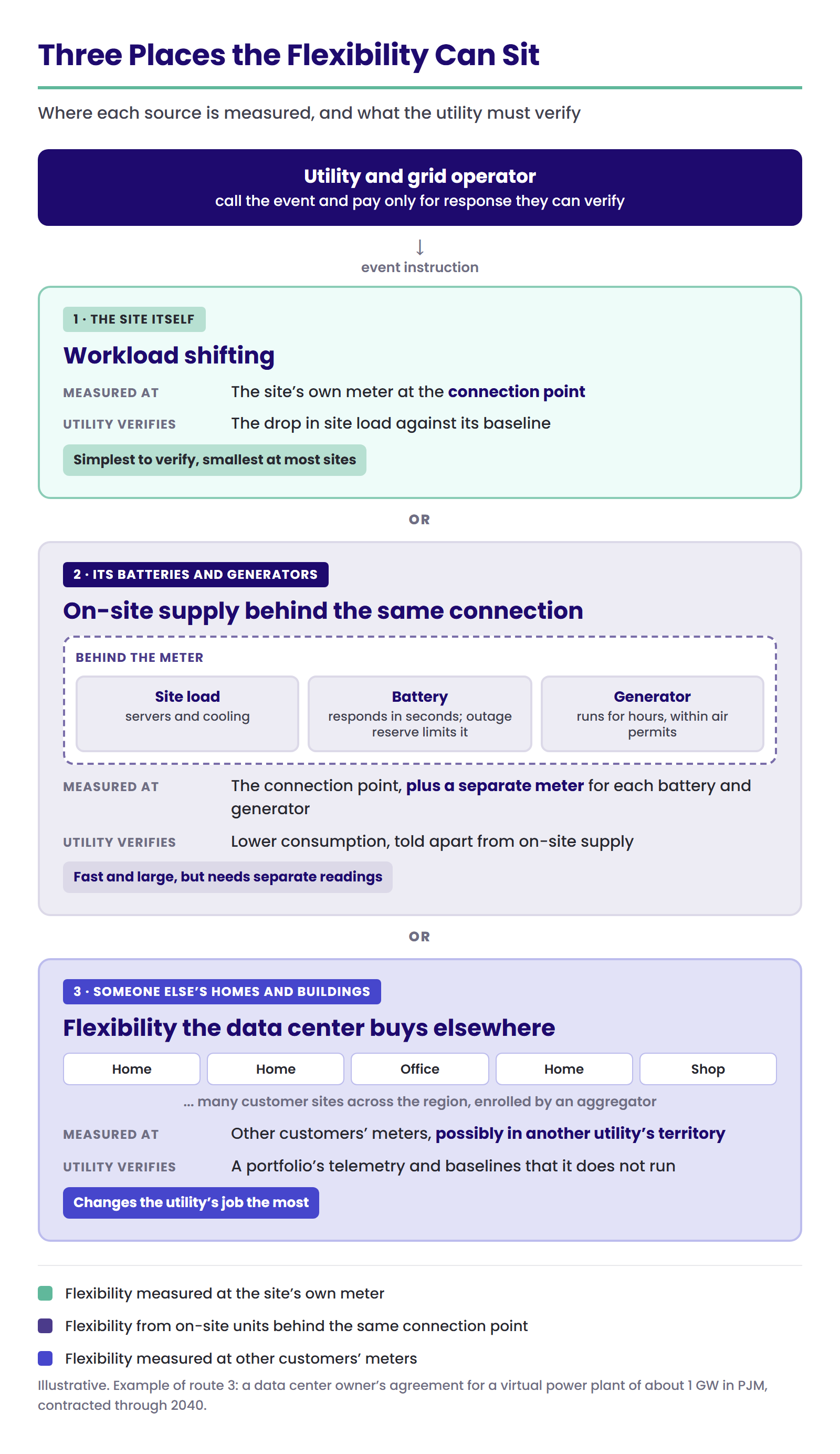
The site itself. Workload shifting shows up at the site’s own meter. It is the simplest source to verify and, at most sites, the smallest.
Its batteries and generators. The utility must meter each separately from the site load, and the reserve kept for outages limits what the battery can offer.
Someone else’s homes. On October 22, 2026, Google and Voltus, a demand response aggregator, added 1,070 MW to a 100 MW deal signed in June, for what both companies call a 1 GW virtual power plant in PJM, contracted through 2040 (Utility Dive). The data center owner pays, and the flexibility sits at customer sites across the region. Codibly’s analysis of the PJM capacity auction explains why that purchase now pays off.
This third route changes the utility’s job the most. The megawatts that justify the connection are measured at other customers’ meters, possibly in another utility’s territory, so the utility must verify a portfolio’s telemetry and baselines.
Derapi calls this model Bring Your Own Distributed Capacity. Its CEO, Stina Brock, explains it in a Codibly webinar with Enoch Lenge, Codibly’s Head of US, Energy Practice.
Europe is writing the same deal into rules
Ireland has gone furthest. Under the Commission for Regulation of Utilities (CRU) decision CRU/2025/236 of December 12, 2025, a new data center grid connection of 10 megavolt-amperes (MVA) or more needs dispatchable generation or storage, on site or nearby, matching its Maximum Import Capacity on a de-rated basis (CRU). That plant must take part in the Single Electricity Market. The CRU indicates that compliant sites will be exempt from Mandatory Demand Curtailment.
Ireland thus settles who carries the flexibility in the connection rule: the site brings its own dispatchable plant.
At EU level, the Network Code on Demand Response is not yet adopted. The EU Agency for the Cooperation of Energy Regulators (ACER) submitted it to the European Commission on March 7, 2025 (CIGRE Electra). Codibly’s analysis of demand flexibility in Europe covers those rules in detail.
What to specify before the first large-load contract
The first large-load contract with flexibility terms sets the pattern for the rest. Its terms decide what the utility must dispatch, measure, and prove, so operating teams should write the specification with the account team before signature.
| Specification | Decision to force | Owner |
|---|---|---|
| Event terms | Notice period, maximum duration, events per year, and ramp rate | Large-load account lead, with the DR program director |
| Curtailment order | Which tariff, program, or emergency instruction is called first in a shortfall, and how that sequence is logged | VP grid operations |
| Signal path | The protocol and endpoint for instructions (for example OpenADR 2.0b to the site’s energy management system) and the fallback if the link drops | VP grid operations, with the site’s energy team |
| Metering and telemetry | Revenue metering and real-time telemetry at the connection point, separate metering for batteries and generators, and the maximum data delay | VP grid operations |
| Baseline method | The calculation, its adjustments, and how battery discharge and generator output count | DR program director |
| Settlement and audit | The payment calculation, dispute window, reconciliation with wholesale enrollment, and the cost-allocation report for the commission | DR program director, with rates and regulatory |
| System of record | Where event, meter, and payment data live, and who can audit them | DR program director, with IT |
None of this needs a new platform on day one; several items extend existing demand response systems. The risk is leaving them until after the first event, when the participant, the grid operator, and the regulator all ask for the record at once.
The rules will keep moving: PJM may refile, FERC’s rulemaking is open, Virginia’s utilities file their programs by January 2027, and NERC is drafting standards. A utility that specifies the four functions once and configures them per tariff can take each new rule as a change of terms. Codibly delivers that layer as custom renewable energy software for utilities. Start with the next large-load request on the desk: map each proposed term to the function that will run it and the team that owns it.
Frequently Asked Questions
Large load customers are single sites whose demand runs to tens or hundreds of megawatts. Data centers lead the group, alongside crypto-mining facilities, semiconductor plants, and other heavy industry. Utilities increasingly give them their own rate class, such as the GS-5 class that Virginia’s SCC opens on January 1, 2027.
It depends on the rule: 75 MW in Texas SB 6, 50 MW at one site in PJM’s FERC-accepted definition, and 25 MW with a load factor of 75% or more in Virginia’s law. Ireland applies its strictest terms from 10 MVA of import capacity. A contract should name the definition it relies on, because one site can qualify under one rule and not another.
Yes, within limits. Shifting computing work supplies a small share. Most of the reduction comes from on-site batteries, backup generators within their permits, or flexibility bought from other customers. Each reduction still has to be proven with telemetry and an agreed baseline.
A large-load tariff is a rate schedule that sets the connection and service terms for very large customers, typically contract length, minimum payments, and financial security. A tariff that pays for or requires reductions on request operates as a demand response program.