Flexible Interconnection: What Conditional Grid Access Requires

Executive Summary
549 gigawatts of US generation and storage holds a draft or executed interconnection agreement and still delivers nothing, according to LBNL Queued Up: 2026 Edition. Flexible interconnection is the bargain now being offered in its place: connect years earlier, and accept a limit on export when the local network runs short of room.
The scale of the stall is documented. Lawrence Berkeley National Laboratory’s Queued Up: 2026 Edition, published in June 2026 with data through end-2025, counts roughly 8,200 projects actively seeking interconnection: 1,312 GW of generation plus 749 GW of storage, over 2,060 GW in total. Active queue volume fell 10 percent year on year, and LBNL’s own framing is that the backlog eased amid high withdrawals. The queue is getting shorter because developers are giving up.
Against that, utilities in at least six states now offer some version of a conditional connection. California, Colorado, Illinois, New York, Massachusetts, and Minnesota each have a program, a pilot, or a regulatory order in motion. Europe is running the same experiment under different law and different names: capacity restriction contracts and non-firm transport agreements in the Netherlands, refusal and flexibility provisions under the German Energiewirtschaftsgesetz, cable pooling and a rebuilt connection procedure in Poland.
The bargain is identical in every market. So is the thing nobody negotiates: the condition has to be enforced somewhere, in real time, on a specific machine, and the only place it can be enforced is software. That turns the control layer, the protocol the asset speaks, and the telemetry the operator is willing to trust into terms of the connection agreement, not implementation details for an integrator to settle later.
Most published guidance on the subject stops at “a management system curtails the resource.” The specification underneath that sentence is what decides whether the project earns.
| Attribute | Firm connection | Schedule-based flexible | Dynamic flexible |
|---|---|---|---|
| What the operator commits to | A guaranteed export capability at the point of connection | A published limit profile derived from historical loading | Full export except when live network conditions require a reduction |
| What sets the limit | Network capacity after any required upgrade | The worst credible hour the schedule must cover | Measured conditions on the feeder or substation, refreshed continuously |
| What the operator must send | Nothing after energization | A limit schedule, updated periodically | Addressed setpoints with effective time, duration, and an audit trail |
| What the asset must do | Stay within nameplate | Follow a known profile | Receive, acknowledge, act within an agreed response time, and evidence compliance |
| Time to energize | Governed by queue position and any upgrade required | Sized to headroom that already exists | Sized to headroom that already exists |
| Where the revenue risk sits | On the schedule rather than the output | On conservatism: the schedule covers the worst hour in every hour | On the control layer: unbounded or unevidenced curtailment is unpriced risk |
The queue is not going to clear
Federal Energy Regulatory Commission (FERC) Order No. 2023, issued on 28 July 2023, was written to fix this. It replaced serial first-come first-served study with first-ready first-served cluster study, on a generic design target of roughly 315 days per cycle. Three years on, the interconnection queue has absorbed the reform without changing shape.
The clearest evidence is what the regulator itself has approved. On 24 July 2025 FERC partially accepted PJM’s Order 2023 compliance filing and directed further revisions within 60 days, finding that PJM had leaned on conceptual proposals instead of writing the changes into its tariff. In the same proceeding FERC granted PJM an independent entity variation for a 540-day study cycle. That is the number to plan against: the approved cycle in the largest US market is more than seventy percent longer than the generic target the reform was built on. RMI’s analysis of PJM’s speed-to-power problem puts the average interconnection timeline at over eight years in 2025, against under two years in 2008.
Interconnection queue reform is not a dead letter, and the withdrawals are partly the reform working as designed, flushing speculative positions out of clusters. But the composition of what remains should worry anyone building renewables. On the same LBNL count, active gas capacity rose 86 percent through 2025 while solar, storage, and wind each fell between 16 and 19 percent. The projects leaving are the ones this decade needs.
There are routes that do not depend on the queue clearing. Surplus interconnection service lets a new resource share an existing interconnection right where the incumbent generator does not use the full capacity, which is why so much storage is being sited next to operating solar. Siting against known headroom is a second. Flexible interconnection is the third, and it is the one that changes what a connection agreement is. We have written separately on the interconnection queue backlog and the three routes around it.
What flexible interconnection actually changes
A firm connection is a promise about capacity. The operator guarantees a defined export capability at a defined point, and if the network cannot support it, the network gets upgraded first and the project waits. A flexible interconnection replaces that promise with a rule. The project connects into the headroom that exists today, and agrees that its export can be limited under conditions written into the agreement.
Two forms are in deployment, and they are not interchangeable for a developer’s revenue model.
Schedule-based flexibility, pioneered in California, sets export limits in advance from the operator’s historical loading data. The project knows the shape of its constraint before it is built. It is conservative, because a schedule has to cover the worst hour it might encounter, and it is simple to enforce.
Dynamic flexibility limits export in real time against actual network conditions. It is materially better for the developer, because the asset is only constrained in the hours the network is genuinely tight, which is a small fraction of the year on most feeders. It also demands far more of both parties, because a limit that changes every few minutes has to be computed, transmitted, executed, and evidenced.
Colorado shows how quickly this is moving from pilot to tariff. On 29 October 2025, in proceeding 24A-0547E on Xcel’s 2025-2029 distribution system plan, the state’s Public Utilities Commission ordered the utility to file a flexible interconnection tariff, a requirement a 2024 state statute had already established. The order covers generation and load together, so solar, battery storage, and EV charging infrastructure fall under the same framework. That is a regulator moving conditional access out of the pilot column and into standard commercial practice.
Where the headroom actually is
Conditional access only works if someone can say, credibly and at a specific location, how much room exists. Hosting capacity is that number: the amount of distributed generation a given feeder or substation can absorb before voltage, thermal, or protection limits are breached.
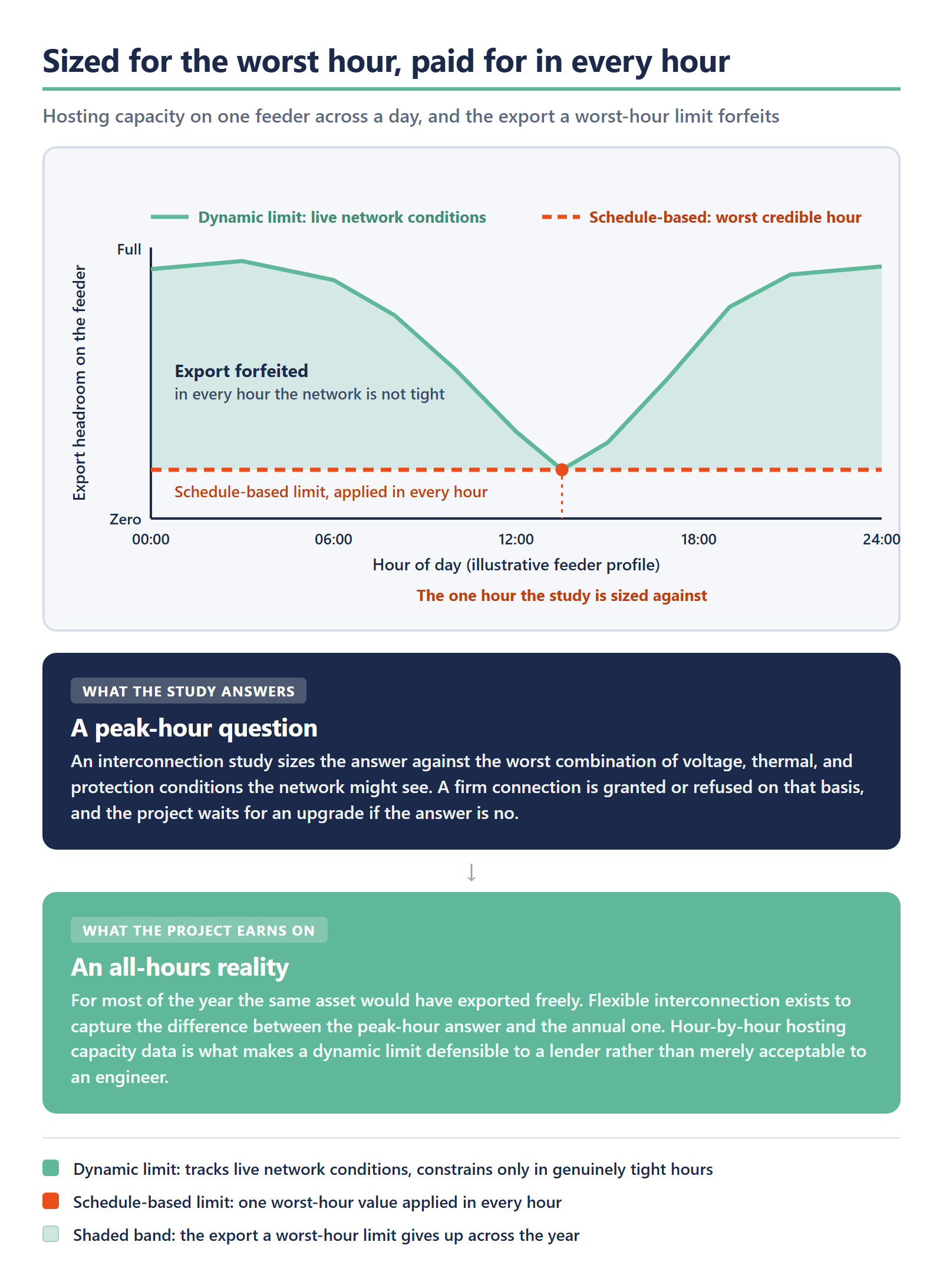
The awkward part is that a feeder’s constraint is a peak-hour phenomenon while its revenue is an all-hours one. Interconnection studies size the answer against the worst combination of conditions the network might see, and a firm connection has to be granted or refused on that basis. For most of the year the same asset would have exported freely. Flexible interconnection exists to capture the difference between the peak-hour answer and the annual one.
Hosting capacity analysis has therefore stopped being an internal engineering artifact and started becoming a public obligation. The same Colorado order requires Xcel to remove restrictions on its hosting capacity maps and refresh them with current data, moving to monthly updates by end of 2026 and hour-by-hour analysis by end of 2027. Hour-by-hour hosting capacity is what makes dynamic export limits defensible to a lender rather than merely acceptable to an engineer.
Policy is moving faster than energization. ComEd’s grid plan, filed in Illinois Commerce Commission docket P2022-0486, proposes a $21.2 million expansion of its management platform to enable a minimum of 240 MW of distributed capacity. The workshop report of 22 April 2025 records that demonstrations to date had enabled 6.75 MW of solar. Two hundred and forty megawatts of intent, under seven megawatts in the ground. Grid upgrade deferral is a genuine prize, and almost nobody has collected it yet, because the enforcement layer that makes deferral safe is the part still being built.
The condition is enforced in software
A distributed energy resource management system (DERMS) curtails the resource. That sentence is the whole of most treatments of the subject, and for a buyer it hides every decision that determines whether a conditional connection is an asset or a liability.
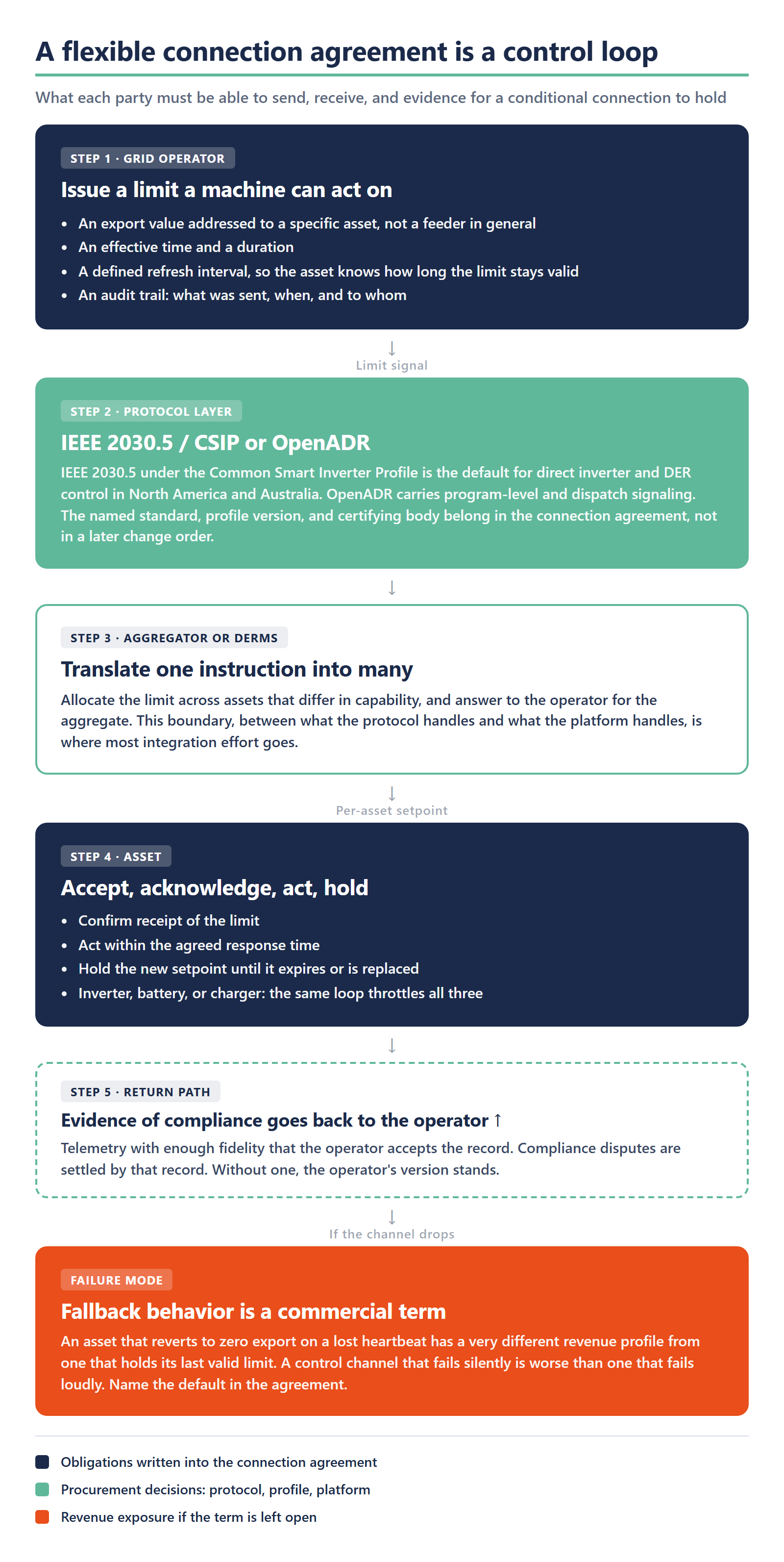
A flexible connection agreement is a contract with a control loop inside it. The loop has two ends and a procurement decision in the middle.
What the grid operator has to be able to send
The operator’s obligation is to produce a limit that a machine can act on and a court could later read. That means a value, addressed to a specific asset rather than a feeder in general, with an effective time and a duration. It means a defined refresh interval, so the asset knows how long a limit stays valid. It means an audit trail: what was sent, when, and to whom. And it means a documented fallback for the case where the signal does not arrive, because a control channel that fails silently is worse than one that fails loudly.
Operators that cannot yet do this at scale default to schedule-based limits, which is why the conservative form dominates early programs.
What the asset has to be able to receive
The asset’s obligations are symmetrical, and they are where developers get caught. It has to accept the limit, confirm receipt, act within an agreed response time, hold the new setpoint, and report back what it actually did with enough fidelity that the operator accepts the record. It has to behave predictably when the channel drops, and the default it falls back to is a commercial decision as much as a safety setting: an asset that reverts to zero export on a lost heartbeat has a very different revenue profile from one that holds its last valid limit.
Aggregators carry a harder version of this. A platform that sits between an operator and a fleet has to translate one instruction into many, allocate the limit across assets that differ in capability, and answer for the aggregate. The boundary between what the protocol handles and what the aggregator handles is where most integration effort actually goes.
Why the protocol choice is a procurement decision
Two standards carry most of this traffic. IEEE 2030.5, applied through the Common Smart Inverter Profile (CSIP), is the default path for direct inverter and DER control in North America and Australia. OpenADR carries program-level and dispatch signaling, and is the incumbent where the relationship runs through a utility program rather than a connection tariff. Both work. Choosing between them after the connection agreement is signed is what turns a deployment into a change order, because the protocol determines which assets are eligible, which utility territories a platform can serve, and how long certification takes.
In practice this is settled ground, and three production deployments show it. SolarEdge aligned its IEEE 2030.5 client with CSIP-Australia across multiple distribution network service providers, with Codibly making the architectural changes that connected already certified technology to regional networks. APG&E runs a custom DERMS platform built by Codibly across ERCOT, PJM, and NYISO, delivered production-ready in twelve weeks with a standards-ready path for OpenADR and IEEE 2030.5. OpConnect took IEEE 2030.5 CSIP onto charging infrastructure, covering both US CSIP and CSIP-AUS requirements. Codibly led the formal certification testing as a SunSpec Alliance certified test lab.
Australia is the working precedent for all of it. Flexible exports are becoming the default connection rather than an option: Endeavour Energy in New South Wales makes them the default for eligible new and upgraded solar systems from November 2026, and Western Power’s two-pathway model has required the CSIP-AUS communications profile since 1 May 2026. The multi-DNSP integration for SolarEdge runs in that environment daily. What US and European regulators are now legislating toward has been operating at population scale for years.
| Market | What it is called | Status in 2026 | What it means for a project |
|---|---|---|---|
| United States | Flexible interconnection | Programs, pilots, or orders in at least six states: CA, CO, IL, NY, MA, MN | Connect against existing hosting capacity and accept schedule-based or dynamic export limits |
| Netherlands | Capacity restriction contracts (2022); non-firm transport agreements (2024); alternative transport rights (ACM/23/187219) | Capacity restriction contracts and non-firm transport are established; alternative transport rights are rolling out unevenly across networks | Non-firm capacity is a routine commercial option, and congestion is priced into the offer |
| Germany | Refusal and flexible connection agreements under §17 EnWG | BNetzA upheld a refusal in BK6-25-325 (30 March 2026); §17 Abs. 2b permits but does not require an operator to offer a flexible agreement | An operator may lawfully refuse; ask for a conditional offer in writing before the capacity assessment closes |
| Poland | Connection refusals; cable pooling (since 1 October 2023) | 4,897 refusals covering 107,000 MW in 2025, against 7,817 covering 73.58 GW in 2024 (URE); Energy Law amendments in force 30 April 2026 | Structural sharing is available; dynamic conditional access is not yet built at scale |
| Australia | Dynamic export limits under CSIP-AUS | Operating and becoming the default connection in a growing number of networks | The working precedent for what US and EU regulators are legislating toward |
Europe is running the same experiment under different names
The mechanism is the same on both continents. The legal instrument is not, and the legal instrument decides what a developer can actually negotiate.
The Netherlands: non-firm transport, and a queue measured in gigawatts
Dutch congestion is the most advanced version of this problem in Europe. Netbeheer Nederland’s waiting-list publication shows TenneT holding 161 injection requests for 34 GW at national level, with regional grid operators holding a further 8,539 injection requests for 4,591 MW. Injection is the relevant column: those are projects waiting to feed in, not consumers waiting for supply.
The Netherlands responded earlier than anyone else and with real instruments. Capacity restriction contracts have been available since 2022 and non-firm transport agreements since 2024, both granting a connection in exchange for accepting curtailment during congested periods. Alternative transport rights sit alongside them under ACM’s code decision on alternative transport rights (ACM/23/187219, decided 16 July 2024). Two forms exist: a time-duration right covering transport in at least 85% of hours annually on TenneT’s national high-voltage network, and a time-block right covering agreed windows on regional networks. Both trade firmness for a lower network tariff. Rollout across Dutch networks is uneven, so treat availability as a question to ask an operator rather than an entitlement to assume. Dutch developers now treat non-firm capacity as an ordinary commercial option, which is roughly where the US market is heading.
Germany: the regulator has upheld a refusal
Germany is the corrective to any assumption that flexibility is always on offer. On 30 March 2026 the Bundesnetzagentur decided case BK6-25-325, an abuse proceeding under §31 of the Energiewirtschaftsgesetz (EnWG) brought by BESS Germany 1 GmbH against E.DIS Netz GmbH over a refused battery storage connection. The regulator held that battery storage falls outside KraftNAV on both the injection and the offtake side, so large batteries are assessed under the EnWG alone. On the facts, it found the network operator entitled to refuse under §17 Abs. 2 EnWG because of capacity constraints on the offtake side. The refusal stood.
The statute is explicit about who holds the option. §17 EnWG Abs. 2b says operators können offer a flexible connection agreement, meaning they may, not that they must, and the agreement gives the operator the right to demand a static or dynamic limit on maximum withdrawal or feed-in power. Distribution operators already publish standard forms against it. Taken together, the German position is that a conditional connection is something an operator may offer and a developer should therefore ask for early, in writing, before the capacity assessment closes.
Poland: refusals as the default answer
Polish numbers are blunt. The report of the President of the Energy Regulatory Office (URE) for 2025 records 4,897 refusals to grant connection conditions, covering 107,000 MW of refused capacity, an average of more than 20 megawatts per refused project. The direction is the interesting part. URE recorded 7,448 refusals in 2023 covering 83.51 GW, and 7,817 in 2024 covering 73.58 GW. Poland is now refusing far fewer projects and far more capacity: the queue is consolidating into larger schemes, and the grid is turning away the big ones.
Poland’s answers so far have been structural rather than dynamic. Cable pooling, which lets generation assets share one connection point, has been available since 1 October 2023. Energy Law amendments in force from 30 April 2026 introduced the largest changes to connection rules in years. What Poland has not yet built at scale is the enforcement layer that would let an operator say yes conditionally instead of no outright, which is precisely the gap the Dutch and US programs are filling.
Curtailment stops being an accident and becomes a term in the model
Renewable energy curtailment used to be an operational exception logged after the fact. It is now large enough to model. The US Energy Information Administration reported on 28 May 2025 that CAISO curtailed 3.4 million megawatt-hours of utility-scale wind and solar in 2024, up 29 percent on 2023, with solar accounting for 93 percent of the total.
Curtailment inside a flexible connection is a different animal, because it is contractual and bounded rather than market-driven. Early evidence is encouraging. ComEd’s platform-connected customers saw 17 curtailment event days across seven months in 2022. In New York, Avangrid’s flexible interconnection pilot connected three 5 MW solar sites, 15 MW in total, and recorded actual curtailment of 0.047 percent over more than three years, against a forecast of 0.27 percent, according to the utility’s reports to the New York Department of Public Service.
Those figures come from pilots at demonstration scale. Low observed curtailment is not yet an underwriting basis, and curtailment exposure has to be priced and allocated at signature.
Four ways to live inside a limit
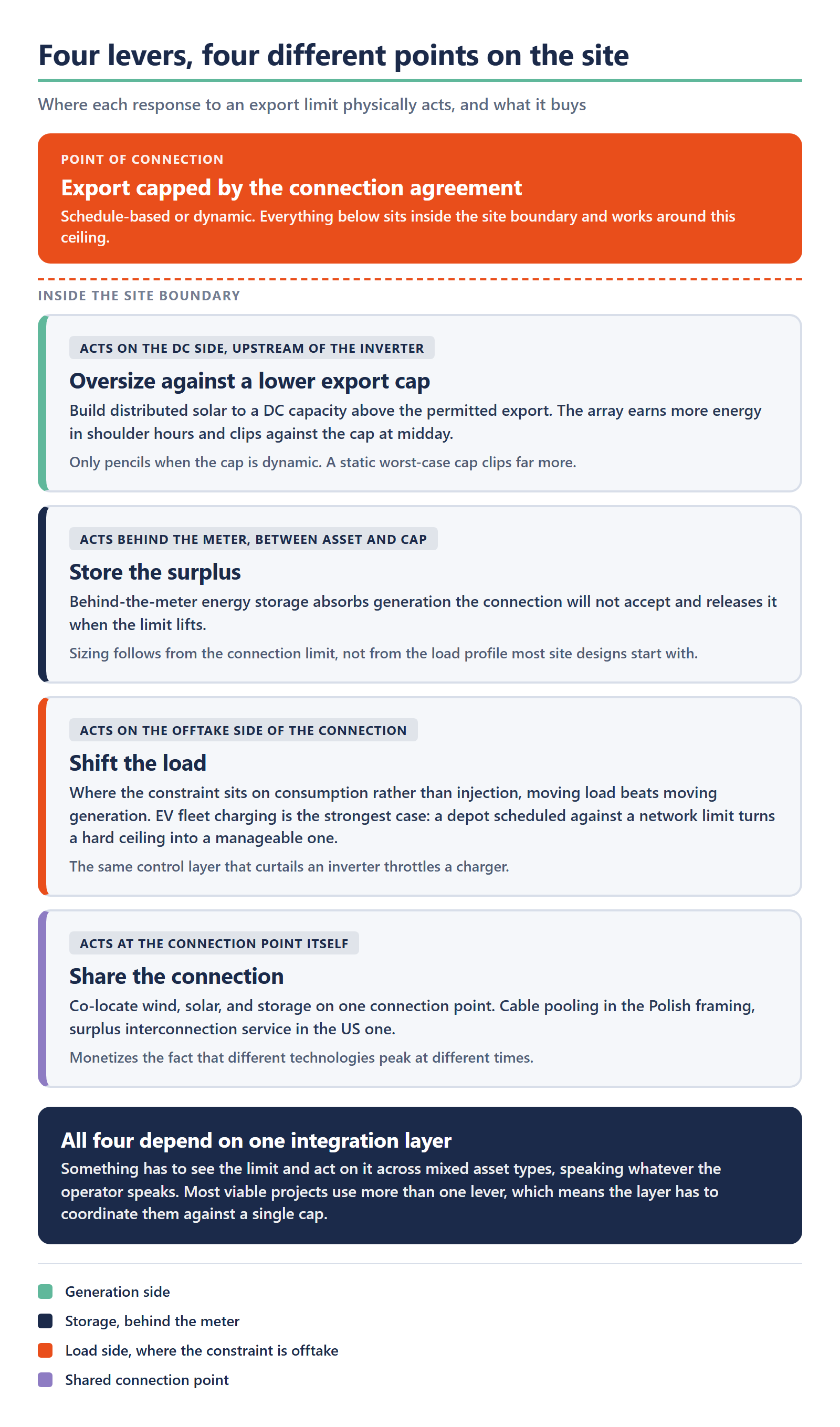
A conditional connection is only as good as the project’s ability to keep earning under it. Four levers do the work, and most viable projects use more than one.
Store the surplus. Behind-the-meter energy storage absorbs generation the connection will not accept and releases it when the limit lifts. Sizing follows from the connection limit, which is a different calculation than most site designs start with.
Shift the load. Where the constraint sits on the offtake side, as it did in the German case, moving consumption is more effective than moving generation. EV fleet charging is the strongest example: a depot that can schedule against a network limit turns a hard connection ceiling into a manageable one, and the same control layer that curtails an inverter throttles a charger.
Oversize against a lower export cap. Distributed solar built to a DC capacity above its permitted export earns more energy in shoulder hours and clips against the cap at midday. This only pencils when the cap is dynamic, because a static worst-case cap clips far more than a real-time one.
Share the connection. Co-location of wind, solar, and storage on one connection point, cable pooling in the Polish framing, and surplus interconnection service in the US one all monetize the fact that different technologies peak at different times. The same logic is what makes large-load co-location attractive to data-center developers, on a track moving faster than the generation queue.
Each of these depends on the same thing: an integration layer that can see the limit and act on it across mixed asset types, speaking whatever the operator speaks.
What to specify before you sign a conditional connection
Most of the terms below are negotiable at the point of the connection offer and effectively fixed afterward. The asymmetry is severe. An unnamed protocol costs a change order. An unnamed fallback behavior costs revenue in every hour the channel drops. An unbounded curtailment right costs the financing.
| Term | What to require in the agreement | What it costs if you leave it open |
|---|---|---|
| The limit | Whether it is schedule-based or dynamic, its maximum depth, and the conditions that trigger it | An undefined limit is an unpriced one, and the operator sets it later |
| Curtailment bound | An annual ceiling in hours or energy, plus how curtailment is measured and reported | Lenders can only price exposure they can bound |
| Protocol and profile | The named standard and profile version, who certifies, and against which utility programs | A protocol chosen after signature becomes a change order and a delay |
| Command semantics | What a valid signal is, required acknowledgment, response time, and telemetry returned | Compliance disputes are settled by the record; without one, the operator’s version stands |
| Fallback behavior | What the asset does when the signal fails to arrive or the channel drops | Defaulting to zero export is a revenue decision disguised as a safety setting |
| Data rights | Access to the curtailment log and to the hosting capacity data behind the limit | You cannot model next year’s exposure or contest this year’s without the record |
| Path to firm | The trigger, cost-sharing, and timeline that convert the connection to firm | Conditional becomes permanent by default |
Two additions to that list matter for anyone operating a portfolio rather than a single site. First, ask which utility territories the chosen stack already serves, because a platform certified for one program is not automatically eligible for the next one. Codibly’s IEEE 2030.5 accelerator and regulatory compliance practice exist because that eligibility question is where multi-market rollouts stall. Second, ask whether the conditional connection can also become a revenue position: an asset already instrumented to receive and evidence a curtailment signal is most of the way to participating in utility demand response programs, which pay for the same behavior the connection agreement extracts for free.
A connection agreement is a technical document now
Grid access used to be granted or withheld. It is increasingly granted with conditions attached, and those conditions are executed by machines exchanging messages at intervals measured in minutes or seconds. Regulators have made the direction clear: Colorado has ordered a tariff and public hour-by-hour hosting capacity data, the Netherlands has had non-firm instruments in force for years, and the Bundesnetzagentur has confirmed that a German operator can lawfully say no when the capacity is not there.
For a developer or an aggregator, the practical consequence is that the connection negotiation and the platform decision have merged. The protocol an asset speaks, the response time it can hold, the record it can produce, and the behavior it defaults to when the signal fails are commercial terms with a price attached. They belong in the agreement, argued for by someone who understands the tariff and the control loop at the same time.
Comparing how the EU and the US approach consumer and grid flexibility makes the same point from the demand side: the regulation converges, and the enforcement layer is what differs. Organizations that treat this as an engineering detail to resolve after signature will discover the cost in their first constrained summer. The ones that specify it up front will be exporting while the firm-connection queue is still being studied.
Frequently Asked Questions
An interconnection agreement is the contract between a project owner and the utility or system operator that governs how a generating or storage asset connects to the grid. It fixes the point of connection, the maximum capacity the asset may inject or draw, the protection and metering requirements, the cost allocation for any network upgrades, and the conditions under which the operator may limit or disconnect the asset. Historically the capacity figure was the negotiation. Under a flexible or non-firm agreement, the conditions attached to that figure matter just as much, because they determine how many hours of the year the asset can actually export at full output.
Rule 21 is the interconnection tariff governing how distributed energy resources connect to the distribution systems of California’s investor-owned utilities. It sets the application process, study requirements, and technical standards for anything from a rooftop solar array to a utility-scale battery. Its smart inverter requirements are the part that reaches beyond California: they require advanced inverter functions and, for communication-enabled resources, IEEE 2030.5 under the Common Smart Inverter Profile as the default communication path. Several other states and Australia’s distribution operators have adopted comparable requirements, which is why Rule 21 compliance work tends to be reusable across markets.
In everyday use, interconnection simply means connecting two things together. In electricity it carries a narrower meaning: the physical and contractual process of joining a generating, storage, or large load asset to the grid, including the studies that determine whether the network can accommodate it and the equipment required to do so safely. The word also describes the high-voltage links between separate grids or countries, as in the interconnectors between European transmission systems.
The two terms describe the same activity in different regulatory dialects. In the United States, interconnection is the standard word for attaching a resource to the transmission or distribution system, and it names a formal procedure defined in FERC and state tariffs. In Europe, the equivalent process is usually called grid connection, governed by national connection codes and the European network codes, while interconnection is reserved for cross-border transmission links. When a European operator offers a non-firm connection and a US utility offers flexible interconnection, they are offering the same commercial bargain under different vocabulary.