Behind-the-Meter Battery Storage When the Connection Will Not Grow

A depot owner asks the utility for more power, and the answer comes back as a date. Six to eighteen months is the common range for a service upgrade or a transformer replacement. Behind-the-meter battery storage is what a site buys when it decides to stop waiting for that date to arrive.
Those timings come from trade press and vendor guides, with no tariff or regulator behind them, so they are a planning band rather than a commitment. First-time depot electrification is commonly put at eight to eighteen months end to end. Either way the answer is measured in quarters, and it lands on an operation that has already ordered vehicles and already signed delivery commitments.
That timing gap changes the question a storage project is being asked to answer. Monthly energy consumption is no longer the governing number. What governs is how much power the connection will pass during the worst fifteen minutes of the month.
Behind-the-Meter Battery Storage Is a Connection Decision
Behind the meter means the customer’s side of the utility revenue meter. A battery placed there is invisible to the wholesale market and highly visible to the site’s own electrical envelope, which is exactly why its business case looks different from a merchant asset. A front-of-meter battery sells power into a market. A behind-the-meter battery buys headroom on a connection that already exists.
That distinction matters more now, because grid access itself has become conditional. Utilities in several US states are offering flexible interconnection: connect sooner, accept curtailment when the feeder is tight. On 29 October 2025 Colorado’s Public Utilities Commission ordered Xcel Energy to file a flexible interconnection tariff covering both generation and EV charging load, under a 2024 state statute. Load is now inside the same bargain generation has been inside for years. Codibly’s separate analysis of what conditional grid access requires covers that shift in full.
For a site owner, the consequence is immediate. The connection is a ceiling. Everything the operation wants to add has to fit underneath it, or the ceiling has to move, and moving it costs quarters.
The Two Bills a Constrained Site Pays
A commercial electricity bill has two engines. Energy charges track kilowatt-hours consumed. Demand charges track the single highest demand interval recorded in the billing period, typically fifteen minutes, and they are billed on that one interval regardless of how well the site behaved for the rest of the month.
Storage moves the second one reliably. It moves the first only where the tariff carries a genuine time-of-use spread, and that spread varies enormously by territory. The wholesale market shows where the shape is heading: Modo Energy reported that in June 2026 the California Independent System Operator (CAISO) day-ahead price trough at 2 p.m. averaged $7 per MWh against a $35 evening peak, with negative price hours tripling year on year to 66. Retail tariffs are slower and blunter than that. They follow the same curve eventually.
Demand charge management is where the bill and the connection converge on one number. The interval that sets the monthly demand charge is usually the same interval that would have exceeded the connection limit. A site facing an upgrade quote and a demand-charge bill is facing one problem written twice. Sites already running an energy management system (EMS) for commercial and industrial operations have the metering to see it. Many do not act on it until the upgrade quote lands.
Size the Battery Against the Connection Limit
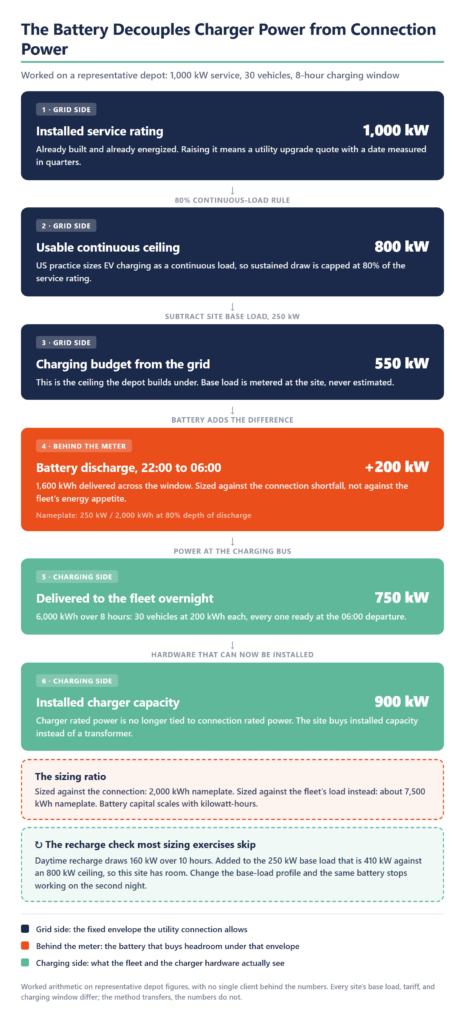
Here is the arithmetic that decides the project, worked through on a representative depot, with no single client behind the numbers.
Start with what is already installed. The US National Electrical Code treats EV charging as a continuous load (Article 625.42) and requires overcurrent protection at not less than 125% of the maximum load (Article 625.41, with 210.20(A)), which is the same as capping sustained draw at 80% of the service rating. A 1,000 kW service is therefore an 800 kW ceiling in practice. Subtract the site’s own evening base load, and what remains is the charging budget. Everything else follows from that subtraction.
| Input | Value | Where the number comes from |
|---|---|---|
| Installed service rating | 1,000 kW | Already built, already energized |
| Usable continuous ceiling | 800 kW | 80% of rating, per the continuous-load rule |
| Site base load, evening peak | 250 kW | Metered at the site, never estimated |
| Headroom available for charging | 550 kW | Subtraction |
| Fleet energy required overnight | 6,000 kWh | 30 vehicles × 200 kWh |
| Charging window | 8 hours | 22:00 to 06:00 departure |
| Flat charging power required | 750 kW | 6,000 kWh ÷ 8 hours |
| Power shortfall against the ceiling | 200 kW | 750 kW minus 550 kW |
| Energy the battery must supply | 1,600 kWh | 200 kW × 8 hours |
| Battery sized against the connection | 250 kW / 2,000 kWh nameplate | 1,600 kWh usable at 80% depth of discharge |
| Battery sized against the load instead | ~7,500 kWh nameplate | 6,000 kWh usable at the same depth of discharge |
| Daytime recharge draw | 160 kW | 1,600 kWh over a 10-hour window |
| Peak daytime site draw during recharge | 410 kW | 160 kW recharge plus 250 kW base load, against an 800 kW ceiling |
Two things fall out of that table. The first is the ratio: a battery specified against the connection is roughly a quarter the size of one specified against the fleet’s energy appetite, and battery capital scales with kilowatt-hours. The second is the recharge check, which sizing exercises routinely skip. A behind-the-meter energy storage system that cannot refill inside the daytime window is a system that works for one night and fails on the second. At 160 kW of recharge draw alongside a 250 kW daytime base load, this site has room. Change the base-load profile and the same battery stops working.
This site avoids roughly 200 kW of billed demand every month. The dollar figure is that number multiplied by the demand rate in the site’s own tariff, which varies by utility and by rate schedule. The energy management system layer around a battery energy storage system (BESS) is what turns those avoided kilowatts into a repeatable monthly result instead of a good first month.
The Charging Depot Is the Hard Case
Depot charging is the hardest version of this problem, because the load is high-power, synchronized, and tied to a departure time that is a customer commitment. Trade estimates put a 50-bus fleet on 150 kW chargers at roughly 7.5 MW if every vehicle charges simultaneously overnight. Take that as an order of magnitude, since it comes from vendor guidance and not an engineering study. The connection binds long before the chargers do.
Battery-buffered EV charging changes what the connection has to support. With storage between the service entrance and the charging bus, the chargers’ rated power is decoupled from the connection’s rated power. A site can install 900 kW of charging hardware behind a 550 kW charging budget, because the battery covers the difference during the hours it matters. That is also what makes microgrid EV charging economically legible. Strip away the language about self-sufficiency, and a depot microgrid is a way of buying installed charger capacity without buying a transformer.
| Decision dimension | Grid upgrade path | Behind-the-meter storage path |
|---|---|---|
| Time to first additional charger | Reported industry ranges of 6 to 18 months for service upgrades and transformer replacement | Weeks to months, governed by procurement and permitting, not by utility construction |
| What it fixes | Raises the ceiling permanently | Lets the site operate above the ceiling for bounded periods |
| What it leaves open | How the site behaves inside the new ceiling | The absolute energy the site can consume over a full day |
| Capital shape | Utility-quoted, largely non-negotiable, often partly contributed | Site-owned asset with a residual value and a second use case |
| Who controls the outcome | The utility’s construction queue | The site’s own control layer |
| Failure mode | The date slips and the vehicles arrive first | The battery is at the wrong state of charge when the fleet plugs in |
Codibly has built both halves of the depot picture. For a global technology solutions provider, our team delivered an eFleet aggregator for utilities with real-time control over distributed charging stations, automated load shedding for demand response, and hardware-agnostic protocol support across MODBUS, the ChargePoint API, and OCPP 1.6j and 2.0.1. The dispatch logic was the straightforward half. Interoperability across that hardware estate was the work. For OpConnect, we implemented the IEEE 2030.5 Common Smart Inverter Profile (CSIP) on charging infrastructure and led the formal SunSpec Alliance certification testing, covering both the US CSIP requirements and the Australian CSIP AUS profile, with Southern California Edison program readiness supported and verified.
The scheduling mechanics that sit on top of all this belong in a separate discussion. Codibly’s article on EV charging load management covers how power gets allocated across a charger fleet in real time. The capital decision comes first: how big the battery has to be, and against what.
The Control Layer Is What Makes the Sizing Assumption Hold
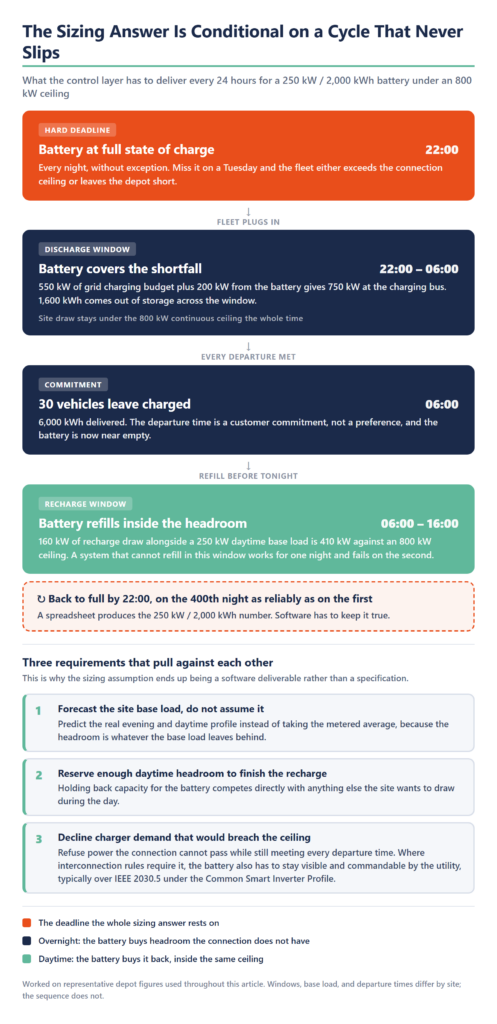
The 250 kW / 2,000 kWh answer in the table above is conditional on one thing. The battery has to be at full state of charge at 22:00, every night, without exception. Miss that on a Tuesday and the fleet either exceeds the ceiling or leaves the depot short.
Holding that condition is a forecasting and arbitration problem. The controller has to predict the site’s own base load instead of assuming the metered average, reserve enough of the daytime headroom to complete the recharge, and decline charger demand that would push the site over the limit while still meeting every departure time. Those three requirements pull against each other, which is why the sizing assumption ends up being a software deliverable. A spreadsheet produces the number. Software has to keep it true, on the 400th night as reliably as on the first. This is where our EMS and BESS integration and dynamic load management work concentrates.
A second control problem stacks on the first. Where the interconnection rules require it, the battery has to be visible and commandable by the utility, not only by the site. Codibly delivered IEEE 2030.5 CSIP certification in eight weeks for an unnamed BESS provider that needed California Rule 21 compliance, using our IEEE 2030.5 Accelerator to shorten the protocol work. The same protocol family governs the charging side. A depot running storage and charging under one ceiling ends up needing both conversations to work, and specifying that at the architecture stage costs far less than retrofitting it after the utility asks.
What Changes When the Connection Stops Being a Variable
Treating the connection as fixed is uncomfortable, because it removes the option every capital plan quietly assumes. It also produces better projects. A site that knows its ceiling can specify a battery a quarter the size of the one it would otherwise buy, install charger capacity it could not otherwise justify, and put a date on its own electrification that does not depend on a utility construction queue. The commercial BESS case improves the moment the ceiling is treated as a design input instead of an obstacle.
The same discipline applies on the generation side of the same fence, where the exposure is curtailment instead of demand charges, and where the limit has to be modeled before anything is financed against it. On a constrained site, the connection is the specification. Everything else is sizing.

Frequently Asked Questions
The meter in question is the utility’s revenue meter, and the difference is which side of it an asset sits on and therefore whose bill it changes. A front-of-meter asset sits on the grid side. It is a market participant: it exports power, is dispatched by a grid operator or an aggregator, and earns from wholesale energy, capacity, and ancillary service markets. A behind-the-meter asset sits on the customer side. It changes what the site draws through the meter, so its value shows up as reduced energy charges, reduced demand charges, backup power, and headroom that lets new load connect without a service upgrade. The physical hardware can be identical. The metering boundary, the interconnection requirements, and the revenue model are what differ. A behind-the-meter battery can still participate in grid programs, but it does so as a modification to site load rather than as a generator.