Demand Flexibility in Europe: From Paid Schemes to Connection Rules

On October 7, 2026, Great Britain’s system operator began buying a new kind of demand flexibility. Its Demand Flexibility Service now also pays for actions that relieve local grid constraints, and the separate Local Constraint Market has closed. Across the Irish Sea, a new data center of 10 megavolt-amperes (MVA) or more must now bring its own dispatchable generation or storage, sized to the power it imports.
Both markets face the same pressure: demand from data centers and electrification is growing faster than networks can be reinforced. In Ireland, data centers used 22% of all metered electricity in 2024, according to the Central Statistics Office.
Europe is moving demand flexibility from paid, voluntary schemes to rules that large users must meet to connect. Nobody has settled how to measure it: what a large site would have drawn, what it delivered, and who checks. That gap is where the work sits for distribution system operators (DSOs) and aggregators. US grid operators are making the same deal with large loads, as Codibly’s white paper on what utilities must operate sets out.
Demand flexibility from a large user is a different product
Demand flexibility, also called energy flexibility or grid flexibility, is a user’s ability to change how much electricity it draws, and when, in response to a price or a grid signal. Most demand response and load shifting programs buy it from distributed energy resources (DERs) that an aggregator pools across homes and small businesses. If some households miss an event, the pool still delivers.
A data center or a large industrial site is different. One connection point can carry tens of megawatts, so one miss is a failed event. Because the operator has promised its customers uptime, the flexibility usually comes from equipment next to the load: batteries, on-site generation, or a process that can pause. Location matters too: large sites tend to sit where grid congestion is worst.
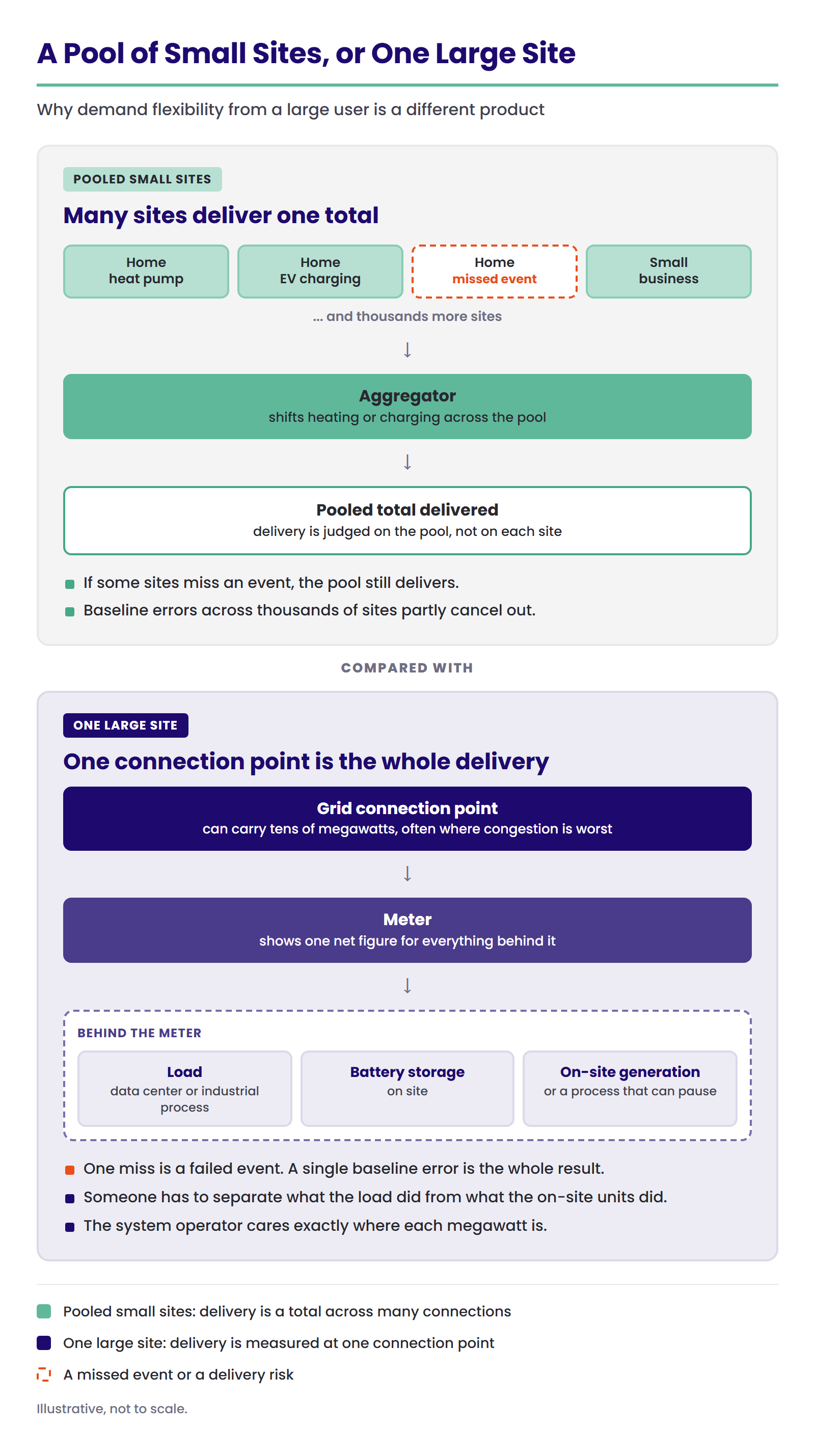
With a few large participants, a contract is worth only what each site can prove it did.
From volunteer schemes to rules
Europe’s flexibility market grew up on voluntary schemes that pay per event. Germany has already traded flexibility for access on small devices: under §14a EnWG, the grid operator may turn a new wallbox or heat pump down to 4.2 kW, and in return may not refuse its connection for lack of capacity.
Great Britain: still a paid scheme
The Demand Flexibility Service is a voluntary, paid service run by the National Energy System Operator (NESO). Since NESO expanded the service on April 9, 2026, it buys flexibility in both directions and by zone, with a 0.1 megawatt (MW) minimum and a Self-Nominated Baseline option.
Zonal procurement and, since October 7, constraint relief start to put a price on location, which a connection rule needs. It remains a payment, though. Nobody in Great Britain has to take part.
The EU Network Code on Demand Response
The EU Network Code on Demand Response (NC DR) is the step from payment to rule at European level. The EU Agency for the Cooperation of Energy Regulators (ACER) submitted the draft on March 7, 2025, as CIGRE’s Electra recounts. It is not yet adopted, so it creates no obligations today.
Codibly’s analysis of Europe’s convergence on a flexibility protocol argued that agreeing how devices are signaled was the first step. The NC DR covers the next: who may offer flexibility, to which system operator, and how delivery is measured. National regulators and system operators will then apply it, so energy standards implementation will run country by country for years.
Ireland: flexibility as a condition of connection
In its decision on connection policy for data centres (CRU/2025/236, December 12, 2025), the Commission for Regulation of Utilities (CRU) set tiers by Maximum Import Capacity (MIC):
- 10 MVA and more: dispatchable generation or storage, on site or nearby, that matches MIC on a de-rated basis and takes part in the Single Electricity Market (SEM).
- 1 to 10 MVA: an autoproducer unit for 100% of MIC.
- Below 1 MVA: out of scope.
The CRU indicates that sites that comply are exempt from Mandatory Demand Curtailment. This is flexibility written into the connection agreement, so the grid operator has to check, at connection and over the life of the site, that the units exist, match MIC on a de-rated basis, and appear in the market when dispatched. Codibly’s article on data center energy storage covers how to size and run that storage.
The measurement problem Europe has not settled
All three cover flexibility from large users, and none has yet fixed how to prove delivery from one large site.
| Scheme or rule | Who must flex | How delivery is measured | Who verifies and settles | What is still open |
|---|---|---|---|---|
| GB Demand Flexibility Service | Nobody. Participation is voluntary | Against a baseline, with a Self-Nominated option since April 2026 | NESO | How nominated baselines are checked as constraint actions grow |
| EU NC DR | Not yet set. The code is not adopted | No adopted method | National regulators and system operators, after adoption | Adoption date, national methods, DSO and transmission operator coordination |
| Ireland CRU/2025/236 | New data centers of 1 MVA and more | On-site or nearby unit capacity against de-rated MIC, plus market participation | System operators at connection; the SEM for dispatch and settlement | How de-rated capacity and the curtailment exemption are re-checked over time |
Baselines are harder for one large site than for a pool. When batteries or generators behind the meter supply the flexibility, the meter shows a net figure, and someone has to separate the load from the on-site units. Ireland sidesteps part of this by measuring the units and their market behavior directly; Great Britain lets the provider nominate the baseline. At one large site, a single baseline error is the whole result.
A DSO or aggregator active in several of these markets will soon run several definitions of “delivered” at once. Codibly’s guide to the demand side response platform describes the settlement layer that turns them into payments.
What aggregators and grid operators should build now
Waiting for the NC DR is tempting, because building against a draft risks rework. Yet Great Britain’s scheme and Ireland’s rule apply today, and the decisions that are expensive to change later are architectural. The choice of method can wait. The ability to run more than one cannot.
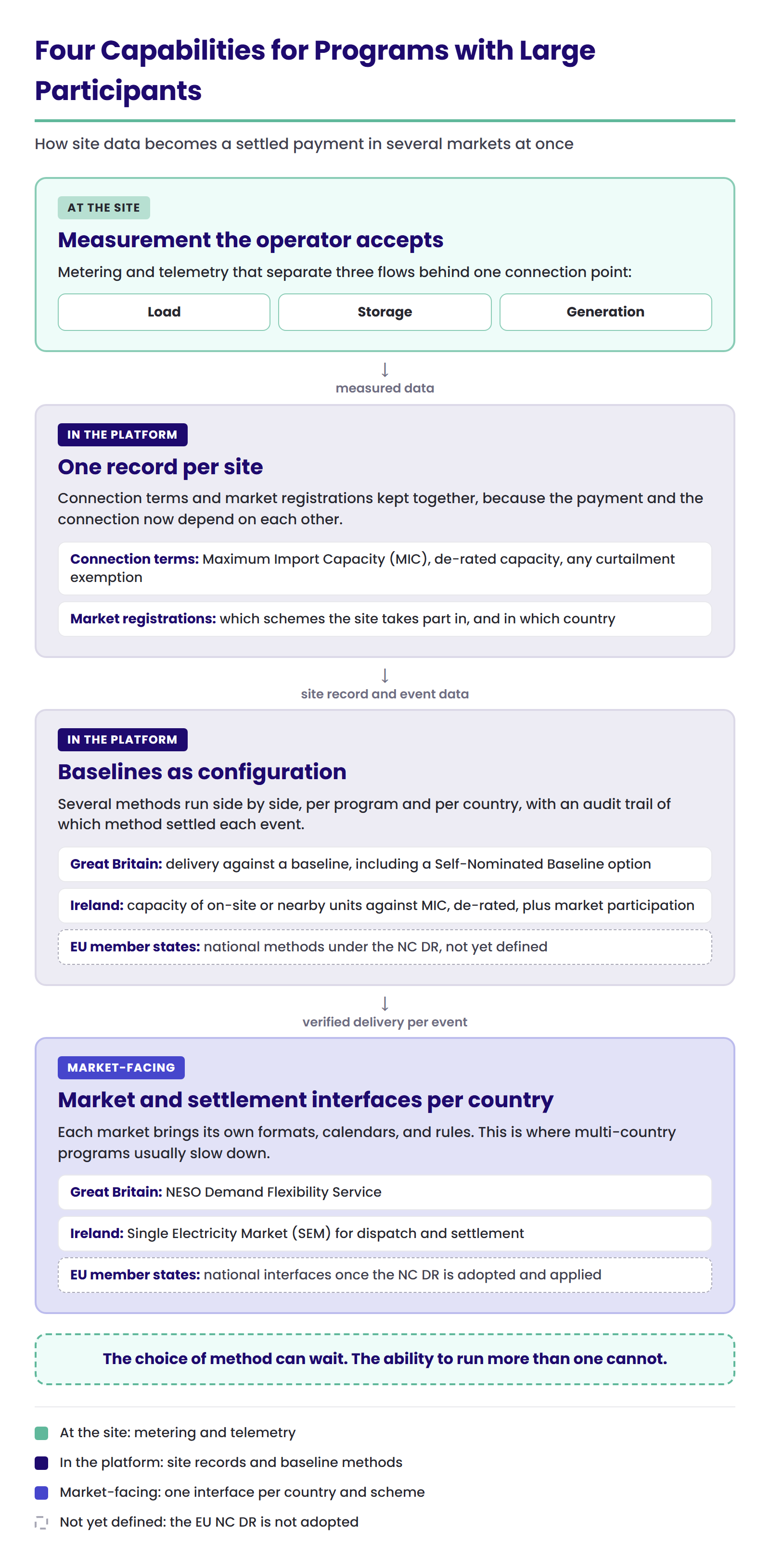
Four capabilities matter for demand flexibility programs with large participants:
- One record per site. Connection terms (MIC, de-rated capacity, any curtailment exemption) and market registrations together, because payment and connection now depend on each other.
- Baselines as configuration. Several methods side by side, per program and country, with an audit trail of which method settled each event.
- Measurement the operator accepts. Metering and telemetry that separate load, storage, and generation behind one connection point.
- Market and settlement interfaces per country. Each market brings its own formats, calendars, and rules.
For a European virtual power plant (VPP) provider, Codibly built automated day-ahead and intraday trading integrations for three markets under one platform: WIRE in Poland, OTE in the Czech Republic, and HUPX in Hungary. Codibly’s demand response program integrations apply the same approach to enrollment, dispatch, and settlement.
Proof of delivery now decides access
In Great Britain, a weak baseline costs a provider a payment. In Ireland, weak evidence of de-rated capacity puts a data center’s curtailment exemption in question. Aggregators that can show, site by site, what was available and what was delivered will be the partners large users choose, and DSOs need the same evidence to enforce connection terms. It is cheaper to design that evidence into the software now than to add it after the first national NC DR methods arrive.

Frequently Asked Questions
Demand flexibility is an electricity user’s ability to change how much power it draws, and when, in response to a price or a grid signal. Small users usually provide it in pools through an aggregator; large users such as data centers provide it site by site.
The Demand Flexibility Service is a voluntary, paid service run by NESO, Great Britain’s system operator, that pays users to change their electricity demand when asked. Since October 7, 2026 it also buys constraint management actions.
No. ACER submitted the draft code on March 7, 2025, and as of late October 2026 it has not been adopted. National rules, such as Ireland’s connection policy for data centers, apply in the meantime.