Data Center Energy Storage: From Backup Battery to Grid Resource

If the grid calls on a data center’s battery in the same hours that the site is most likely to lose its supply, which promise does the battery keep? Until recently, data center energy storage had one job. It sat in the uninterruptible power supply (UPS), carried the servers for the minutes the generators needed to start, and passed one test: the IT load never noticed that the grid had gone.
Grid rules now give the same data center battery a second job. Ireland makes on-site generation or storage that bids into the wholesale market a condition of connection for its largest new data centers. In Texas, new loads of 75 megawatts (MW) and more can face emergency curtailment. The battery can keep both promises, uptime to the site and dispatch to the grid, if a control layer above it decides interval by interval how much energy belongs to each and can prove the split afterward.
Why data centers are adding grid-scale batteries
Grid operators now trade connection speed for flexibility. A large load that accepts curtailment, or brings resources the grid can dispatch, connects sooner or on better terms. DSIRE Insight’s review of large-load tariffs found that a quarter of them already include a flexibility element.
For most sites, that flexibility comes from data center energy storage, because uptime commitments keep most computing load firm. Data center battery storage now appears in the connection application, the development budget, and in some markets a daily bidding schedule. The grid and commercial teams share an asset that once belonged to the electrical engineers alone.
Some operators buy the flexibility elsewhere. On October 22, 2026, Google and Voltus added 1,070 MW to their virtual power plant (VPP) agreement in PJM, making what both companies call a 1 GW VPP, contracted through 2040. The driver is scarcity: PJM’s 2028/2029 Base Residual Auction cleared at its price cap and 6,831 MW short of the reliability requirement. Codibly’s analysis of the PJM capacity auction covers that route. On-site capacity matters most where the connection rule looks at the site itself.
Backup battery and grid battery are different products
Data center battery backup is a mature product, and it does its job well. The UPS carries the IT load without a break when the supply fails, holds it for minutes, and passes it to the generators. A grid-facing battery energy storage system (BESS) has a different duty: it cycles often, runs for hours, takes instructions from outside the building, and earns money doing it.
| Attribute | Backup battery (UPS) | Grid battery (BESS) |
|---|---|---|
| Duty cycle | Held near full charge; discharges on a fault or a test | Charges and discharges regularly, often every day |
| Duration | Minutes, enough to bridge to the generators | Hours, set by the services it sells and the rule it meets |
| Who dispatches it | The site’s power train, automatically, when the supply fails | An energy management system, acting on prices, grid instructions, or tariff terms |
| What it earns | Nothing directly; it protects the revenue that depends on uptime | Peak shaving and lower demand charges, energy arbitrage, frequency regulation, and curtailment response |
| What failure costs | Downtime and penalties under customer service agreements | Lost revenue, non-performance penalties, and possibly the connection terms the battery secured |
A UPS battery is valuable because it is always ready, which is why the two are rarely the same asset. Grid-interactive UPS systems exist, but they can offer only the margin above the ride-through reserve, and on a battery sized in minutes that margin is small.
To the grid operator, a large load that switches to its own power looks like a large load vanishing at once. The North American Electric Reliability Corporation (NERC) issued a Level 3 alert on computational loads on May 4, 2026, after events in which more than 1,000 MW of such load dropped off the grid.
Generators: the flexibility that air permits limit
A data center backup generator fleet is the other on-site resource that grid operators look at. Under Texas rule 16 TAC §25.194, adopted by the Public Utility Commission of Texas (PUCT) on September 18, 2026, a customer with a load of 75 MW or more must disclose its backup generation, which staff of the Electric Reliability Council of Texas (ERCOT) and the PUCT may audit.
On paper, a fleet of diesel generators that can carry the whole site is a large block of flexibility. The air permit limits it. Backup generators are usually permitted for emergencies and testing, often with an annual cap on running hours, which leaves little room for the regular, paid dispatch that grid markets reward. Batteries carry no such cap, one reason the flexible share of the backup system is moving to storage.
Where the rules now ask for on-site storage
Ireland is the strictest case. The Commission for Regulation of Utilities (CRU) decision on connection policy for data centers (CRU/2025/236, December 12, 2025) sets conditions by import size, and a data center BESS is one way to meet them:
- 10 megavolt-amperes (MVA) and more: dispatchable generation, storage, or both, on site or nearby, matching the site’s Maximum Import Capacity (MIC) on a de-rated basis and participating in the Single Electricity Market (SEM).
- 1 to 10 MVA: an autoproducer unit for 100% of the MIC.
The CRU indicates that sites that comply will be exempt from Mandatory Demand Curtailment. Two phrases shape the battery specification. “On a de-rated basis” means storage counts for the output it can sustain, so a battery sized for minutes of ride-through counts for little. “Participate in the SEM” means the asset bids into a market every day, under a market participant’s obligations. Codibly’s article on demand flexibility in Europe traces the wider shift to connection rules.
Texas took a different route. Under Senate Bill 6 (SB 6), new loads of 75 MW and more can face emergency curtailment, and the PUCT rule requires refundable financial security of at least $50,000 per MW of contracted peak. The rule asks the site to be curtailable and leaves the means to the site. A behind-the-meter data center battery keeps the servers running through a curtailment the site has accepted, or through the events of a demand response program it has joined.
Codibly’s article on behind-the-meter battery storage when the connection will not grow sizes storage against a connection ceiling; at a data center, sizing starts from the backup obligation and the flexibility commitment. In Ireland and Texas alike, the large-load rule works like a flexibility program with a few very large participants, the argument of Codibly’s white paper on large-load flexibility.
One battery, two promises
The battery a data center bids into a market is still the battery that must carry the servers when the grid fails, and the grid calls on it in the hours when outage risk is highest.
The workable design treats the uptime reserve as a hard floor. The site calculates the energy it must hold for ride-through and reserves that band of state of charge (SoC) for backup, with a safety margin above it for forecast error, aging, and temperature. The grid and the market get only the capacity above the margin, less some headroom for charging signals. Only a real outage may draw the battery below the floor; prices and dispatch instructions stop at it.
The floor moves. Battery capacity fades with age and IT load grows as racks fill, so the reservation has to be recalculated throughout the battery’s life. A floor set once at commissioning drifts out of date.
The grid-service band also limits the offer: the site may sell only what it can deliver for the whole commitment, with room in both directions for frequency regulation and energy for the full length of a curtailment event. Bidding the band means day-ahead and intraday schedules, market submissions, and settlement, the work of Codibly’s energy markets and trading integration practice.
The control layer that serves both
Keeping both promises is a control problem, solved in the energy management system (EMS). Codibly’s article on the BESS energy management system covers what an EMS must do to make a battery pay. At a data center, it carries two further duties.
The first is arbitration. The EMS holds the uptime floor as a constraint that no market logic may override, tracks the grid-service band as the floor moves, and settles any conflict before it bids, so the site never commits energy it may later have to withhold.
The second is proof: telemetry, a record of each instruction received and executed, settlement data, and evidence that the reserve was never breached. One interval-by-interval record can serve an ERCOT audit of disclosed backup resources, a market participant’s obligations in the SEM, and a tenant reviewing its service agreement.
The site’s power train keeps its own protection logic, and the EMS above it has no path to delay or override a transfer to backup. That separation is what lets the facilities team accept a grid-facing control system near equipment it is accountable for.
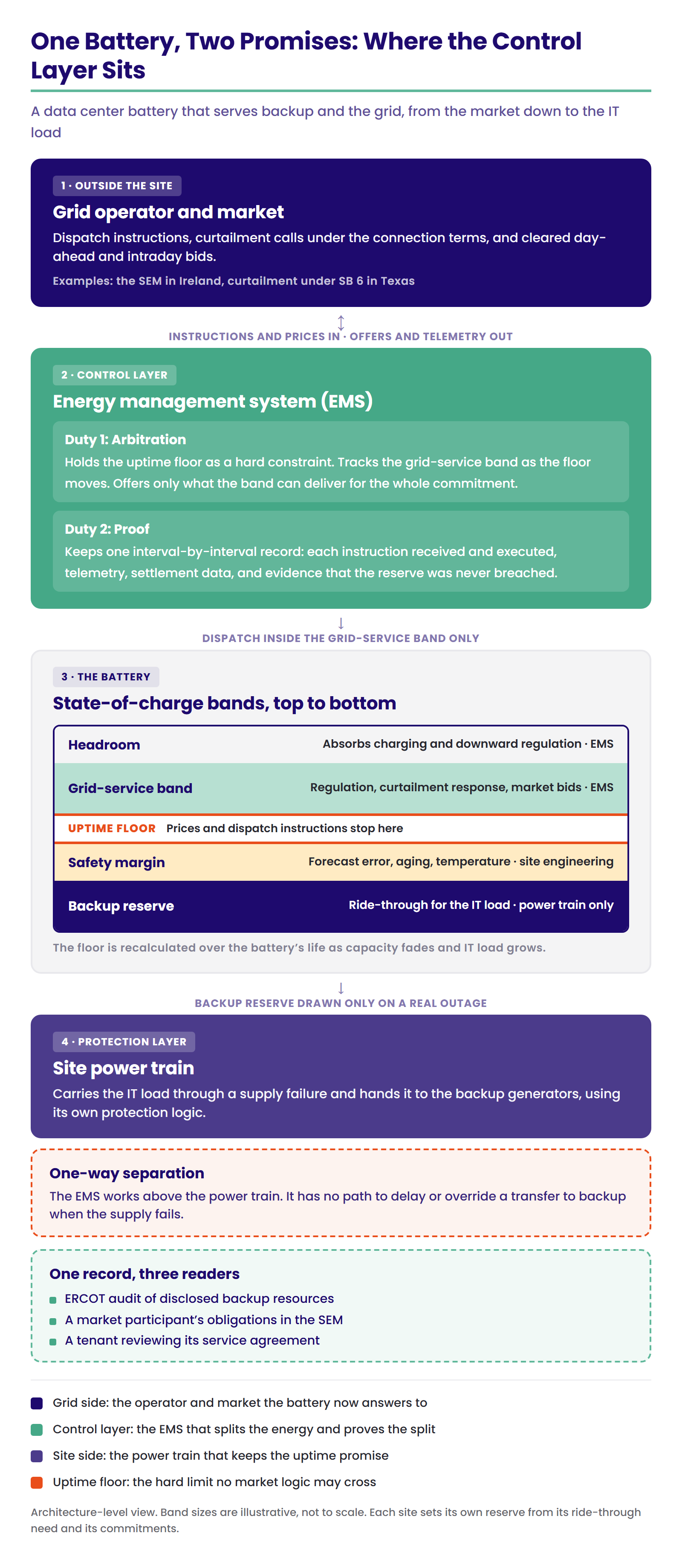
The general BESS control stack, described in Codibly’s white paper on the BESS software dispatch gap, assumes a battery free to chase the best revenue across markets. A data center battery dispatches inside a floor that a connection rule and a customer contract both depend on. The market interfaces stay the same: for a European VPP provider, Codibly automated day-ahead and intraday trading in Poland, the Czech Republic, and Hungary. A data center battery bidding into the SEM needs that integration, joined to reserve logic on the site side.
Codibly’s EMS and BESS integration work connects the battery, the site systems, and the grid and market interfaces into one control layer.
What to decide before the next battery is specified
For battery makers and integrators, three decisions belong at the start of a data center project:
- The floor: how the uptime reserve is calculated, how often it is recalculated, and who may change it.
- The band: which rule or market the capacity above the floor will serve, and for how long it must deliver.
- The record: which system holds the evidence that both promises were kept, and who can read it.
A battery specified with those answers can be connected, bid, and audited. One specified for backup alone will need rework when the connection terms arrive, and in Ireland and Texas they already have.

Frequently Asked Questions
Yes. Most data centers keep batteries in their uninterruptible power supply (UPS), which carries the IT load until the backup generators take over. Some sites now add larger battery energy storage systems that also serve the grid, as connection rules in Ireland and Texas start to ask for flexibility.
Within limits. A UPS battery must stay ready for an outage, so it can offer only the energy above its ride-through reserve, which on a battery sized in minutes is small. Sites that want regular grid revenue add a separate BESS, or a larger battery with a protected backup band and a grid-service band above it.
A UPS battery runs for minutes. Typical design ranges, as summarized by DatacenterDynamics, are 1 to 2 minutes in hyperscale facilities, about 5 minutes in cloud and colocation, and 10 to 15 minutes in finance, until the generators take over. A grid-facing BESS is sized in hours, set by the services it sells and the rules it must meet.